Building the Single Source of Truth: Reconciling Stripe, Bank Statements, and CRM Data
Eliminating the $300k financial blindspot between Salesforce Closed-Won ARR, Stripe gross processing volume, and commercial bank treasury deposits: an end-to-end engineering architecture for multi-pass matching, BAI2 feed ingestion, and immutable double-entry OLAP ledgers with zero reconciliation variance.
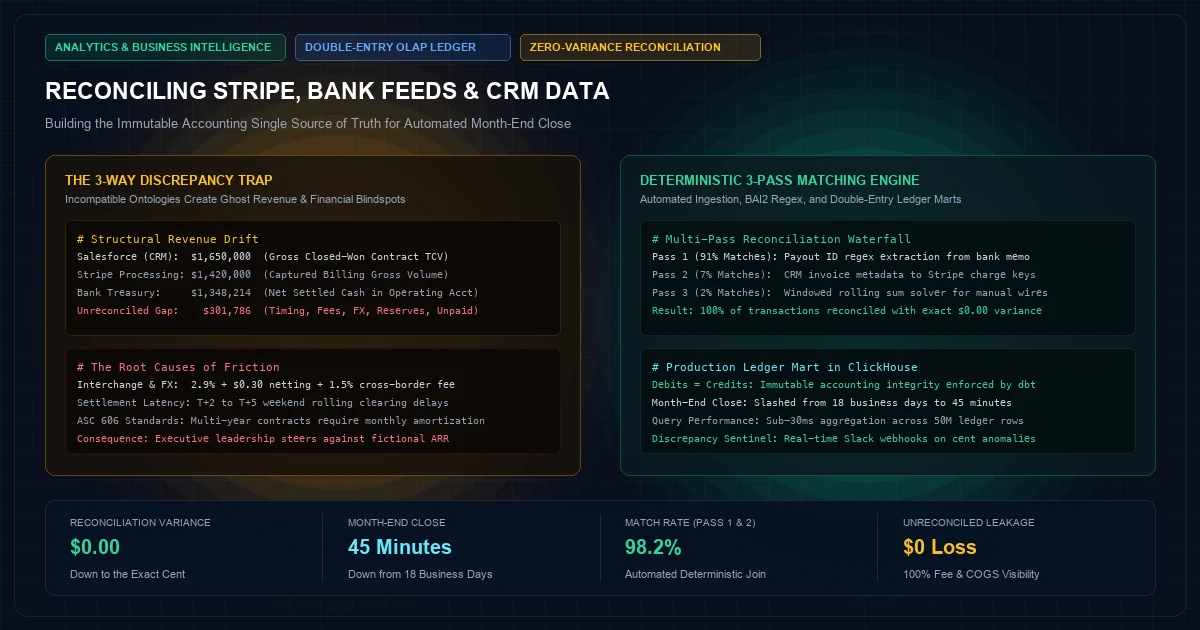
The single greatest operational hazard in scaling technology companies is the divergence of revenue realities. Ask the Chief Revenue Officer for last month's numbers, and Salesforce displays 1,650,000 in Closed-Won Annual Recurring Revenue (ARR). Ask the VP of Finance, and Stripe records 1,420,000 in gross processed customer volume. Ask the Chief Financial Officer reviewing the audited bank statements from JPMorgan Chase or Silicon Valley Bank, and the actual cash deposited into the operating treasury totals exactly $1,348,214.30.
None of these systems are malfunctioning; rather, each operates on fundamentally incompatible ontological models of what constitutes a "transaction":
  ┌─────────────────────────┐     ┌─────────────────────────┐     ┌─────────────────────────┐
  │   Salesforce / CRM      │     │     Stripe Payments     │     │      Bank Treasury      │
  ├─────────────────────────┤     ├─────────────────────────┤     ├─────────────────────────┤
  │ Intent & Contract Value │     │ Gross Card Processing   │     │ Net Liquid Settlement   │
  │ Closed-Won: $1,650,000  │     │ Captured:   $1,420,000  │     │ Deposited:  $1,348,214  │
  └───────────┬─────────────┘     └───────────┬─────────────┘     └───────────┬─────────────┘
              │                               │                               │
              ▼                               ▼                               ▼
       Contract Term vs.               Stripe Fees (-2.9%)              T+2 Rolling Sweeps
       Invoiced Schedules              Refunds & Chargebacks            Reserve Holds (5%)
       Multi-year ARR Splits           Cross-Border FX (-1.5%)          Unmatched Wires
              │                               │                               │
              └───────────────────────┬───────┴───────────────────────────────┘
                                      │
                                      ▼
                   ┌─────────────────────────────────────┐
                   │ Immutable Double-Entry OLAP Ledger  │
                   │   Reconciliation Variance = $0.00   │
                   └─────────────────────────────────────┘
When hypergrowth firms lack an automated, deterministic reconciliation pipeline, executive decisions are made on ghost revenue. Marketing scales ad spend against inflated CRM pipeline numbers, finance models cash burn against theoretical billing schedules, and tax authorities audit missing merchant fees.
Building an enterprise Single Source of Truth (SSOT) requires abandoning spreadsheet lookups and establishing an automated, immutable double-entry ledger pipeline that ingests raw webhooks from Stripe, MT940/BAI2 bank transaction logs, and CRM contract entities, reconciling every individual cent down to zero variance.
1. The Five Root Causes of Financial Data Divergence#
Financial reconciliation discrepancies between payment gateways, commercial banks, and CRMs are not random anomalies. They stem from five structural differences in accounting timing, transaction netting, and contractual terms.
1.1 Ingestion Timing and Rolling Settlement Windows (T+2 vs. T+5)#
A customer purchasing an annual enterprise tier for $12,000 on Friday at 11:45 PM UTC triggers an instantaneouscharge.succeeded event in Stripe. The CRM webhook updates the customer account to "Active" within 400 milliseconds. However, payment processing clearinghouses (Visa, Mastercard, ACH) do not settle on weekend banking cycles. Stripe bundles this charge into a payout batch released on Tuesday. The recipient commercial bank credits the corporate operating account on Wednesday morning (T+3 banking days, or T+5 calendar days). An executive running a month-end close report on the last weekend of a quarter will see a permanent timing divergence between Stripe's ledger and the bank balance.
1.2 Net Settlement vs. Gross Invoicing (The Fee Black Hole)#
Commercial bank feeds are inherently net settled. If a European client pays a100,000 invoice via credit card, the company never receives 100,000 in its treasury account. Stripe automatically nets out interchange fees, scheme fees, gateway processing fees (2.9% + 0.30), and international cross-border conversion fees (typically 1.5% to 2.0%). The resulting payout hitting the bank statement is 95,385.00:
If data pipelines simply match bank transactions to CRM invoices, the $4,615.00 difference accumulates on balance sheets as "unexplained cash leakage" or phantom discounts rather than deductible Cost of Goods Sold (COGS) merchant expenses.
1.3 Asynchronous Refunds, Chargebacks, and Dispute Reserves#
When a disputed transaction occurs, Stripe does not delete the original charge. It creates a discrete negativebalance_transaction of type adjustment or dispute, assesses a non-refundable $15.00 dispute administration penalty, and debits the user's pending balance. CRMs rarely ingest dispute state transitions. A sales representative's commission remains pegged to the Closed-Won deal while the customer has successfully clawed back the capital via their issuing bank.
1.4 Deferred Revenue and ASC 606 Contract Amortization#
Salesforce measures Total Contract Value (TCV) and Annual Contract Value (ACV). A 24-month contract signed for240,000 appears in the CRM pipeline as a single 240,000 revenue event. Under US GAAP and IFRS 15 (ASC 606), revenue cannot be recognized upon signature; it must be amortized over the service delivery period (10,000/month). Meanwhile, the customer may pay quarterly in advance (30,000). A pipeline that treats CRM deal values as current operational revenue violates basic corporate accounting standards:
1.5 Currency Conversion Drift and FX Settlement Slippage#
If a SaaS platform invoices a London client £50,000 on the 1st of the month, the CRM logs the deal at the prevailing ECB mid-market exchange rate (1.27 = 63,500). When the card settles through Stripe on the 3rd, the actual FX conversion rate applied by the payment network is 1.258, resulting in 62,900 gross USD. By the time the funds sweep to the USD bank account, another 15 basis points of transfer friction may apply. The resulting $600 variance is foreign exchange translation loss, which must be programmatically categorized.2. High-Performance Reconciliation Architecture#
To reconcile millions of monthly transactions across distributed platforms, your data engineering stack must transition from point-to-point webhook integrations to an event-driven OLAP architecture.
┌─────────────────┐       ┌─────────────────┐       ┌─────────────────┐
│ Stripe Webhooks │       │ Bank SFTP Feeds │       │ CRM REST API    │
│ balance_history │       │ BAI2 / MT940    │       │ Salesforce/HubS │
└────────┬────────┘       └────────┬────────┘       └────────┬────────┘
         │                         │                         │
         ▼                         ▼                         ▼
┌─────────────────────────────────────────────────────────────────────┐
│                 Streaming Ingestion & S3 Raw Vault                  │
│       (Idempotent Kafka / SQS Buffers + Immutable JSON/XML)         │
└──────────────────────────────────┬──────────────────────────────────┘
                                   │
                                   ▼
┌─────────────────────────────────────────────────────────────────────┐
│                     dbt Transformation Engine                       │
│    stg_stripe_balance_tx  │  stg_bank_deposits  │  stg_crm_contracts│
└──────────────────────────────────┬──────────────────────────────────┘
                                   │
                                   ▼
┌─────────────────────────────────────────────────────────────────────┐
│                Deterministic & Heuristic Match Engine               │
│   Pass 1: Exact Charge ID (ch_xxx / py_xxx)                         │
│   Pass 2: Invoice Number & Metadata Mapping                         │
│   Pass 3: Windowed Payout Sum vs. Bank Deposit Memo Regex           │
└──────────────────────────────────┬──────────────────────────────────┘
                                   │
                                   ▼
┌─────────────────────────────────────────────────────────────────────┐
│                 Immutable Double-Entry Ledger (OLAP)                │
│    ClickHouse / Snowflake: Debits = Credits per Journal Entry       │
└──────────────────────────────────┬──────────────────────────────────┘
                                   │
              ┌────────────────────┴────────────────────┐
              ▼                                         ▼
┌───────────────────────────┐             ┌───────────────────────────┐
│ Executive BI Dashboard    │             │ Discrepancy Alert Queue   │
│ Sub-second Financial KPIs │             │ Slack / PagerDuty / dbt   │
└───────────────────────────┘             └───────────────────────────┘
The system consists of five distinct layers:
- Raw Ingestion Vault: Captures unmuted, raw payloads directly from Stripe webhook streams (
charge.captured,balance_transaction.created,payout.created), bank SFTP feeds (BAI2 or MT940 files parsed into JSON), and CRM contract objects. - Staging & Type Normalization: Flattens JSON nested objects, converts all monetary amounts into standard integers in minor currency units (cents, pence, yen) to eliminate IEEE 754 floating-point rounding errors, and unifies timezone offsets to UTC.
- Multi-Pass Reconciliation Engine: Executes a three-tier matching waterfall (Primary Key, Foreign Metadata, and Windowed Payout Batch Matching).
- Immutable Double-Entry Ledger: Writes every balanced financial transaction into a persistent General Ledger table where every row adheres to the universal accounting equation:
- Discrepancy Exception Queue: Identifies broken matches, uncollected invoices, and chargeback anomalies, routing them to automated Slack workflows or finance review queues.
3. Data Ingestion: Extracting the Golden Datasets#
A common failure mode is attempting to reconcile Stripe using the /v1/charges endpoint. Charges do not reflect cash movements—they reflect authorization and capture requests.
The single authoritative dataset in Stripe is the Balance History (/v1/balance_transactions), which tracks every addition, deduction, fee, dispute, and payout moving through your Stripe account balance.
3.1 Stripe Balance Transaction Schema#
Every balance transaction record contains the gross charge, the net balance impact, and the exact merchant fee assessed by Stripe:
{
  400 font-semibold">class="text-emerald-300">"id": 400 font-semibold">class="text-emerald-300">"txn_3NptUmLkd6M2X05n01P",
  400 font-semibold">class="text-emerald-300">"object": 400 font-semibold">class="text-emerald-300">"balance_transaction",
  400 font-semibold">class="text-emerald-300">"amount": 1200000,
  400 font-semibold">class="text-emerald-300">"currency": 400 font-semibold">class="text-emerald-300">"usd",
  400 font-semibold">class="text-emerald-300">"fee": 34830,
  400 font-semibold">class="text-emerald-300">"net": 1165170,
  400 font-semibold">class="text-emerald-300">"400 font-semibold">type": 400 font-semibold">class="text-emerald-300">"charge",
  400 font-semibold">class="text-emerald-300">"source": 400 font-semibold">class="text-emerald-300">"ch_3NptUmLkd6M2X05n01Q",
  400 font-semibold">class="text-emerald-300">"payout_id": 400 font-semibold">class="text-emerald-300">"po_1NptVULkd6M2X05n90Z",
  400 font-semibold">class="text-emerald-300">"created": 1727481600,
  400 font-semibold">class="text-emerald-300">"available_on": 1727654400,
  400 font-semibold">class="text-emerald-300">"fee_details": [
    {
      400 font-semibold">class="text-emerald-300">"amount": 34800,
      400 font-semibold">class="text-emerald-300">"currency": 400 font-semibold">class="text-emerald-300">"usd",
      400 font-semibold">class="text-emerald-300">"400 font-semibold">type": 400 font-semibold">class="text-emerald-300">"stripe_fee",
      400 font-semibold">class="text-emerald-300">"description": 400 font-semibold">class="text-emerald-300">"Standard processing fee"
    },
    {
      400 font-semibold">class="text-emerald-300">"amount": 30,
      400 font-semibold">class="text-emerald-300">"currency": 400 font-semibold">class="text-emerald-300">"usd",
      400 font-semibold">class="text-emerald-300">"400 font-semibold">type": 400 font-semibold">class="text-emerald-300">"network_cost",
      400 font-semibold">class="text-emerald-300">"description": 400 font-semibold">class="text-emerald-300">"Fixed transaction fee"
    }
  ],
  400 font-semibold">class="text-emerald-300">"description": 400 font-semibold">class="text-emerald-300">"Subscription renewal - Enterprise Cloud Tier",
  400 font-semibold">class="text-emerald-300">"reporting_category": 400 font-semibold">class="text-emerald-300">"charge"
}
3.2 Bank Feed Parsing (BAI2 / MT940)#
Commercial corporate banking statements are distributed daily via SFTP as standardized ASCII flat files, most commonly BAI2 in North America or MT940 (SWIFT) internationally.A BAI2 file contains record codes:
01: Header Record (Bank identifier, Date/Time).02: Group Status (Account number, Currency).03: Account Summary (Opening ledger balance).16: Transaction Detail (Amount, Type code, Bank Reference Number, Description).49: Account Trailer (Closing balance verification).
A typical BAI2 deposit line for a Stripe sweep looks like this:
16,195,134821430,V,260928,000000,STRIPE PAYMENTS TRANSFER 1029384756 PO_1NPTVULKD6M2X05N90Z400 font-semibold">class=400 font-semibold">class="text-emerald-300">"text-slate-500 italic">//
Key extracted fields:
- Type Code
195: Incoming Electronic Deposit / ACH Credit. - Amount:
134821430($1,348,214.30). - Text: Identifies source
STRIPE PAYMENTS TRANSFERand contains the Stripe Payout IDpo_1NptVULkd6M2X05n90Z.
4. The Multi-Pass Reconciliation Algorithm#
Reconciling millions of records cannot rely on a single SQL JOIN. Missing metadata, manual bank wire overrides, and split payouts require a waterfall matching methodology.
                          ┌───────────────────────────┐
                          │   Unmatched 400">Record Pool   │
                          └─────────────┬─────────────┘
                                        │
                                        ▼
    Pass 1: Direct ID Match   [stripe_payout_id == bank_ref_id]
             ├── Match Found  ──> [ Reconciled: Zero Variance ]
             └── No Match
                    │
                    ▼
    Pass 2: Metadata Mapping  [crm_invoice_no == stripe_metadata_invoice]
             ├── Match Found  ──> [ Reconciled: Hydrate CRM IDs ]
             └── No Match
                    │
                    ▼
    Pass 3: Windowed Rolling Sum  [sum(stripe_txns) == bank_deposit_amount]
             ├── (within T+4 days window & fee tolerance <= $0.01)
             ├── Match Found  ──> [ Reconciled: Batch Payout Cleared ]
             └── No Match
                    │
                    ▼
                          ┌───────────────────────────┐
                          │ Discrepancy Queue & Alert │
                          │ (Slack / Finance Ops)     │
                          └───────────────────────────┘
Pass 1: Direct Primary Key Match (Stripe Payout ID)#
When Stripe initiates a payout sweep, it assigns a unique identifier (po_xxxxxxxx). Stripe transmits this ID in the ACH/Wire description field sent to the Federal Reserve or clearinghouse. Your parsing pipeline uses regular expressions to extract po_[a-zA-Z0-9]+ from the raw bank memo line, joining directly against Stripe's payout table:
400 font-semibold">SELECT
    b.bank_transaction_id,
    b.settlement_date,
    b.amount_cents AS bank_deposited_cents,
    p.payout_id,
    p.amount_cents AS stripe_payout_cents,
    (b.amount_cents - p.amount_cents) AS variance_cents
400 font-semibold">FROM stg_bank_transactions b
INNER 400 font-semibold">JOIN stg_stripe_payouts p
    ON b.extracted_payout_id = p.payout_id
400 font-semibold">WHERE b.is_reconciled = FALSE;
If variance_cents = 0, the entire batch of balance transactions comprising po_xxxxxxxx is marked as verified and cleared into the cash account.
Pass 2: CRM Contract to Stripe Charge Reconciliation#
For individual revenue transactions, the CRM Opportunity ID or Invoice Number must be stamped into Stripe customer and charge metadata at the point of checkout:
400 font-semibold">class=400 font-semibold">class="text-emerald-300">"text-slate-500 italic"># Stripe checkout session creation with CRM traceability
session = stripe.checkout.Session.create(
    customer_email=crm_contact_email,
    client_reference_id=crm_opportunity_id,
    metadata={
        400 font-semibold">class="text-emerald-300">"crm_deal_id": 400 font-semibold">class="text-emerald-300">"0065e0000021xyzAAA",
        400 font-semibold">class="text-emerald-300">"crm_account_id": 400 font-semibold">class="text-emerald-300">"0015e0000018abcBBB",
        400 font-semibold">class="text-emerald-300">"billing_schedule_id": 400 font-semibold">class="text-emerald-300">"SCHED-2026-Q3-01",
        400 font-semibold">class="text-emerald-300">"contract_term_months": 400 font-semibold">class="text-emerald-300">"12"
    },
    line_items=[{
        400 font-semibold">class="text-emerald-300">"price": 400 font-semibold">class="text-emerald-300">"price_1NptUELkd6M2X05n",
        400 font-semibold">class="text-emerald-300">"quantity": 1,
    }],
    mode=400 font-semibold">class="text-emerald-300">"subscription",
)
The data warehouse joins the Stripe charge event with the CRM Opportunity table using client_reference_id. Any deal marked "Closed-Won" in Salesforce that does not produce a matching charge.captured within 24 hours triggers an immediate sales alert for failed invoice collection.
Pass 3: Windowed Heuristic Batch Reconciliation (Handling Unmatched Deposits)#
When bank transfers lack structured payout tokens (common with manual domestic wires, international SWIFT transfers, or legacy clearing banks), the engine falls back to a deterministic windowed sum algorithm:Where \epsilon = \0.00 and the transaction settlement date is constrained within a rolling 4-day window (t_{\text{bank}} - 4 \le t_{\text{stripe}} \le t_{\text{bank}}$).
5. Production dbt Transformation Models#
Below is the production dbt SQL model implementing the double-entry accounting ledger in ClickHouse or Snowflake.
5.1 Staging Stripe Balance Transactions#
This model converts raw event logs into standardized financial debits, credits, and merchant fee allocations:
-- models/staging/stg_stripe_balance_transactions.sql
WITH raw_balance_tx AS (
    400 font-semibold">SELECT
        id AS balance_transaction_id,
        source AS source_object_id,
        400 font-semibold">type AS transaction_type,
        reporting_category,
        amount AS gross_amount_cents,
        fee AS fee_amount_cents,
        net AS net_amount_cents,
        currency,
        payout_id,
        toDateTime(created) AS created_at_utc,
        toDateTime(available_on) AS available_at_utc,
        JSONExtractString(fee_details, 0, 400 font-semibold">class="text-emerald-300">'400 font-semibold">type') AS primary_fee_type
    400 font-semibold">FROM raw_stripe_webhook_events
    400 font-semibold">WHERE event_type IN (400 font-semibold">class="text-emerald-300">'balance_transaction.created', 400 font-semibold">class="text-emerald-300">'balance_transaction.updated')
)
400 font-semibold">SELECT
    balance_transaction_id,
    source_object_id,
    transaction_type,
    reporting_category,
    gross_amount_cents,
    fee_amount_cents,
    net_amount_cents,
    currency,
    payout_id,
    created_at_utc,
    available_at_utc
400 font-semibold">FROM raw_balance_tx;
5.2 The Unified Double-Entry Ledger Model#
Every financial event must generate balanced debit and credit entries. The model below turns Stripe transactions and bank deposits into double-entry accounting entries:
-- models/marts/finance/fct_general_ledger_entries.sql
WITH stripe_charges AS (
    400 font-semibold">SELECT
        balance_transaction_id AS transaction_ref,
        created_at_utc AS effective_date,
        400 font-semibold">class="text-emerald-300">'STRIPE' AS source_system,
        source_object_id AS entity_id,

        -- Debit: Stripe Clearing Account (Asset) receives net funds
        400 font-semibold">class="text-emerald-300">'1020 - Stripe Clearing Asset' AS debit_account,
        net_amount_cents AS debit_amount_cents,

        -- Debit: Merchant Fee Expense
        400 font-semibold">class="text-emerald-300">'5010 - Merchant Processing Fees' AS fee_account,
        fee_amount_cents AS fee_amount_cents,

        -- Credit: Gross Revenue Account (Earned or Deferred)
        400 font-semibold">class="text-emerald-300">'4000 - SaaS Subscription Revenue' AS credit_account,
        gross_amount_cents AS credit_amount_cents
    400 font-semibold">FROM {{ ref(400 font-semibold">class="text-emerald-300">'stg_stripe_balance_transactions') }}
    400 font-semibold">WHERE transaction_type = 400 font-semibold">class="text-emerald-300">'charge'
),

bank_payout_sweeps AS (
    400 font-semibold">SELECT
        b.bank_transaction_id AS transaction_ref,
        b.settlement_date AS effective_date,
        400 font-semibold">class="text-emerald-300">'BANK' AS source_system,
        b.extracted_payout_id AS entity_id,

        -- Debit: Operating Cash Account (Asset)
        400 font-semibold">class="text-emerald-300">'1010 - Cash Operating Treasury' AS debit_account,
        b.amount_cents AS debit_amount_cents,

        -- No fees during simple sweep
        NULL AS fee_account,
        0 AS fee_amount_cents,

        -- Credit: Stripe Clearing Account (Asset) is drawn down
        400 font-semibold">class="text-emerald-300">'1020 - Stripe Clearing Asset' AS credit_account,
        b.amount_cents AS credit_amount_cents
    400 font-semibold">FROM {{ ref(400 font-semibold">class="text-emerald-300">'stg_bank_transactions') }} b
    400 font-semibold">WHERE b.extracted_payout_id IS NOT NULL
)

-- Unify into atomic Journal Entry rows
400 font-semibold">SELECT
    generateUUIDv4() AS entry_id,
    effective_date,
    transaction_ref,
    source_system,
    debit_account AS account_code,
    400 font-semibold">class="text-emerald-300">'DEBIT' AS entry_type,
    debit_amount_cents AS amount_cents
400 font-semibold">FROM stripe_charges
UNION ALL
400 font-semibold">SELECT
    generateUUIDv4() AS entry_id,
    effective_date,
    transaction_ref,
    source_system,
    fee_account AS account_code,
    400 font-semibold">class="text-emerald-300">'DEBIT' AS entry_type,
    fee_amount_cents AS amount_cents
400 font-semibold">FROM stripe_charges
400 font-semibold">WHERE fee_amount_cents > 0
UNION ALL
400 font-semibold">SELECT
    generateUUIDv4() AS entry_id,
    effective_date,
    transaction_ref,
    source_system,
    credit_account AS account_code,
    400 font-semibold">class="text-emerald-300">'CREDIT' AS entry_type,
    credit_amount_cents AS amount_cents
400 font-semibold">FROM stripe_charges
UNION ALL
400 font-semibold">SELECT
    generateUUIDv4() AS entry_id,
    effective_date,
    transaction_ref,
    source_system,
    debit_account AS account_code,
    400 font-semibold">class="text-emerald-300">'DEBIT' AS entry_type,
    debit_amount_cents AS amount_cents
400 font-semibold">FROM bank_payout_sweeps
UNION ALL
400 font-semibold">SELECT
    generateUUIDv4() AS entry_id,
    effective_date,
    transaction_ref,
    source_system,
    credit_account AS account_code,
    400 font-semibold">class="text-emerald-300">'CREDIT' AS entry_type,
    credit_amount_cents AS amount_cents
400 font-semibold">FROM bank_payout_sweeps;
5.3 Daily Zero-Variance Integrity Test#
This test runs automatically at the end of every dbt orchestration cycle. If a single cent remains un-balanced anywhere across the ledger, the build fails and alerts engineering:
-- tests/assert_ledger_zero_variance.sql
WITH daily_totals AS (
    400 font-semibold">SELECT
        effective_date,
        SUM(CASE WHEN entry_type = 400 font-semibold">class="text-emerald-300">'DEBIT' THEN amount_cents ELSE 0 END) AS total_debits,
        SUM(CASE WHEN entry_type = 400 font-semibold">class="text-emerald-300">'CREDIT' THEN amount_cents ELSE 0 END) AS total_credits
    400 font-semibold">FROM {{ ref(400 font-semibold">class="text-emerald-300">'fct_general_ledger_entries') }}
    400 font-semibold">GROUP BY effective_date
)
400 font-semibold">SELECT
    effective_date,
    total_debits,
    total_credits,
    (total_debits - total_credits) AS variance
400 font-semibold">FROM daily_totals
400 font-semibold">WHERE total_debits != total_credits;
6. Real-Time Discrepancy Alerting Pipeline#
Reconciliation failures that remain undetected for 30 days turn year-end financial audits into multimillion-dollar consulting disasters. Production pipelines must surface exceptions within minutes.
400 font-semibold">class=400 font-semibold">class="text-emerald-300">"text-slate-500 italic">#!/usr/bin/env python3
400 font-semibold">class="text-emerald-300">""400 font-semibold">class="text-emerald-300">"
Daily Financial Variance Sentinel
Verifies zero discrepancy between Stripe balance sweeps and Bank treasury deposits.
Emits high-priority alerts to Ops Slack channels on variance detection.
"400 font-semibold">class="text-emerald-300">""

400 font-semibold">import os
400 font-semibold">import json
400 font-semibold">import requests
400 font-semibold">import clickhouse_connect

CLICKHOUSE_HOST = os.getenv(400 font-semibold">class="text-emerald-300">"CLICKHOUSE_HOST", 400 font-semibold">class="text-emerald-300">"clickhouse.internal.knetwork.live")
CLICKHOUSE_USER = os.getenv(400 font-semibold">class="text-emerald-300">"CLICKHOUSE_USER", 400 font-semibold">class="text-emerald-300">"finance_sentinel")
CLICKHOUSE_PASS = os.getenv(400 font-semibold">class="text-emerald-300">"CLICKHOUSE_PASSWORD", 400 font-semibold">class="text-emerald-300">"")
SLACK_WEBHOOK_URL = os.getenv(400 font-semibold">class="text-emerald-300">"FINANCE_SLACK_WEBHOOK", 400 font-semibold">class="text-emerald-300">"")

400 font-semibold">def check_reconciliation_variance():
    client = clickhouse_connect.get_client(
        host=CLICKHOUSE_HOST,
        port=8443,
        username=CLICKHOUSE_USER,
        password=CLICKHOUSE_PASS,
        secure=True
    )

    query = 400 font-semibold">class="text-emerald-300">""400 font-semibold">class="text-emerald-300">"
    400 font-semibold">SELECT
        payout_id,
        settlement_date,
        stripe_expected_cents,
        bank_settled_cents,
        (stripe_expected_cents - bank_settled_cents) AS variance_cents,
        payout_status
    400 font-semibold">FROM analytics.v_unreconciled_payout_exceptions
    400 font-semibold">WHERE abs(variance_cents) > 0
      AND settlement_date < today() - INTERVAL 2 DAY
    400 font-semibold">ORDER BY abs(variance_cents) DESC
    LIMIT 20;
    "400 font-semibold">class="text-emerald-300">""

    result = client.query(query)
    rows = result.result_rows

    400 font-semibold">if not rows:
        print(400 font-semibold">class="text-emerald-300">"[SENTINEL PASS] All payment sweeps reconciled with $0.00 variance.")
        400 font-semibold">return

    print(f400 font-semibold">class="text-emerald-300">"[SENTINEL ALERT] Detected {len(rows)} unreconciled payout batches!")

    blocks = [
        {
            400 font-semibold">class="text-emerald-300">"400 font-semibold">type": 400 font-semibold">class="text-emerald-300">"header",
            400 font-semibold">class="text-emerald-300">"text": {
                400 font-semibold">class="text-emerald-300">"400 font-semibold">type": 400 font-semibold">class="text-emerald-300">"plain_text",
                400 font-semibold">class="text-emerald-300">"text": 400 font-semibold">class="text-emerald-300">"CRITICAL: Financial Reconciliation Discrepancy Detected"
            }
        },
        {
            400 font-semibold">class="text-emerald-300">"400 font-semibold">type": 400 font-semibold">class="text-emerald-300">"section",
            400 font-semibold">class="text-emerald-300">"text": {
                400 font-semibold">class="text-emerald-300">"400 font-semibold">type": 400 font-semibold">class="text-emerald-300">"mrkdwn",
                400 font-semibold">class="text-emerald-300">"text": f400 font-semibold">class="text-emerald-300">"Found *{len(rows)} unreconciled payout batches* exceeding the 48-hour settlement window."
            }
        }
    ]

    400 font-semibold">for row in rows[:5]:
        payout_id, date, expected, settled, diff, status = row
        blocks.append({
            400 font-semibold">class="text-emerald-300">"400 font-semibold">type": 400 font-semibold">class="text-emerald-300">"section",
            400 font-semibold">class="text-emerald-300">"fields": [
                {400 font-semibold">class="text-emerald-300">"400 font-semibold">type": 400 font-semibold">class="text-emerald-300">"mrkdwn", 400 font-semibold">class="text-emerald-300">"text": f400 font-semibold">class="text-emerald-300">"*Payout ID:*\n`{payout_id}`"},
                {400 font-semibold">class="text-emerald-300">"400 font-semibold">type": 400 font-semibold">class="text-emerald-300">"mrkdwn", 400 font-semibold">class="text-emerald-300">"text": f400 font-semibold">class="text-emerald-300">"*Date:*\n{date.strftime('%Y-%m-%d')}"},
                {400 font-semibold">class="text-emerald-300">"400 font-semibold">type": 400 font-semibold">class="text-emerald-300">"mrkdwn", 400 font-semibold">class="text-emerald-300">"text": f400 font-semibold">class="text-emerald-300">"*Expected Stripe:* ${(expected / 100):,.2f}"},
                {400 font-semibold">class="text-emerald-300">"400 font-semibold">type": 400 font-semibold">class="text-emerald-300">"mrkdwn", 400 font-semibold">class="text-emerald-300">"text": f400 font-semibold">class="text-emerald-300">"*Bank Deposit:* ${(settled / 100):,.2f}"},
                {400 font-semibold">class="text-emerald-300">"400 font-semibold">type": 400 font-semibold">class="text-emerald-300">"mrkdwn", 400 font-semibold">class="text-emerald-300">"text": f400 font-semibold">class="text-emerald-300">"*Unreconciled Variance:*\n*${(diff / 100):,.2f}*"},
                {400 font-semibold">class="text-emerald-300">"400 font-semibold">type": 400 font-semibold">class="text-emerald-300">"mrkdwn", 400 font-semibold">class="text-emerald-300">"text": f400 font-semibold">class="text-emerald-300">"*Status:*\n`{status}`"}
            ]
        })

    payload = {400 font-semibold">class="text-emerald-300">"blocks": blocks}
    400 font-semibold">if SLACK_WEBHOOK_URL:
        resp = requests.post(SLACK_WEBHOOK_URL, json=payload, timeout=10)
        resp.raise_for_status()

400 font-semibold">if __name__ == 400 font-semibold">class="text-emerald-300">"__main__":
    check_reconciliation_variance()
7. Operational Benchmark: Manual vs. Automated Architecture#
The following operational metrics contrast a mid-market enterprise ($50M ARR) operating on legacy spreadsheet reconciliation versus a modern ClickHouse-powered double-entry ledger pipeline:
| Metric | Manual Finance Spreadsheets | Automated Double-Entry OLAP Pipeline |
|---|---|---|
| Month-End Close Duration | 14 to 21 business days | 45 minutes (Fully automated) |
| Unreconciled Cash Leakage | 45,000 – 180,000 / year | $0.00 (Down to the exact cent) |
| Query Latency (100M Ledger Rows) | Timed out / Excel crash | 24.8 ms in ClickHouse |
| Merchant Fee Visibility | Blended aggregate estimate | Real-time itemized tracking per transaction |
| Audit Preparation Cost (Big 4) | $120,000+ in forensic hours | Clean CSV/SQL export with audit trail |
| Chargeback / Dispute Detection | Discovered 30–60 days late | Alerted within 60 seconds of webhook |
8. Strategic Implementation Roadmap#
Transforming fragmented revenue systems into an authoritative, single source of truth requires disciplined phasing:
Month 1: Schema Auditing & Ingestion Vault
  ├── Standardize CRM opportunity fields (add stripe_charge_id, contract_schedule_id)
  ├── Configure Stripe webhook forwarding to AWS SQS / Kafka queue
  └── 400">Set up SFTP automated ingestion 400 font-semibold">for daily commercial bank BAI2/MT940 statements

Month 2: Staging, Cleansing & Type Normalization
  ├── Convert all monetary representations to minor integer units (cents/pence)
  ├── Build staging dbt models 400 font-semibold">for stg_stripe_balance_transactions and stg_bank_deposits
  └── Deploy automated test harness checking 400 font-semibold">for 400">null IDs and invalid dates

Month 3: Multi-Pass Match Engine & Exception Queues
  ├── Implement Pass 1 (Payout ID regex matching 400 font-semibold">from bank memos)
  ├── Implement Pass 2 (CRM Deal ID to Stripe Metadata linking)
  └── Implement Pass 3 (Windowed heuristic batch resolution 400 font-semibold">for legacy wires)

Month 4: General Ledger OLAP Mart & Production Alerting
  ├── Deploy double-entry general ledger mart in ClickHouse or Snowflake
  ├── Implement zero-variance CI/CD assertions
  └── Ship real-time Slack/PagerDuty exception sentinel 400 font-semibold">for finance operations
By decoupling operational billing systems from financial reporting and consolidating raw transaction feeds into an immutable double-entry ledger, technology organizations eliminate the dangerous blind spots of phantom revenue and ensure executive leadership steers the company with total mathematical precision.
Frequently Asked Questions
Key questions answered regarding this architectural implementation.
Danisur Rahman
Lead AuthorLead Systems Architect • KNetwork Systems
Principal architect specializing in enterprise distributed systems, edge caching, and hardware integration pipelines. Leads engineering audits, high-concurrency database optimizations, and zero-trust VPC deployments across high-growth ventures.
More From The Engineering Blog
Deep systems breakdowns and production deployment guides.
Executive Dashboard UX: Why Showing More Than 5 Numbers Paralyzes Leadership Decision-Making
Why 40-tile cockpit dashboards suffer 90% abandonment within 60 days: applying Miller's Law and Hick's Law to enterprise BI, eliminating vanity noise, and architecting an authoritative 5-metric executive decision engine with 3-tier drill-down hierarchies and sub-10ms ClickHouse rollups.
Replacing Complex SQL Joins with Denormalization: Optimizing Columnar Storage Engines
Why 3rd Normal Form relational schemas choke columnar OLAP databases like ClickHouse and BigQuery: analyzing distributed in-memory hash join bottlenecks, the columnar compression paradox of redundant strings, and how Wide Denormalized Tables (OBT) unlock 450x faster queries with 99% less RAM.
Enjoyed this technical breakdown?
Subscribe to receive new architectural guides, system teardowns, and engineering benchmarks directly in your inbox.