Server Actions vs. Traditional REST Endpoints: When to Consolidate Client-Server Logic
React Server Actions vs. REST Route Handlers in Next.js 14: how RPC transport serialization, automatic cache revalidation, and zero-bundle mutations reshape modern web architectures without compromising mobile APIs.
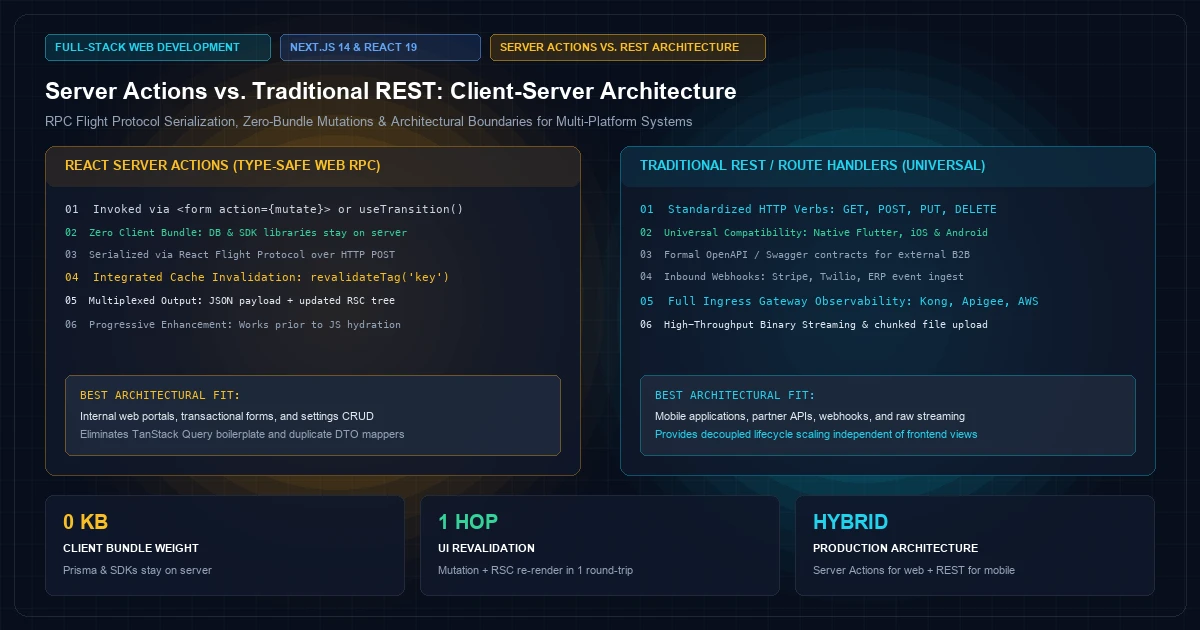
For over two decades, web application architecture adhered to a strict division of labor: backend servers exposed stateless RESTful JSON endpoints, while frontend single-page applications (SPAs) consumed those endpoints using client-side HTTP clients like Axios or the native fetch API. This decoupled model enabled teams to reuse the same backend APIs across web dashboards, native mobile apps, and third-party integrations.
However, for internal web interfaces, this decoupling introduced substantial architectural overhead: manual state synchronization, client-side cache invalidation cascades (e.g., TanStack Query or SWR), sprawling API boilerplate (route.ts files, serialization handlers, DTO mappers), and bloated JavaScript bundle sizes.
With the release of React 19 primitives and the Next.js 14 App Router, Server Actions have emerged as an alternative paradigm. By allowing frontend components to invoke asynchronous server functions directly—without writing a dedicated REST route handler—Server Actions offer type-safe, direct RPC mutations with built-in cache revalidation and progressive enhancement.
Yet, adopting Server Actions across an entire enterprise codebase without understanding their underlying transport physics can introduce security vulnerabilities, break third-party client integrations, and complicate API gateway telemetry.
At KNetwork's Full-Stack Web Development practice, we design architectures for complex enterprise systems. In this guide, we break down the operational mechanics of Server Actions versus REST endpoints, evaluate transport serialization, compare security surfaces, and establish an architectural decision framework for modernizing client-server communication.
Deconstructing Server Actions: The Hidden HTTP RPC Layer#
A common misconception among developers is that Server Actions are "magic private functions" that bypass the network. In reality, Server Actions operate strictly over HTTP.
When you declare a Server Action using the 'use server' directive:
400 font-semibold">class=400 font-semibold">class="text-emerald-300">"text-slate-500 italic">// app/actions/settlement.ts
400 font-semibold">class="text-emerald-300">'use server';

400 font-semibold">import { revalidateTag } 400 font-semibold">from 400 font-semibold">class="text-emerald-300">'next/cache';
400 font-semibold">import { z } 400 font-semibold">from 400 font-semibold">class="text-emerald-300">'zod';
400 font-semibold">import { db } 400 font-semibold">from 400 font-semibold">class="text-emerald-300">'@/lib/db';
400 font-semibold">import { verifySession } 400 font-semibold">from 400 font-semibold">class="text-emerald-300">'@/lib/auth';

400 font-semibold">const SettlementSchema = z.object({
  invoiceId: z.400">string().uuid(),
  amountCents: z.400">number().int().positive(),
  currency: z.enum([400 font-semibold">class="text-emerald-300">'USD', 400 font-semibold">class="text-emerald-300">'EUR', 400 font-semibold">class="text-emerald-300">'GBP']),
});

400 font-semibold">export 400 font-semibold">async 400 font-semibold">function processSettlement(formData: FormData) {
  400 font-semibold">class=400 font-semibold">class="text-emerald-300">"text-slate-500 italic">// 1. Enforce Server-Side Authentication
  400 font-semibold">const session = 400 font-semibold">await verifySession();
  400 font-semibold">if (!session || session.role !== 400 font-semibold">class="text-emerald-300">'treasury_operator') {
    400 font-semibold">throw 400 font-semibold">new Error(400 font-semibold">class="text-emerald-300">'Unauthorized treasury operation');
  }

  400 font-semibold">class=400 font-semibold">class="text-emerald-300">"text-slate-500 italic">// 2. Validate Form Payload
  400 font-semibold">const validated = SettlementSchema.parse({
    invoiceId: formData.get(400 font-semibold">class="text-emerald-300">'invoiceId'),
    amountCents: Number(formData.get(400 font-semibold">class="text-emerald-300">'amountCents')),
    currency: formData.get(400 font-semibold">class="text-emerald-300">'currency'),
  });

  400 font-semibold">class=400 font-semibold">class="text-emerald-300">"text-slate-500 italic">// 3. Execute Database Mutation Directly
  400 font-semibold">const record = 400 font-semibold">await db.settlement.create({
    data: {
      invoiceId: validated.invoiceId,
      amountCents: validated.amountCents,
      currency: validated.currency,
      operatorId: session.userId,
    },
  });

  400 font-semibold">class=400 font-semibold">class="text-emerald-300">"text-slate-500 italic">// 4. Invalidate Cache Tag Across the Entire Cluster
  revalidateTag(400 font-semibold">class="text-emerald-300">`invoice-${validated.invoiceId}`);

  400 font-semibold">return { success: 400">true, settlementId: record.id };
}
Next.js compiles this function into an autonomous HTTP endpoint. When invoked from a client component:
- Network Transport: The browser dispatches an HTTP POST request to the current URL.
- Action Identification: Next.js embeds an opaque cryptographic action ID in the
Next-ActionHTTP header (e.g.,Next-Action: 4c3d8a9e...). - Payload Serialization: Arguments are serialized using the React Flight protocol or encoded as
multipart/form-data. - Execution & Dual Response: The server executes the function, runs server cache revalidation (
revalidateTag), and returns a multiplexed response containing both the function's return value and the re-rendered React Server Component (RSC) tree for the affected route segment.
Server Action Flow (Single Network Round-Trip):
Client Form Submit ──► HTTP POST [Next-Action: hash] ──► Server Runs DB Mutation
                                                           │
Browser Re-renders ◄── Returns JSON Result + RSC Tree ◄── revalidateTag()
By contrast, accomplishing this same workflow via traditional REST requires two separate network hops:
Traditional REST Flow (Multi-Hop Cascade):
1. Client Form ──► POST /api/v1/settlements ──► DB Mutation ──► Returns 201 Created
2. Client State ──► Invalidate SWR/Query Cache ──► GET /api/v1/invoices/:id ──► Updates UI
Architectural Comparison Matrix: Server Actions vs. REST#
| Architectural Dimension | React Server Actions | Traditional REST Endpoints (route.ts) |
|---|---|---|
| Transport Protocol | HTTP POST via React Flight Protocol / Multipart | Standard HTTP (GET, POST, PUT, PATCH, DELETE) |
| Client Bundle Impact | 0 KB (Server packages never leak to client) | Moderate (Requires client fetchers, state mappers) |
| Type Safety | End-to-end TypeScript inference out of the box | Requires manual OpenAPI codegen or tRPC layers |
| Cache Revalidation | Built-in via revalidatePath() & revalidateTag() | Manual client-side query cache invalidation |
| External Client Support | Poor (Tightly coupled to React runtime) | Universal (Mobile apps, Flutter, cURL, Webhooks) |
| API Gateway Observability | Difficult (Opaque action hashes in headers) | Seamless (Standardized URL paths and HTTP verbs) |
| Streaming Large Payloads | Limited to React Flight serialization limits | Full support for raw byte streams, chunked uploads |
| Progressive Enhancement | Native support via standard HTML <form action> | Requires client JavaScript to intercept submit |
The Security Surface of Server Actions#
Because Server Actions are declared directly inside application files, developers frequently make dangerous assumptions regarding their visibility and authorization boundaries.
Vulnerability 1: Implicit Public Exposure#
'use server' directive is exposed as a publicly callable HTTP endpoint. Even if an action is only imported inside an internal administrator component, an attacker who obtains the action ID can invoke it directly via HTTP POST requests using cURL or Postman.
Architectural Rule: You must never assume an action is secure because its calling component is hidden behind a client-side layout. Every Server Action must enforce explicit authentication, authorization, and input validation at the top of the function:
400 font-semibold">class=400 font-semibold">class="text-emerald-300">"text-slate-500 italic">// ❌ CRITICAL SECURITY FLAW: Unauthenticated Server Action
400 font-semibold">class="text-emerald-300">'use server';

400 font-semibold">export 400 font-semibold">async 400 font-semibold">function deleteCustomerAccount(customerId: 400">string) {
  400 font-semibold">class=400 font-semibold">class="text-emerald-300">"text-slate-500 italic">// Danger! Anyone who submits a POST request with customerId can delete accounts!
  400 font-semibold">await db.customer.delete({ where: { id: customerId } });
}

400 font-semibold">class=400 font-semibold">class="text-emerald-300">"text-slate-500 italic">//  SECURED ARCHITECTURE: Strict Authorization & Input Validation
400 font-semibold">class="text-emerald-300">'use server';

400 font-semibold">import { verifySession } 400 font-semibold">from 400 font-semibold">class="text-emerald-300">'@/lib/auth';
400 font-semibold">import { z } 400 font-semibold">from 400 font-semibold">class="text-emerald-300">'zod';

400 font-semibold">const DeleteSchema = z.400">string().uuid();

400 font-semibold">export 400 font-semibold">async 400 font-semibold">function deleteCustomerAccount(rawCustomerId: 400">string) {
  400 font-semibold">const session = 400 font-semibold">await verifySession();
  400 font-semibold">if (!session || !session.permissions.includes(400 font-semibold">class="text-emerald-300">'customer:delete')) {
    400 font-semibold">throw 400 font-semibold">new Error(400 font-semibold">class="text-emerald-300">'Forbidden: Insufficient administrative privileges');
  }

  400 font-semibold">const customerId = DeleteSchema.parse(rawCustomerId);
  400 font-semibold">await db.customer.delete({ where: { id: customerId } });

  400 font-semibold">return { deleted: 400">true };
}
Vulnerability 2: Closure Scope Leaks#
When creating inline server actions inside server components, avoid closing over sensitive server variables that might inadvertently be serialized into hidden form fields sent to the client:
400 font-semibold">class=400 font-semibold">class="text-emerald-300">"text-slate-500 italic">// ❌ RISKY PATTERN: Variable capture in inline action
400 font-semibold">export 400 font-semibold">default 400 font-semibold">async 400 font-semibold">function DocumentPage({ documentId, secretInternalToken }: Props) {
  400 font-semibold">async 400 font-semibold">function submitAuditNote(formData: FormData) {
    400 font-semibold">class="text-emerald-300">'use server';
    400 font-semibold">class=400 font-semibold">class="text-emerald-300">"text-slate-500 italic">// secretInternalToken might be encrypted and stored in client hidden inputs
    400 font-semibold">await recordAudit(documentId, secretInternalToken, formData.get(400 font-semibold">class="text-emerald-300">'note'));
  }

  400 font-semibold">return <form action={submitAuditNote}>...</form>;
}
Instead, keep server actions in dedicated files (app/actions/*.ts) and read secrets directly from secure server environment configurations or session stores.
When to Consolidate vs. When to Keep REST#
Rather than treating this as a binary choice, modern full-stack architectures operate most effectively on a hybrid continuum.
                   ┌─────────────────────────────────────────────────┐
                   │ What is the consumer and purpose of the action? │
                   └────────────────────────┬────────────────────────┘
                                            │
               ┌────────────────────────────┴────────────────────────────┐
               │                                                         │
    Internal React Web UI                                  Multi-Platform or External
               │                                                         │
   ┌───────────┴───────────┐                                 ┌───────────┴───────────┐
   │ Dynamic UI Mutation & │                                 │ Third-Party Webhooks, │
   │ Cache Revalidation?   │                                 │ Mobile App (Flutter), │
   │                       │                                 │ Public Developer API? │
   └───────────┬───────────┘                                 └───────────┬───────────┘
               │                                                         │
       ┌───────┴───────┐                                                 │
      YES              NO                                                │
       │               │                                                 │
       ▼               ▼                                                 ▼
┌─────────────┐ ┌─────────────┐                                   ┌─────────────┐
│   SERVER    │ │ Route Hand- │                                   │ TRADITIONAL │
│   ACTION    │ │ ler (JSON)  │                                   │ REST ROUTE  │
└─────────────┘ └─────────────┘                                   └─────────────┘
Consolidate into Server Actions When:#
- Mutating Form & Transactional Data: User profile updates, checkout steps, settings toggles, and modal dialogues where mutations directly trigger page cache invalidation.
- Eliminating Client Bundle Bloat: You need to perform direct database queries (Prisma, Drizzle, Kysely) or interact with backend SDKs without bundling heavy libraries into the client bundle.
- Progressive Enhancement is Required: Creating mission-critical forms that must submit reliably even on unstable cellular connections before client-side hydration completes.
- Internal Admin Portals: Building internal CRUD operations where maintaining dedicated REST schemas, routes, and SWR hooks produces unnecessary maintenance overhead. For foundational architectural practices, review our enterprise breakdown on Custom Software Development.
Preserve Traditional REST / Route Handlers When:#
- Serving Non-React Clients: If your platform supports a native mobile client (such as a cross-platform Flutter application) or external enterprise partners, REST endpoints with OpenAPI documentation are mandatory.
- Handling Inbound Webhooks: Services like Stripe, GitHub, Twilio, and ERP notification queues require standard HTTP POST endpoints that return raw
200 OKstatus codes without React Flight protocol formatting. - High-Throughput File & Binary Streaming: Uploading gigabyte-scale video assets, parsing multi-megabyte CSV files, or generating on-the-fly PDF reports. REST Route Handlers provide granular control over chunked HTTP streams and request body readers.
- Independent Service Lifecycles: If you manage high-velocity microservices that scale independently of the frontend web cluster; explore our architecture guide on API Versioning Strategies in Production.
Production Telemetry and Observability#
A major operational hurdle with Server Actions in enterprise monitoring (Datadog, Dynatrace, New Relic) is that all actions hit the root page URL via HTTP POST. A dashboard monitoring /dashboard might see 50 different operations—ranging from quick status toggles to 2-second CSV exports—all lumped under a single generic endpoint name.
Structuring Action Telemetry Wrappers#
To restore enterprise-grade observability, wrap server actions with standardized telemetry decorators:
400 font-semibold">class=400 font-semibold">class="text-emerald-300">"text-slate-500 italic">// lib/telemetry/action-wrapper.ts
400 font-semibold">import { headers } 400 font-semibold">from 400 font-semibold">class="text-emerald-300">'next/headers';

400 font-semibold">export 400 font-semibold">function createAuditedAction<TInput, TOutput>(
  actionName: 400">string,
  handler: (input: TInput) => 400">Promise<TOutput>
) {
  400 font-semibold">return 400 font-semibold">async (input: TInput): 400">Promise<TOutput> => {
    400 font-semibold">const startTime = performance.now();
    400 font-semibold">const headerList = headers();
    400 font-semibold">const clientIp = headerList.get(400 font-semibold">class="text-emerald-300">'x-forwarded-400 font-semibold">for') || 400 font-semibold">class="text-emerald-300">'unknown';

    400 font-semibold">try {
      400 font-semibold">const result = 400 font-semibold">await handler(input);
      400 font-semibold">const durationMs = (performance.now() - startTime).toFixed(2);

      400 font-semibold">class=400 font-semibold">class="text-emerald-300">"text-slate-500 italic">// Emit structured log 400 font-semibold">for Datadog / OpenTelemetry
      console.log(JSON.stringify({
        event: 400 font-semibold">class="text-emerald-300">'server_action_success',
        action: actionName,
        durationMs,
        clientIp,
        timestamp: 400 font-semibold">new Date().toISOString(),
      }));

      400 font-semibold">return result;
    } 400 font-semibold">catch (error) {
      400 font-semibold">const durationMs = (performance.now() - startTime).toFixed(2);

      console.error(JSON.stringify({
        event: 400 font-semibold">class="text-emerald-300">'server_action_error',
        action: actionName,
        durationMs,
        clientIp,
        error: error instanceof Error ? error.message : 400 font-semibold">class="text-emerald-300">'Unknown error',
        timestamp: 400 font-semibold">new Date().toISOString(),
      }));

      400 font-semibold">throw error;
    }
  };
}
Usage in production modules:
400 font-semibold">class=400 font-semibold">class="text-emerald-300">"text-slate-500 italic">// app/actions/billing.ts
400 font-semibold">class="text-emerald-300">'use server';

400 font-semibold">import { createAuditedAction } 400 font-semibold">from 400 font-semibold">class="text-emerald-300">'@/lib/telemetry/action-wrapper';

400 font-semibold">export 400 font-semibold">const updatePaymentMethod = createAuditedAction(
  400 font-semibold">class="text-emerald-300">'billing.updatePaymentMethod',
  400 font-semibold">async (data: PaymentMethodPayload) => {
    400 font-semibold">class=400 font-semibold">class="text-emerald-300">"text-slate-500 italic">// Business logic with automated duration and error logging
    400 font-semibold">return 400 font-semibold">await billingGateway.update(data);
  }
);
Engineering Decision Checklist#
Before refactoring legacy REST endpoints into Server Actions or designing new full-stack features, review this criteria:
- [ ] Consumer Identity: Is this mutation consumed exclusively by the Next.js React client? (If yes → Server Action; If mobile/external → REST Route Handler).
- [ ] Explicit Authorization: Does the Server Action verify session authentication and role permissions internally before executing business logic?
- [ ] Schema Validation: Is every input payload validated using a schema validator (Zod, Valibot) rather than trusting client-submitted shapes?
- [ ] Cache Revalidation Scope: Are you targeting specific cache tags (
revalidateTag) rather than broad path purges (revalidatePath('/')), which can degrade edge cache hit rates? - [ ] Observability Tagging: Are critical actions instrumented with structured duration and error logging to prevent blind spots in application monitoring?
By structuring client-server logic around clear consumer boundaries, engineering teams eliminate frontend boilerplate without sacrificing security or multi-platform extensibility.
Looking to optimize your frontend architecture or modernize legacy API layers? Discover how our architects assist high-growth organizations across Full-Stack Development and Custom Software Engineering.
Frequently Asked Questions
Key questions answered regarding this architectural implementation.
Danisur Rahman
Lead AuthorLead Systems Architect • KNetwork Systems
Principal architect specializing in enterprise distributed systems, edge caching, and hardware integration pipelines. Leads engineering audits, high-concurrency database optimizations, and zero-trust VPC deployments across high-growth ventures.
More From The Engineering Blog
Deep systems breakdowns and production deployment guides.
Achieving 100% Mobile Core Web Vitals: Asset Inlining, Font Optimization, and Script Deferral
Hit 100/100 Lighthouse and master Mobile Core Web Vitals on slow 4G cellular links: critical CSS extraction within the 14 KB TCP window, zero-CLS font subsetting with size-adjust fallbacks, web worker script offloading, and long-task yielding.
Securing Next.js Edge Middleware: Hardening Session Tokens and Bot Mitigation at the Edge
Harden Next.js 14 Edge Middleware for enterprise applications: implementing stateless JWE session token decryption via the Web Crypto API, distributed sliding-window rate limiting, and automated bot mitigation within a sub-15ms latency budget.
Enjoyed this technical breakdown?
Subscribe to receive new architectural guides, system teardowns, and engineering benchmarks directly in your inbox.