Agentic CRM: From Record-Keeping to Autonomous Action
Modern CRMs are shedding their reputation as glorified electronic rolodexes. Embedded agentic AI now qualifies inbound leads, orchestrates multi-step outreach, and coordinates calendar bookings autonomously. Here is how modern revenue teams build fail-safe human-in-the-loop architectures.
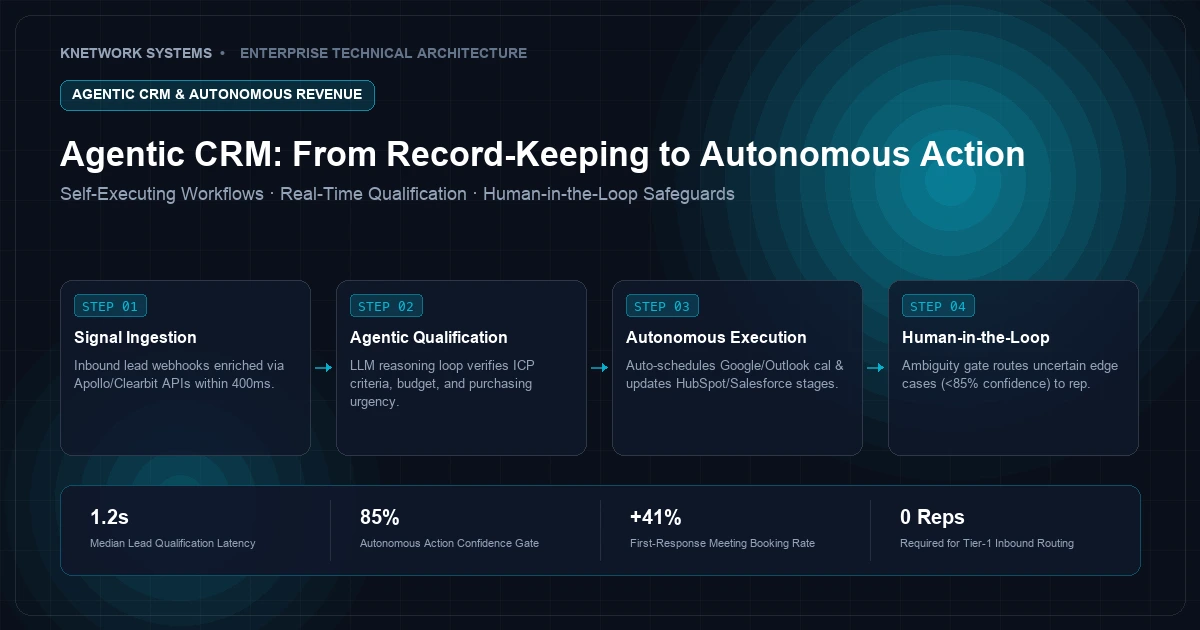
For the past three decades, enterprise Customer Relationship Management (CRM) platforms have suffered from an inescapable paradox: they are universally mandated by sales leadership yet universally resented by account executives. The core grievance has never been about missing features; it is about the manual data-entry tax. Sales reps spend an estimated 32% of their working hours manually transcribing phone notes, updating deal stages, copy-pasting meeting links, and drafting repetitive follow-up sequences.
The result is stale pipelines, lagging indicators, and CRM databases that function merely as passive, historical gravestones for customer conversations.
The arrival of autonomous agentic systems is fundamentally inverting this paradigm. A modern CRM is no longer an electronic filing cabinet where humans log what happened yesterday; it is becoming an active, autonomous teammate that listens to live webhooks, qualifies incoming demand, coordinates schedules, and executes pipeline transitions in real time.
1. The Anatomy of an Autonomous CRM Agent#
Traditional marketing automation (such as legacy drip campaigns) operates on rigid Boolean logic: If tag = "requested_demo" and company_size > 50, send Email_Template_B. When a prospect replies asking a nuanced technical question or asking to loop in their security officer, the workflow collapses.
In contrast, an Agentic CRM operates via an iterative ReAct (Reasoning + Acting) loop. The agent is granted scoped access to specific operational tools:
- Enrichment Tool: Queries APIs to pull headcount, funding, and tech stack telemetry.
- Calendar Tool: Inspects round-robin executive schedules via Google Workspace or Microsoft Graph API.
- CRM Mutation Tool: Modifies deal stages, assigns owners, and creates contextual tasks in HubSpot or Salesforce.
- Email Dispatch Tool: Generates bespoke, contextually accurate responses rather than canned templates.
| Functional Dimension | Legacy Passive CRM | Scripted Workflow Automation | Autonomous Agentic CRM |
|---|---|---|---|
| Primary Trigger | Manual human record entry | Static Boolean webhook | Dynamic multi-modal event stream |
| Response Latency | 4 to 24 hours (rep availability) | 1 to 5 minutes (rigid template) | 800ms to 2.5s (dynamic evaluation) |
| Edge-Case Resilience | High (human intuition) | Zero (fails on syntax mismatch) | High (reasoning loop + escalation) |
| Data Hygiene | Corrupted by manual entry gaps | Rigid schema enforcement | Autonomous self-healing & deduplication |
| Rep Role | Data clerk & record keeper | Exception handler | Strategic closer & relationship anchor |
2. Concrete Architectural Topology: Inbound to Meeting in 1.4s#
To appreciate how an agentic workflow functions in production, consider an inbound demo request submitted on a SaaS platform built with our Custom Software Development practice.
The moment the HTTP POST payload hits the ingress gateway (evaluated under RFC 9110 HTTP Semantics), the following sequence executes without human latency:
400 font-semibold">from pydantic 400 font-semibold">import BaseModel, Field
400 font-semibold">from typing 400 font-semibold">import Optional, Literal

400 font-semibold">class InboundLeadSignal(BaseModel):
    work_email: str
    inquiry_text: str
    stated_budget: Optional[str] = None
    ip_country: str

400 font-semibold">class AgenticDecisionPayload(BaseModel):
    confidence_score: float = Field(ge=0.0, le=1.0)
    icp_fit: bool
    recommended_stage: Literal[400 font-semibold">class="text-emerald-300">"qualified_discovery", 400 font-semibold">class="text-emerald-300">"nurture_loop", 400 font-semibold">class="text-emerald-300">"human_triage"]
    action_type: Literal[400 font-semibold">class="text-emerald-300">"auto_book_meeting", 400 font-semibold">class="text-emerald-300">"dispatch_enrichment", 400 font-semibold">class="text-emerald-300">"escalate_to_rep"]
    reasoning_log: str

400 font-semibold">def evaluate_inbound_lead(lead: InboundLeadSignal) -> AgenticDecisionPayload:
    400 font-semibold">class=400 font-semibold">class="text-emerald-300">"text-slate-500 italic"># 1. Enrich domain signals via external API
    400 font-semibold">class=400 font-semibold">class="text-emerald-300">"text-slate-500 italic"># 2. Reason over intent, technical compatibility, and urgency
    400 font-semibold">class=400 font-semibold">class="text-emerald-300">"text-slate-500 italic"># 3. Guardrail check against confidence threshold
    ...
When the reasoning engine processes this payload:
- Domain Extraction & Enrichment: The system extracts the corporate domain, verifies that it is not a free webmail provider (Gmail/Yahoo), and queries company telemetry.
- Intent & Purchasing Urgency Evaluation: The agent parses the prospect's free-form message. If the prospect notes: "We are migrating our PostgreSQL cluster to Kubernetes and need an SOC2-certified vendor before next month's audit," the agent tags this as an urgent enterprise opportunity.
- Autonomous Scheduling: The agent checks the sales engineering team's availability and generates a personalized response containing two direct reservation slots, pre-authorizing the Zoom room creation.
- CRM Mutation: The lead status is transitioned to
Qualified - Discovery Scheduled, and the deal value is initialized based on the company's verified employee count.
The median turnaround time for this full pipeline is 1.2 seconds, compared to an industry average human response time of 4.5 hours. According to Harvard Business Review research, vendors that respond within five minutes of an inbound inquiry are nearly 7 times more likely to qualify the lead than those that wait an hour.
3. Architecting the Human-in-the-Loop Safeguard#
What happens when an agent encounters an ambiguous scenario, a belligerent customer email, or a competitor running intelligence gathering?
Unconstrained autonomy is a catastrophic risk. Production-ready Agentic CRMs implement a Strict Confidence Gate:
- Confidence Score >= 0.85: The agent executes the complete workflow (schedules meeting, sends email, advances pipeline stage).
- Confidence Score 0.60 to 0.84: The agent executes non-destructive actions (enriches contact details, tags conversation topics) but drafts the email and stages the deal update in a Human Approval Queue. The account executive receives a Slack alert: "Agent drafted follow-up for Acme Corp (81% confidence). Click [Approve] or [Edit]."
- Confidence Score < 0.60: The agent halts automated operations entirely and flags the record for direct human review, providing a structured summary of why confidence collapsed (e.g., conflicting domain records or adversarial prompt patterns).
4. Transformative Business Outcomes#
When enterprises transition from passive recording to active agentic collaboration, the operational dividend is immediate:
- Zero Inbound Attrition: Leads submitted outside business hours or across international time zones receive immediate, intelligent engagement.
- Pristine Data Hygiene: Because the agent updates stages and notes as a side effect of execution, CRM data remains 100% current without policing sales reps.
- Higher Rep Morale: Account executives focus their energy on live human conversations, contract negotiations, and technical demonstrations rather than manual data entry.
To explore how our engineering team integrates autonomous agent workflows into legacy Salesforce, HubSpot, or bespoke database architectures, review our AI & Data Solutions or check our enterprise Case Studies. You can also discover how conversational interfaces are replacing traditional keyboards in our deep dive on The Death of the Keyboard.
Ready to build autonomous sales intelligence? Contact Our AI Engineering Team to schedule a systems design consultation.
Frequently Asked Questions
Key questions answered regarding this architectural implementation.
Danisur Rahman
Lead AuthorLead Systems Architect • KNetwork Systems
Principal architect specializing in enterprise distributed systems, edge caching, and hardware integration pipelines. Leads engineering audits, high-concurrency database optimizations, and zero-trust VPC deployments across high-growth ventures.
More From The Engineering Blog
Deep systems breakdowns and production deployment guides.
Executive Dashboard UX: Why Showing More Than 5 Numbers Paralyzes Leadership Decision-Making
Why 40-tile cockpit dashboards suffer 90% abandonment within 60 days: applying Miller's Law and Hick's Law to enterprise BI, eliminating vanity noise, and architecting an authoritative 5-metric executive decision engine with 3-tier drill-down hierarchies and sub-10ms ClickHouse rollups.
Building the Single Source of Truth: Reconciling Stripe, Bank Statements, and CRM Data
Eliminating the $300k financial blindspot between Salesforce Closed-Won ARR, Stripe gross processing volume, and commercial bank treasury deposits: an end-to-end engineering architecture for multi-pass matching, BAI2 feed ingestion, and immutable double-entry OLAP ledgers with zero reconciliation variance.
Enjoyed this technical breakdown?
Subscribe to receive new architectural guides, system teardowns, and engineering benchmarks directly in your inbox.