Creative Fatigue Detection: Metric Signals That Tell You When to Rotate Ad Variations
How modern algorithmic ad auctions penalize saturated creatives: analyzing the physics of Meta Advantage+ and Google PMax auction formulas, leading telemetry indicators (First-Time Impression Ratio and Hook Rate decay velocity), and automated Python fatigue detection pipelines.
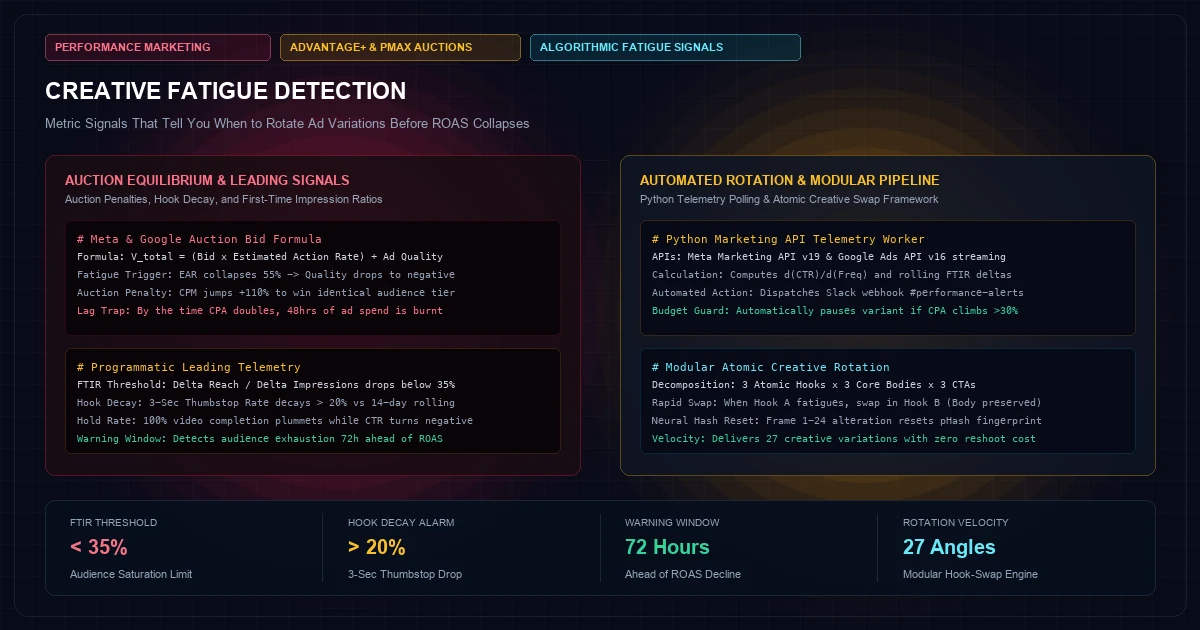
In modern algorithmic performance advertising—dominated by Meta’s Advantage+ / Andromeda auction engines and Google’s Performance Max (PMax)—creative is no longer merely visual branding. Creative is the targeting parameter.
As machine learning auction algorithms replaced manual demographic and interest-based segmentation with broad targeting, an advertiser’s competitive advantage shifted entirely to creative velocity: producing, testing, and scaling varied ad hooks, angles, and formats.
However, scaling ad spend across Facebook, Instagram, YouTube, and TikTok introduces an inevitable financial hazard: Ad Creative Fatigue.
When an audience is saturated with an identical visual hook or messaging angle:
- Auction Value Penalty: The ad platform’s bidding formula penalizes decaying engagement, driving CPMs up by 40% to 120%.
- Burned Media Spend: By the time a media buyer observes a drop in blended ROAS (Return on Ad Spend) or a spike in Cost Per Acquisition (CPA), the campaign has already incinerated thousands of dollars in sub-optimal auctions.
- Account-Level Performance Drag: When multiple ad variations inside an ad set experience simultaneous fatigue, the platform’s exploration algorithm destabilizes, resetting learning phases and driving volatile conversion swings.
To maintain stable return on ad spend at scale (50,000 to 1,000,000+ monthly budgets), performance engineering teams must abandon reactive manual dashboard reviews. Instead, they deploy Automated Creative Fatigue Detection Pipelines that monitor programmatic leading indicators and trigger proactive creative rotation before financial efficiency degrades.
This guide outlines the mathematical physics of auction decay, defines the 4 core leading fatigue signals, and provides production-ready automated monitoring code to protect ad spend.
The Auction Physics of Ad Creative Fatigue#
To detect fatigue before it damages CAC, performance engineers must examine how modern ad platforms calculate auction winning bids:
+---------------------------------------------------------------------------------------------------+
|                        ALGORITHMIC AD AUCTION EQUILIBRIUM                                         |
+---------------------------------------------------------------------------------------------------+
|                                                                                                   |
|  Total Auction Value Formula (Meta & Google Standard):                                            |
|                                                                                                   |
|  V_total = (Bid_advertiser x Estimated_Action_Rate) + Ad_Quality_Score                            |
|                                                                                                   |
|  STAGE 1: FRESH CREATIVE LAUNCH                                                                   |
|  - High initial engagement -> High Estimated Action Rate (EAR = 0.082)                            |
|  - Zero negative user hides -> Maximum Ad Quality Score (+15.0)                                    |
|  - Outcome: Wins high-intent impressions at low CPM ($14.50) -> ROAS = 3.8x                       |
|                                                                                                   |
|                                         |                                                         |
|                                         v (Audience Saturation: Frequency > 3.2)                  |
|  STAGE 2: CREATIVE FATIGUE DECAY                                                                  |
|  - Users scroll past familiar visuals -> EAR drops by 55% (EAR = 0.037)                           |
|  - 400 font-semibold">class="text-emerald-300">"Hide ad" and report rates climb -> Ad Quality Score collapses (-8.5)                          |
|  - Auction Penalty: To win the same user tier, algorithm MUST bid higher base CPM ($38.20!)       |
|  - Outcome: CPA doubles 400 font-semibold">from $42 to $89 -> ROAS collapses to 1.4x                                |
+---------------------------------------------------------------------------------------------------+
When an ad fatigues, the platform is not "punishing" the account out of spite. The algorithm’s objective is to maximize platform ad revenue while preserving user feed retention. If users repeatedly scroll past or hide an ad, the system demands a severe monetary premium (higher CPM) to display it again.
Leading vs. Lagging Fatigue Indicators#
Most media buyers rely on lagging indicators: ROAS, CPA, and blended customer acquisition cost. Relying on lagging metrics to detect creative fatigue is like steering a ship by looking at the wake behind the stern: by the time ROAS drops below break-even, the budget has been hemorrhaging for 48 to 72 hours.
High-performance teams monitor leading programmatic telemetry:
+---------------------------------------------------------------------------------------------------+
|                        CREATIVE FATIGUE METRIC TELEMETRY                                          |
+---------------------------------------------------------------------------------------------------+
|                                                                                                   |
|  TELEMETRY SIGNAL                 MEASUREMENT MECHANIC          FATIGUE ALARM THRESHOLD           |
|                                                                                                   |
|  1. First-Time Impression Ratio   New Reach / Total Impressions Drops below 35% within 7-day window|
|     (FTIR)                                                                                        |
|                                                                                                   |
|  2. Hook Rate (Thumbstop)         3-Second Video Plays / Total  Decays > 20% relative to 14-day    |
|                                   Impressions                   rolling baseline                  |
|                                                                                                   |
|  3. Hold Rate (Engagement)        100% Video Plays / 3-Sec Plays Drops > 25% 400 font-semibold">while CTR decays     |
|                                                                                                   |
|  4. Click-to-Frequency Velocity   d(CTR) / d(Frequency)        Negative slope steepening:         |
|     (CFV Derivative)                                            |Delta CTR| / Delta Freq > 0.45    |
+---------------------------------------------------------------------------------------------------+
1. First-Time Impression Ratio (FTIR)
FTIR measures the percentage of impressions delivered to users who have never seen the ad before:In a healthy scaling campaign, FTIR remains between 65% and 85%. When FTIR collapses below 35%, the algorithm has exhausted its receptive sub-audience and is repeatedly bludgeoning the same users, preceding an imminent CPA spike.
2. The Hook Rate Decay Derivative
For short-form video creative (Reels, TikTok, YouTube Shorts), the Hook Rate (also known as the 3-second thumbstop rate) measures visual capture efficiency:When an ad creative fatigues, the Hook Rate begins decaying 3 to 5 days before Cost Per Click (CPC) or CPA shows any degradation. If your historical baseline hook rate is 32% and drops to 24% over a 3-day moving average, fatigue is actively occurring.
Automated Fatigue Detection Architecture#
Rather than requiring media buyers to manually inspect hundreds of ad variations in Meta Ads Manager, the architecture executes an automated Python worker that queries marketing APIs, computes velocity derivatives, and dispatches automated rotation webhooks:
+---------------------------------------------------------------------------------------------------+
|                        AUTOMATED FATIGUE DETECTION & ROTATION MESH                                |
+---------------------------------------------------------------------------------------------------+
|                                                                                                   |
|   +-----------------------+           +-----------------------+           +-------------------+   |
|   | Meta Marketing API    |           | Google Ads API v16    |           | TikTok Ads API    |   |
|   | Insights Endpoint     |           | Hourly Metrics Stream |           | Performance Feed  |   |
|   +-----------+-----------+           +-----------+-----------+           +---------+---------+   |
|               |                                   |                                 |             |
|               +-----------------------------------+---------------------------------+             |
|                                                   |                                               |
|                                                   v                                               |
|   +-------------------------------------------------------------------------------------------+   |
|   |                       PYTHON AUTOMATED FATIGUE MONITORING WORKER                          |   |
|   |                                                                                           |   |
|   |  +-------------------------+   +--------------------------+   +------------------------+  |   |
|   |  | Ingestion & Rolling Avg |   | Decay Derivative Engine  |   | Rule & Threshold Guard |  |   |
|   |  | 3-Day vs 14-Day Baseline|   | d(CTR)/dt & d(FTIR)/dt   |   | Status: FATIGUE_ALERT  |  |   |
|   |  +-------------------------+   +--------------------------+   +-----------+------------+  |   |
|   +---------------------------------------------------------------------------|---------------+   |
|                                                                               |                   |
|                                         +-------------------------------------+                   |
|                                         |                                                         |
|                                         v (Trigger Event: FTIR < 0.35 AND Hook Decay > 20%)       |
|   +-------------------------------------------------------------------------------------------+   |
|   |                       AUTOMATED MITIGATION & NOTIFICATION CHANNELS                        |   |
|   |                                                                                           |   |
|   |  +-------------------------+   +--------------------------+   +------------------------+  |   |
|   |  | Slack Operations Alert  |   | Automated API Action     |   | Creative Pipeline Queue|  |   |
|   |  | 400 font-semibold">class=400 font-semibold">class="text-emerald-300">"text-slate-500 italic">#performance-alerts     |   | Pause Fatigued Ad Variant|   | Promote Staged Backup  |  |   |
|   |  | 400 font-semibold">class="text-emerald-300">"Ad_884 Fatigued: FTIR"|   | Shift 40% Budget to B2   |   | Winner 400 font-semibold">from Test Pool  |  |   |
|   |  +-------------------------+   +--------------------------+   +------------------------+  |   |
|   +-------------------------------------------------------------------------------------------+   |
+---------------------------------------------------------------------------------------------------+
Production Fatigue Detection Script
The following Python script analyzes daily ad metrics from the Meta Marketing API and calculates the decay velocity of hook rates and FTIR:
400 font-semibold">class=400 font-semibold">class="text-emerald-300">"text-slate-500 italic">#!/usr/bin/env python3
400 font-semibold">class="text-emerald-300">""400 font-semibold">class="text-emerald-300">"
creative_fatigue_monitor.py
Calculates rolling performance decay derivatives to detect ad fatigue in Meta Ads.
"400 font-semibold">class="text-emerald-300">""

400 font-semibold">from dataclasses 400 font-semibold">import dataclass
400 font-semibold">from typing 400 font-semibold">import List

@dataclass
400 font-semibold">class DailyAdMetric:
    date: str
    ad_id: str
    impressions: int
    reach: int
    spend: float
    video_3s_views: int
    clicks: int

400 font-semibold">def evaluate_creative_fatigue(metrics: List[DailyAdMetric]) -> dict:
    400 font-semibold">if len(metrics) < 7:
        400 font-semibold">return {400 font-semibold">class="text-emerald-300">"status": 400 font-semibold">class="text-emerald-300">"INSUFFICIENT_DATA"}

    400 font-semibold">class=400 font-semibold">class="text-emerald-300">"text-slate-500 italic"># Sort chronologically
    sorted_m = sorted(metrics, key=lambda x: x.date)

    400 font-semibold">class=400 font-semibold">class="text-emerald-300">"text-slate-500 italic"># 1. Calculate 14-day baseline vs recent 3-day average
    baseline_window = sorted_m[:-3]
    recent_window = sorted_m[-3:]

    baseline_hook = sum(m.video_3s_views 400 font-semibold">for m in baseline_window) / max(1, sum(m.impressions 400 font-semibold">for m in baseline_window))
    recent_hook = sum(m.video_3s_views 400 font-semibold">for m in recent_window) / max(1, sum(m.impressions 400 font-semibold">for m in recent_window))

    hook_decay_pct = (baseline_hook - recent_hook) / max(0.001, baseline_hook)

    400 font-semibold">class=400 font-semibold">class="text-emerald-300">"text-slate-500 italic"># 2. Calculate Recent First-Time Impression Ratio (FTIR)
    recent_reach_delta = sum(m.reach 400 font-semibold">for m in recent_window)
    recent_impressions = sum(m.impressions 400 font-semibold">for m in recent_window)
    ftir = recent_reach_delta / max(1, recent_impressions)

    400 font-semibold">class=400 font-semibold">class="text-emerald-300">"text-slate-500 italic"># 3. Frequency vs CTR decay velocity
    recent_ctr = sum(m.clicks 400 font-semibold">for m in recent_window) / max(1, recent_impressions)
    baseline_ctr = sum(m.clicks 400 font-semibold">for m in baseline_window) / max(1, sum(m.impressions 400 font-semibold">for m in baseline_window))
    ctr_decay_pct = (baseline_ctr - recent_ctr) / max(0.001, baseline_ctr)

    400 font-semibold">class=400 font-semibold">class="text-emerald-300">"text-slate-500 italic"># Decision Matrix
    is_fatigued = (hook_decay_pct > 0.20 and ftir < 0.40) or (ctr_decay_pct > 0.25 and ftir < 0.35)

    400 font-semibold">return {
        400 font-semibold">class="text-emerald-300">"ad_id": sorted_m[0].ad_id,
        400 font-semibold">class="text-emerald-300">"is_fatigued": is_fatigued,
        400 font-semibold">class="text-emerald-300">"hook_decay_pct": round(hook_decay_pct * 100, 2),
        400 font-semibold">class="text-emerald-300">"ctr_decay_pct": round(ctr_decay_pct * 100, 2),
        400 font-semibold">class="text-emerald-300">"current_ftir": round(ftir, 3),
        400 font-semibold">class="text-emerald-300">"recommended_action": 400 font-semibold">class="text-emerald-300">"ROTATE_IMMEDIATELY" 400 font-semibold">if is_fatigued 400 font-semibold">else 400 font-semibold">class="text-emerald-300">"STABLE"
    }
The Modular Creative Rotation Framework#
Detecting fatigue is useless without a rapid replacement mechanism. Enterprise performance teams avoid creative exhaustion by decoupling ad production into modular atomic elements:
+---------------------------------------------------------------------------------------------------+
|                        MODULAR CREATIVE COMPOSITION MATRIX                                        |
+---------------------------------------------------------------------------------------------------+
|                                                                                                   |
|  ATOMIC HOOK (First 3 Sec)       BODY VALUE PROP (Sec 4-20)        CALL TO ACTION (Sec 21-30)     |
|                                                                                                   |
|  [Hook A: Pain Point Question]   [Body 1: Architecture Diagram]   [CTA X: Book Architecture Call] |
|  [Hook B: Controversial Stat] -> [Body 2: Customer Case Study]  -> [CTA Y: Download Whitepaper]   |
|  [Hook C: Screen Recording]      [Body 3: Side-by-Side Comparison] [CTA Z: Interactive ROI Calc]  |
|                                                                                                   |
|  Combinatorial Output: 3 Hooks x 3 Bodies x 3 CTAs = 27 Unique Variations                         |
+---------------------------------------------------------------------------------------------------+
When Hook A fatigues, the production team does not reshoot the entire commercial. They retain the proven Body (Body 1) and swap in Hook B or Hook C. To the platform’s computer vision and audio hash algorithms, this represents a completely fresh creative asset, immediately resetting the ad's Quality Score and restoring low-CPM auction delivery.
Technical FAQ#
1. Why does high ad frequency not always mean an ad is fatigued?
Frequency is an average across an entire audience cohort. In high-intent retargeting campaigns or localized enterprise B2B accounts, a frequency of 6.0 to 12.0 may remain highly profitable if conversion rates stay steady. True creative fatigue is defined by the co-occurrence of high frequency with deteriorating engagement metrics (falling hook rate, collapsing FTIR, and rising CPM). High frequency with stable CPA indicates high brand affinity, not fatigue.2. Does pausing a fatigued ad hurt the overall ad set's algorithmic learning?
Pausing a fatigued ad inside an active ad set does not reset the ad set’s learning phase, provided the ad set maintains at least 50 conversion events per week across its remaining active ads. However, abruptly pausing an ad that represents more than 60% of the ad set’s total spend can shock the delivery algorithm. The recommended approach is to launch the fresh creative variation into the ad set and let the algorithm organically migrate spend as the new variation wins auction auctions.3. How many creative variations should be active simultaneously in a single ad set?
For Meta Advantage+ and broad-targeting ad sets, optimal concurrency is 4 to 6 active creatives per $1,000 of daily spend. Overloading an ad set with 25+ creatives causes budget fragmentation, where no single creative accumulates sufficient conversion data to exit the learning phase. Under-loading with only 1 creative creates single-point-of-failure exposure when fatigue strikes.4. How does video aspect ratio (9:16 vs. 1:1 vs. 16:9) affect fatigue velocity?
Vertical 9:16 assets (Instagram Reels, TikTok) fatigue 3x faster than square 1:1 or landscape 16:9 desktop feed assets. Full-screen mobile placements command 100% of user visual attention; users internalize and tire of the visual hook within 2 to 3 impressions. Feed placements shared with competing posts fatigue more gradually.5. How do ad networks visually fingerprint creative to detect duplicates?
Meta, Google, and ByteDance utilize automated deep convolutional neural networks (CNNs) and perceptual hashing (pHash) on uploaded video frames, alongside audio spectrum analysis. Changing minor metadata or adding an invisible 1-pixel border does not fool the algorithm. Resetting creative perception requires altering the first 24 frames (the hook) or introducing distinct audio tracks and voiceovers.Conclusion & Operational Blueprint#
Creative fatigue is an algorithmic inevitability of modern performance marketing. By implementing:
- Leading Telemetry Dashboards: Monitor First-Time Impression Ratio (FTIR) and Hook Rate velocity rather than waiting for lagging ROAS declines.
- Automated Fatigue Pipelines: Deploy automated Python monitoring to detect decay derivatives and flag fatigued assets before spend is wasted.
- Modular Creative Sprints: Deconstruct video assets into swappable hooks, bodies, and CTAs to maintain an endless supply of fresh variations without multiplying production budgets.
Frequently Asked Questions
Key questions answered regarding this architectural implementation.
Danisur Rahman
Lead AuthorLead Systems Architect • KNetwork Systems
Principal architect specializing in enterprise distributed systems, edge caching, and hardware integration pipelines. Leads engineering audits, high-concurrency database optimizations, and zero-trust VPC deployments across high-growth ventures.
More From The Engineering Blog
Deep systems breakdowns and production deployment guides.
Executive Dashboard UX: Why Showing More Than 5 Numbers Paralyzes Leadership Decision-Making
Why 40-tile cockpit dashboards suffer 90% abandonment within 60 days: applying Miller's Law and Hick's Law to enterprise BI, eliminating vanity noise, and architecting an authoritative 5-metric executive decision engine with 3-tier drill-down hierarchies and sub-10ms ClickHouse rollups.
Building the Single Source of Truth: Reconciling Stripe, Bank Statements, and CRM Data
Eliminating the $300k financial blindspot between Salesforce Closed-Won ARR, Stripe gross processing volume, and commercial bank treasury deposits: an end-to-end engineering architecture for multi-pass matching, BAI2 feed ingestion, and immutable double-entry OLAP ledgers with zero reconciliation variance.
Enjoyed this technical breakdown?
Subscribe to receive new architectural guides, system teardowns, and engineering benchmarks directly in your inbox.