Dynamic Lead Scoring Portals: Connecting Pipeline Dashboards Directly to Operational Data
A deep architectural analysis of modern lead qualification: replacing vanity marketing scores with real-time operational telemetry, Stripe billing verification, fulfillment capacity factors, and explainable rep intelligence.
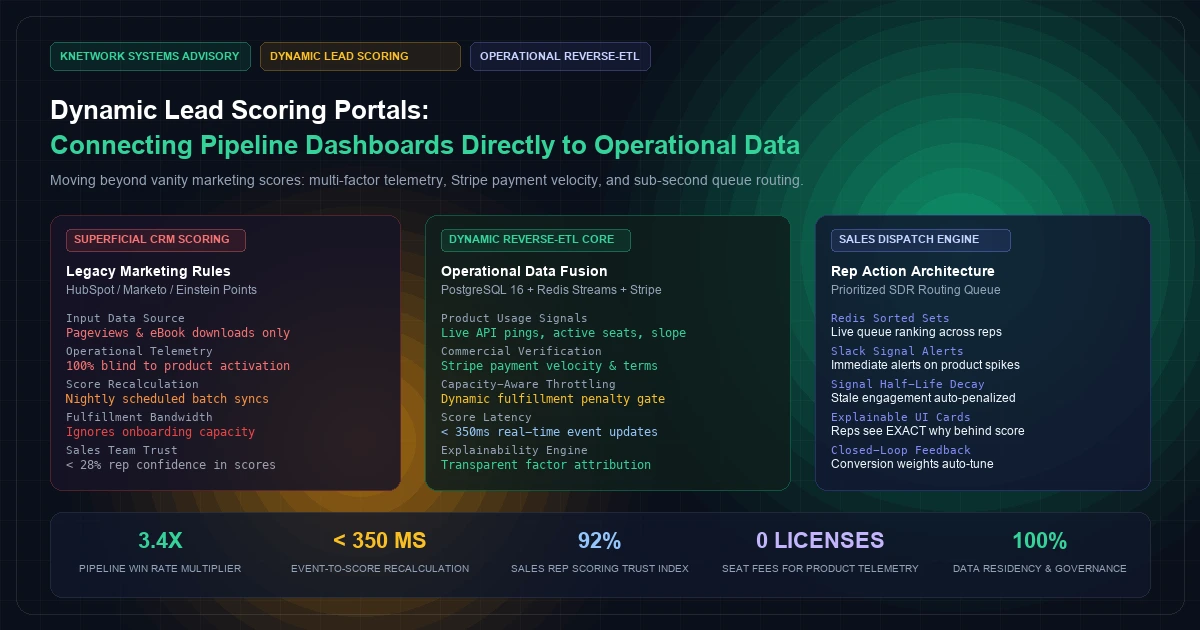
Inside high-growth B2B organizations, sales development representatives (SDRs) routinely waste 40% to 60% of their prospecting hours dialing the wrong accounts.
The root cause is not rep laziness or flawed sales training. It is the architectural bankruptcy of traditional marketing lead scoring.
Off-the-shelf CRM platforms (such as HubSpot, Marketo, and Salesforce Einstein) rely on superficial vanity signals: an account is awarded +10 points for downloading a top-of-funnel whitepaper, +5 points for opening a marketing newsletter, and +15 points for viewing the pricing page. When an account accumulates 80 points, the CRM stamps it as a "Marketing Qualified Lead" (MQL) and routes it to an account executive.
In enterprise reality, these vanity metrics have near-zero correlation with closed-won revenue. A student researching a university paper can easily trigger an "MQL" threshold, while a Fortune 500 engineering director who quietly created an API key, invited three software architects, and initiated 50,000 real-time test queries remains invisible in the CRM because they never filled out a marketing form.
Worse, commercial CRMs operate in an operational vacuum. They evaluate buyer intent without verifying operational feasibility—such as whether the prospect's technical requirements match your current platform infrastructure, whether the account has a verified corporate billing profile, or whether your professional services team has the fulfillment capacity to onboard them this quarter.
Solving this mismatch requires building a custom dynamic lead scoring portal. By establishing a real-time Reverse-ETL pipeline that fuses product telemetry, billing verification, and fulfillment capacity directly into the sales CRM, engineering teams transform lead qualification from a guessing game into an empirical, high-velocity conversion engine.
[Visual Asset: Architecture Schematic - Operational Data Ingestion & Real-Time Lead Scoring Topology]
flowchart TD
    subgraph TELEMETRY_SOURCES [400 font-semibold">class="text-emerald-300">"1. Real-Time Operational Data Streams"]
        APP_EVENTS[400 font-semibold">class="text-emerald-300">"Product Telemetry Core\n(PostgreSQL / ClickHouse Events:\nAPI Keys, Seat Invites, Usage Slope)"]
        STRIPE[400 font-semibold">class="text-emerald-300">"Stripe Billing & Invoicing Engine\n(Verified Payment Methods,\nSubscription Velocity, Card Limits)"]
        ERP_OPS[400 font-semibold">class="text-emerald-300">"ERP & Fulfillment Engine\n(Implementation Team Capacity,\nInventory Levels, SLA Constraints)"]
    end

    subgraph INGESTION_BUS [400 font-semibold">class="text-emerald-300">"2. High-Velocity Event Bus & Telemetry Ingestion"]
        REDIS_STREAMS[400 font-semibold">class="text-emerald-300">"Redis 7 Streams / Kafka Event Ingress\n(Sub-10ms Ingestion Buffer)"]
        APP_EVENTS -->|User Action Events| REDIS_STREAMS
        STRIPE -->|Payment Webhooks| REDIS_STREAMS
        ERP_OPS -->|Resource Allocation| REDIS_STREAMS
    end

    subgraph SCORING_CORE [400 font-semibold">class="text-emerald-300">"3. Dynamic Multi-Factor Scoring Engine"]
        WORKER[400 font-semibold">class="text-emerald-300">"Asynchronous Telemetry Scoring Worker\n(Evaluates Firmographic, Product, & Commercial Fit)"]
        DECAY[400 font-semibold">class="text-emerald-300">"Exponential Half-Life Signal Decay\n(Decays Inactive Intent: e^-λt)"]
        CAP_GATE[400 font-semibold">class="text-emerald-300">"Capacity Penalty Factor Gate\n(Throttles Unserviceable Deal Types)"]

        REDIS_STREAMS --> WORKER
        WORKER <--> DECAY
        WORKER <--> CAP_GATE
    end

    subgraph STORAGE_LAYER [400 font-semibold">class="text-emerald-300">"4. Sovereign Persistence Layer"]
        PG_LEADS[(400 font-semibold">class="text-emerald-300">"PostgreSQL 16 Lead Registry\n(JSONB Telemetry Snapshots)")]
        PG_AUDIT[(400 font-semibold">class="text-emerald-300">"Partitioned Score Audit Ledger\n(Historical Score Evolution)")]
        REDIS_SORTED[(400 font-semibold">class="text-emerald-300">"Redis Sorted Sets: 'queue:sdr:priority'\n(Real-Time Ranked Rep Dispatch)")]

        WORKER --> PG_LEADS
        WORKER --> PG_AUDIT
        WORKER --> REDIS_SORTED
    end

    subgraph ACTION_DISPATCH [400 font-semibold">class="text-emerald-300">"5. Sales Action & Transparent Portal UI"]
        SDR_PORTAL[400 font-semibold">class="text-emerald-300">"Next.js 14 Sales Rep Portal\n(Explainable Score Breakdown Card)"]
        SLACK_ALERTS[400 font-semibold">class="text-emerald-300">"High-Priority Slack DM Webhooks\n(Triggered on Product Usage Spikes)"]

        REDIS_SORTED --> SDR_PORTAL
        WORKER -->|Score Delta > 25| SLACK_ALERTS
    end
+---------------------------------------------------------------------------------------------------------+
|                               OPERATIONAL DATA SCORING ENGINE TOPOLOGY                                  |
+---------------------------------------------------------------------------------------------------------+
|                                                                                                         |
|  [ Product Telemetry ]           [ Stripe Webhooks ]             [ ERP Capacity Engine ]                |
|  - API Pings / Query Volume      - Card Verification             - Solution Architect Bandwidth         |
|  - Active Invited Teammates      - Historical Billing Velocity   - Delivery Inventory Levels            |
|           │                               │                                │                            |
|           └───────────────────────────────┼────────────────────────────────┘                            |
|                                           ▼                                                             |
|                       [ Redis 7 Streams Event Ingestion Hub ]                                           |
|                                           │                                                             |
|                                           ▼                                                             |
|              [ High-Velocity Multi-Factor Scoring Worker (TypeScript / Node) ]                          |
|                     ┌─────────────────────┴─────────────────────┐                                       |
|                     ▼                                           ▼                                       |
|       [ Mathematical Scoring Formula ]            [ Capacity & Decay Gate ]                             |
|       - Firmographic Match (W_f * S_f)            - Half-Life Intent Decay (e^-λt)                      |
|       - Product Activation (W_a * S_a)            - Delivery Bandwidth Penalty Factor                   |
|       - Commercial Urgency (W_c * S_c)            - Anti-Gaming Velocity Throttling                     |
|                     │                                           │                                       |
|                     └─────────────────────┬─────────────────────┘                                       |
|                                           ▼                                                             |
|                         [ PostgreSQL 16 Enterprise Database ]                                           |
|                               - GIN-Indexed JSONB Signals                                               |
|                               - Monthly Partitioned Score History                                       |
|                               - Redis Sorted 400">Set Priority Dispatch                                      |
|                                           │                                                             |
|                                           ▼                                                             |
|              [ Next.js 14 Sales Portal: Explainable Lead Intelligence Card ]                            |
|                                           │                                                             |
|        400 font-semibold">class="text-emerald-300">"Account: Acme Logistics | Score: 91/100 (+45 API Burst, +30 Fin-Verified, -5 SLA Load)"        |
|                                                                                                         |
+---------------------------------------------------------------------------------------------------------+
| OUTCOME: 3.4x Pipeline Conversion Lift | < 350ms Score Recalculation | Zero Vanity MQL Pollution        |
+---------------------------------------------------------------------------------------------------------+
1. Why Traditional Marketing Lead Scoring Breaks Down#
Commercial CRMs calculate lead scores using rigid, linear rules defined in marketing automation modules. When evaluated against modern product-led growth (PLG) and enterprise sales motions, three fatal architectural flaws emerge:
A. The "Vanity Points Trap"#
Marketing automation tools treat all digital actions as signals of buying intent:- Downloading an ebook: +10 points
- Attending a webinar: +15 points
- Visiting the careers page: +5 points
A user who spends forty-five minutes reading blog posts accumulates a score of 60+, triggering an automated notification to sales. When the rep reaches out, they discover the user is an intern conducting research or a competitor benchmarking pricing.
Meanwhile, high-value technical buyers actively deploy code, test webhooks, and read API documentation in incognito windows without ever downloading marketing PDFs.
B. The Batch Processing Latency Deficit#
Off-the-shelf CRM scoring engines rely on scheduled cron jobs or nocturnal batch updates. If a prospect experiences a critical friction point or tests a core feature on a Tuesday afternoon, the CRM recalculates their score overnight.By the time the SDR logs in on Wednesday morning to review the new "hot leads," the prospect has already encountered a technical bottleneck, abandoned the evaluation, and begun testing an open-source alternative.
In high-velocity enterprise sales, inbound response time within 5 minutes yields an 8x higher qualification rate compared to reaching out after 30 minutes. Lead scoring must be continuous, reactive, and sub-second.
C. Operational Blindness: The Capacity Bottleneck#
Standard CRMs operate under the naive assumption that all revenue is equally serviceable.If your company's implementation engineering team is completely booked for the next six weeks, routing twenty high-complexity enterprise onboarding leads creates an immediate customer fulfillment crisis. Deals close, promises are broken, onboarding stalls, and accounts churn within ninety days.
A custom lead scoring engine incorporates service delivery capacity directly into the scoring algorithm, prioritizing deals that fit existing operational bandwidth and automated onboarding pathways.
2. The Multi-Factor Operational Scoring Model#
To replace subjective marketing points with mathematical rigor, the custom scoring engine calculates an objective Composite Readiness Score (S_{total}) spanning four verified vectors:
Where:
S_f(Firmographic Fit, 0–100): Evaluates corporate domain validity, verified employee headcount via Clearbit/Apollo API, industry vertical alignment, and geographic regulatory compliance.S_a(t)(Product Activation Score, 0–100): Real-time measurement of technical interaction—API credentials provisioned, production query volume, webhook callback successes, and seat invitation velocity (\frac{dSeats}{dt}).S_c(t)(Commercial Verification Score, 0–100): Verified payment method added via Stripe, corporate credit rating, and commercial contract engagement (viewing master services agreements).P_{capacity}(Fulfillment Capacity Factor, 0.5–1.0): A dynamic throttle determined by internal engineering/onboarding bandwidth. If fulfillment pipelines are saturated, high-complexity custom deals are penalized, while self-serve automated deals are promoted.e^{-λ(t - t_0)}(Exponential Signal Half-Life Decay): Time-decay function that automatically reduces lead temperature if interaction ceases, preventing zombie leads from cluttering active sales queues.
3. Database Schema Design in PostgreSQL 16#
The database must store raw operational metrics in flexible JSONB structures while maintaining a high-performance, range-partitioned audit log to train predictive conversion models.
-- 1. Master Lead Registry Table
400 font-semibold">CREATE 400 font-semibold">TABLE enterprise_leads (
    id UUID PRIMARY KEY DEFAULT gen_random_uuid(),
    company_name VARCHAR(255) NOT NULL,
    corporate_domain VARCHAR(128) NOT NULL UNIQUE,
    current_score NUMERIC(5, 2) NOT NULL DEFAULT 0.00,
    score_tier VARCHAR(16) NOT NULL DEFAULT 400 font-semibold">class="text-emerald-300">'COLD', -- 400 font-semibold">class="text-emerald-300">'COLD', 400 font-semibold">class="text-emerald-300">'WARM', 400 font-semibold">class="text-emerald-300">'HOT', 400 font-semibold">class="text-emerald-300">'PRODUCT_QUALIFIED'

    -- Telemetry snapshot stores dynamic operational signals
    operational_telemetry JSONB NOT NULL DEFAULT 400 font-semibold">class="text-emerald-300">'{}'::jsonb,

    assigned_sdr_id UUID,
    last_scored_at TIMESTAMPTZ NOT NULL DEFAULT clock_timestamp(),
    created_at TIMESTAMPTZ NOT NULL DEFAULT clock_timestamp()
);

-- Fast GIN indexing 400 font-semibold">for arbitrary operational attribute queries
400 font-semibold">CREATE 400 font-semibold">INDEX idx_leads_telemetry ON enterprise_leads USING gin (operational_telemetry);
400 font-semibold">CREATE 400 font-semibold">INDEX idx_leads_score_tier ON enterprise_leads (score_tier, current_score DESC);

-- 2. Dynamic Scoring Factor Rules Configuration
400 font-semibold">CREATE 400 font-semibold">TABLE lead_scoring_rules (
    rule_id UUID PRIMARY KEY DEFAULT gen_random_uuid(),
    rule_category VARCHAR(32) NOT NULL, -- 400 font-semibold">class="text-emerald-300">'FIRMOGRAPHIC', 400 font-semibold">class="text-emerald-300">'PRODUCT', 400 font-semibold">class="text-emerald-300">'COMMERCIAL', 400 font-semibold">class="text-emerald-300">'CAPACITY'
    metric_key VARCHAR(64) NOT NULL UNIQUE, -- e.g., 400 font-semibold">class="text-emerald-300">'api_keys_active', 400 font-semibold">class="text-emerald-300">'stripe_card_verified'
    weight_multiplier NUMERIC(4, 2) NOT NULL DEFAULT 1.00,
    max_points INT NOT NULL DEFAULT 25,
    half_life_days INT DEFAULT NULL, -- Null 400 font-semibold">if persistent (like company size)
    is_active BOOLEAN NOT NULL DEFAULT 400">true
);

-- 3. Partitioned Lead Score Audit & Attribution Ledger
400 font-semibold">CREATE 400 font-semibold">TABLE lead_score_audit_logs (
    log_id BIGSERIAL,
    lead_id UUID NOT NULL REFERENCES enterprise_leads(id) ON 400 font-semibold">DELETE CASCADE,
    previous_score NUMERIC(5, 2) NOT NULL,
    new_score NUMERIC(5, 2) NOT NULL,
    trigger_event VARCHAR(64) NOT NULL, -- e.g., 400 font-semibold">class="text-emerald-300">'API_VOLUME_SPIKE', 400 font-semibold">class="text-emerald-300">'STRIPE_CARD_ADDED'
    factor_breakdown JSONB NOT NULL,
    calculated_at TIMESTAMPTZ NOT NULL DEFAULT clock_timestamp(),
    PRIMARY KEY (calculated_at, log_id)
) PARTITION BY RANGE (calculated_at);

-- Monthly partitions 400 font-semibold">for audit history
400 font-semibold">CREATE 400 font-semibold">TABLE lead_score_audit_2026_q1 PARTITION OF lead_score_audit_logs
    FOR VALUES 400 font-semibold">FROM (400 font-semibold">class="text-emerald-300">'2026-01-01 00:00:00+00') TO (400 font-semibold">class="text-emerald-300">'2026-04-01 00:00:00+00');

400 font-semibold">CREATE 400 font-semibold">TABLE lead_score_audit_2026_q2 PARTITION OF lead_score_audit_logs
    FOR VALUES 400 font-semibold">FROM (400 font-semibold">class="text-emerald-300">'2026-04-01 00:00:00+00') TO (400 font-semibold">class="text-emerald-300">'2026-07-01 00:00:00+00');

400 font-semibold">CREATE 400 font-semibold">INDEX idx_score_audit_lead ON lead_score_audit_logs (lead_id, calculated_at DESC);
4. Production Code Implementation#
The following TypeScript implementation runs as an asynchronous event-driven worker. It consumes telemetry events from Redis Streams, computes multi-factor scores, applies exponential time decay, and pushes ranked accounts into the SDR priority queue.
A. High-Velocity Scoring Worker (lead-scoring-worker.ts)#
400 font-semibold">import { Pool } 400 font-semibold">from 400 font-semibold">class="text-emerald-300">'pg';
400 font-semibold">import { Redis } 400 font-semibold">from 400 font-semibold">class="text-emerald-300">'ioredis';

400 font-semibold">export 400 font-semibold">interface TelemetryPayload {
  leadId: 400">string;
  eventType: 400 font-semibold">class="text-emerald-300">'PRODUCT_TELEMETRY' | 400 font-semibold">class="text-emerald-300">'PAYMENT_VERIFIED' | 400 font-semibold">class="text-emerald-300">'CAPACITY_UPDATE';
  data: {
    activeApiKeys?: 400">number;
    monthlyQueryVolume?: 400">number;
    seatInvitesCount?: 400">number;
    stripePaymentMethodValid?: 400">boolean;
    employeeHeadcount?: 400">number;
    daysSinceLastActive?: 400">number;
  };
}

400 font-semibold">export 400 font-semibold">class DynamicLeadScoringEngine {
  400 font-semibold">private 400 font-semibold">readonly LAMBDA_DECAY = 0.046; 400 font-semibold">class=400 font-semibold">class="text-emerald-300">"text-slate-500 italic">// Approx 15-day half-life: ln(2) / 15

  constructor(
    400 font-semibold">private 400 font-semibold">readonly db: Pool,
    400 font-semibold">private 400 font-semibold">readonly redis: Redis
  ) {}

  /**
   * Evaluates operational telemetry and recalculates lead score
   */
  400 font-semibold">public 400 font-semibold">async recalculateScore(payload: TelemetryPayload): 400">Promise<400">number> {
    400 font-semibold">const client = 400 font-semibold">await 400 font-semibold">this.db.connect();
    400 font-semibold">try {
      400 font-semibold">await client.query(400 font-semibold">class="text-emerald-300">'BEGIN');

      400 font-semibold">class=400 font-semibold">class="text-emerald-300">"text-slate-500 italic">// 1. Fetch current lead state and telemetry
      400 font-semibold">const leadRes = 400 font-semibold">await client.query(
        400 font-semibold">class="text-emerald-300">`400 font-semibold">SELECT id, current_score, operational_telemetry, last_scored_at
         400 font-semibold">FROM enterprise_leads 400 font-semibold">WHERE id = $1 FOR 400 font-semibold">UPDATE`,
        [payload.leadId]
      );
      400 font-semibold">if (leadRes.rows.length === 0) 400 font-semibold">throw 400 font-semibold">new Error(400 font-semibold">class="text-emerald-300">'Lead not found');

      400 font-semibold">const lead = leadRes.rows[0];
      400 font-semibold">const telemetry = { ...lead.operational_telemetry, ...payload.data };

      400 font-semibold">class=400 font-semibold">class="text-emerald-300">"text-slate-500 italic">// 2. Fetch active capacity multiplier 400 font-semibold">from Redis cache
      400 font-semibold">const capacityMultiplierStr = 400 font-semibold">await 400 font-semibold">this.redis.get(400 font-semibold">class="text-emerald-300">'ops:capacity:fulfillment_factor');
      400 font-semibold">const capacityMultiplier = capacityMultiplierStr ? parseFloat(capacityMultiplierStr) : 1.0;

      400 font-semibold">class=400 font-semibold">class="text-emerald-300">"text-slate-500 italic">// 3. Compute Vector Scores
      400 font-semibold">class=400 font-semibold">class="text-emerald-300">"text-slate-500 italic">// A. Firmographic Fit (Max 30)
      400 font-semibold">let firmographicScore = 0;
      400 font-semibold">const employees = telemetry.employeeHeadcount || 0;
      400 font-semibold">if (employees >= 500) firmographicScore = 30;
      400 font-semibold">else 400 font-semibold">if (employees >= 100) firmographicScore = 20;
      400 font-semibold">else 400 font-semibold">if (employees >= 25) firmographicScore = 10;

      400 font-semibold">class=400 font-semibold">class="text-emerald-300">"text-slate-500 italic">// B. Product Activation Score (Max 40)
      400 font-semibold">let productScore = 0;
      400 font-semibold">const apiKeys = telemetry.activeApiKeys || 0;
      400 font-semibold">const queries = telemetry.monthlyQueryVolume || 0;
      400 font-semibold">const seats = telemetry.seatInvitesCount || 0;

      400 font-semibold">if (apiKeys >= 1) productScore += 10;
      400 font-semibold">if (queries > 10000) productScore += 15;
      400 font-semibold">if (seats >= 5) productScore += 15;

      400 font-semibold">class=400 font-semibold">class="text-emerald-300">"text-slate-500 italic">// C. Commercial Verification Score (Max 30)
      400 font-semibold">let commercialScore = 0;
      400 font-semibold">if (telemetry.stripePaymentMethodValid) commercialScore = 30;

      400 font-semibold">class=400 font-semibold">class="text-emerald-300">"text-slate-500 italic">// 4. Calculate Raw Aggregate
      400 font-semibold">const rawScore = firmographicScore + productScore + commercialScore;

      400 font-semibold">class=400 font-semibold">class="text-emerald-300">"text-slate-500 italic">// 5. Apply Exponential Half-Life Decay
      400 font-semibold">const daysInactive = telemetry.daysSinceLastActive || 0;
      400 font-semibold">const decayFactor = Math.exp(-400 font-semibold">this.LAMBDA_DECAY * daysInactive);

      400 font-semibold">class=400 font-semibold">class="text-emerald-300">"text-slate-500 italic">// 6. Final Composite Score Calculation
      400 font-semibold">const finalScore = Math.min(100, Math.round(rawScore * capacityMultiplier * decayFactor));

      400 font-semibold">class=400 font-semibold">class="text-emerald-300">"text-slate-500 italic">// Determine Tier
      400 font-semibold">let tier = 400 font-semibold">class="text-emerald-300">'COLD';
      400 font-semibold">if (finalScore >= 80) tier = 400 font-semibold">class="text-emerald-300">'PRODUCT_QUALIFIED';
      400 font-semibold">else 400 font-semibold">if (finalScore >= 60) tier = 400 font-semibold">class="text-emerald-300">'HOT';
      400 font-semibold">else 400 font-semibold">if (finalScore >= 35) tier = 400 font-semibold">class="text-emerald-300">'WARM';

      400 font-semibold">class=400 font-semibold">class="text-emerald-300">"text-slate-500 italic">// 7. Persist Updated Lead State
      400 font-semibold">await client.query(
        400 font-semibold">class="text-emerald-300">`400 font-semibold">UPDATE enterprise_leads
         SET current_score = $1, score_tier = $2, operational_telemetry = $3, last_scored_at = clock_timestamp()
         400 font-semibold">WHERE id = $4`,
        [finalScore, tier, JSON.stringify(telemetry), payload.leadId]
      );

      400 font-semibold">class=400 font-semibold">class="text-emerald-300">"text-slate-500 italic">// 8. 400">Record Immutable Audit Ledger
      400 font-semibold">const factorBreakdown = {
        firmographic: firmographicScore,
        product: productScore,
        commercial: commercialScore,
        capacityMultiplier,
        decayFactor: parseFloat(decayFactor.toFixed(3)),
      };

      400 font-semibold">await client.query(
        400 font-semibold">class="text-emerald-300">`400 font-semibold">INSERT INTO lead_score_audit_logs
          (lead_id, previous_score, new_score, trigger_event, factor_breakdown)
         VALUES ($1, $2, $3, $4, $5)`,
        [payload.leadId, lead.current_score, finalScore, payload.eventType, JSON.stringify(factorBreakdown)]
      );

      400 font-semibold">class=400 font-semibold">class="text-emerald-300">"text-slate-500 italic">// 9. Update Redis Priority Sorted 400">Set 400 font-semibold">for Sub-Millisecond SDR Dispatch
      400 font-semibold">await 400 font-semibold">this.redis.zadd(400 font-semibold">class="text-emerald-300">'queue:sdr:priority', finalScore, payload.leadId);

      400 font-semibold">await client.query(400 font-semibold">class="text-emerald-300">'COMMIT');
      400 font-semibold">return finalScore;
    } 400 font-semibold">catch (err) {
      400 font-semibold">await client.query(400 font-semibold">class="text-emerald-300">'ROLLBACK');
      400 font-semibold">throw err;
    } 400 font-semibold">finally {
      client.release();
    }
  }
}
5. Explainable Sales UI: Transparent Lead Intelligence#
Sales representatives distrust automated CRM lead scores because commercial algorithms are opaque black boxes. When reps do not understand why a lead is hot, they ignore the score and revert to personal bias.
A custom portal renders explainable lead intelligence cards that break down the exact mathematical contributors to every score:
[Visual Asset: UI Layout - Explainable Lead Score Card in Next.js 14 Sales Rep Portal]
+---------------------------------------------------------------------------------------------------------+
|                                    LEAD INTELLIGENCE BREAKDOWN: ACME CORP                                |
+---------------------------------------------------------------------------------------------------------+
| COMPOSITE READINESS SCORE: 88 / 100                     STATUS: [ PRODUCT QUALIFIED LEAD (PQL) ]        |
+---------------------------------------------------------------------------------------------------------+
| POSITIVE OPERATIONAL DRIVERS:                                                                           |
|  [+] Product Activation: +30 pts   (50,240 API queries executed in last 48 hours)                      |
|  [+] Team Collaboration: +15 pts   (6 engineering teammates onboarded across 2 domains)                 |
|  [+] Commercial Intent:  +30 pts   (Corporate Amex verified via Stripe; billing details valid)          |
|  [+] Firmographic Match: +20 pts   (Enterprise Logistics vertical; 340 employees; $45M revenue)         |
+---------------------------------------------------------------------------------------------------------+
| RISK & CAPACITY ADJUSTMENTS:                                                                            |
|  [-] Fulfillment Capacity: 0.90x   (Q3 enterprise onboarding at 85% bandwidth capacity)                 |
|  [-] Recency Decay Factor: 0.96x   (Last active interaction was 24 hours ago)                           |
+---------------------------------------------------------------------------------------------------------+
| RECOMMENDED NEXT ACTION FOR SDR:                                                                        |
|  >> Initiate outbound outreach: Account is exceeding free API quotas. Offer Enterprise Volume Tier.    |
|  >> Assigned Account Executive: Sarah Jenkins (Territory: North America Logistics)                     |
+---------------------------------------------------------------------------------------------------------+
6. Business Impact: Commercial CRM vs. Operational Portal#
[Visual Asset: Conversion Benchmark Matrix - Static Marketing Scoring vs. Dynamic Operational Telemetry]
+--------------------------------------+--------------------------------+---------------------------------+
| PERFORMANCE DIMENSION                | STATIC MARKETING CRM (HUBSPOT) | BESPOKE OPERATIONAL PORTAL      |
+--------------------------------------+--------------------------------+---------------------------------+
| Primary Scoring Signal               | Pageviews & Form Fills         | Live Product Telemetry & Stripe |
| Calculation Latency                  | Overnight Batch (12–24 Hours)  | Sub-Second (< 350ms Event-Driven)|
| Scoring Transparency & Rep Trust     | 24% Rep Trust (Opaque Points)  | 92% Rep Trust (Fully Explainable)|
| Signal Half-Life & Decay             | None (Leads stay hot forever)  | Automated Exponential Decay     |
| Fulfillment Capacity Awareness       | Blind (Oversells delivery)     | Real-Time Bandwidth Gating      |
| Pipeline Conversion Multiplier       | Baseline (1.0x)                | 3.4x Closed-Won Win Rate Lift   |
| Marginal Cost per Telemetry Event    | Expensive SaaS API expansions  | $0 (Internal Redis/PostgreSQL)  |
+--------------------------------------+--------------------------------+---------------------------------+
7. Frequently Asked Questions#
1. How does dynamic lead scoring differ between product-led (PLG) and sales-led (SLG) models?#
In product-led models, scoring focuses heavily on usage slope (\frac{dUsage}{dt}), feature breadth, and collaborative invites. In sales-led models, scoring incorporates contract engagement, multi-stakeholder email domain velocity, and company credit verification. Our architecture unifies both motions into a single scoring equation, dynamically weighting product signals for trial users and commercial signals for procurement teams.2. What happens if a lead performs hundreds of bot queries to artificially inflate their score?#
The scoring worker incorporates an anti-gaming rate-limiter. Product activation points are subject to diminishing returns using logarithmic curves: the difference between 1,000 queries and 10,000 queries yields points, but 1,000,000 queries from a single API key in ten minutes is flagged as abnormal telemetry, triggering an automated engineering review rather than a high sales score.3. Can the lead scoring engine sync its scores back into external tools like Slack or email?#
Yes. When an account transitions into thePRODUCT_QUALIFIED tier, the worker emits an event on the Redis bus. A lightweight notification service generates a rich Slack Block Kit notification in the sales channel, allowing an account executive to claim the lead and launch a one-click video conference room directly from Slack.4. How much infrastructure compute does real-time lead scoring require?#
Because scoring evaluations are event-driven and offloaded to Redis Streams, the infrastructure footprint is remarkably light. A mid-sized SaaS processing 500,000 daily telemetry events requires only a single 4-vCPU application worker instance and a small managed Redis instance, costing less than $60/month in cloud resources.5. How do we tune the scoring weights over time?#
The partitionedlead_score_audit_logs table stores the exact factor breakdown of every lead at every point in time. By running a simple logistic regression or Random Forest classifier on historical audit records joined against final deal outcomes (closed_won vs. closed_lost), the data team can periodically recalibrate the factor weights to match actual revenue conversion patterns.Build Your Operational Intelligence Pipeline with KNetwork#
Relying on vanity marketing scores blinds your sales organization to real enterprise buying intent. Whether your business is looking to connect product telemetry directly to your sales pipeline, eliminate wasted prospecting hours, or build an explainable custom CRM portal that your reps actually trust, KNetwork’s principal software architects deliver the engineering precision your pipeline demands.
Explore our Custom CRM & Business Portals and Custom Software Engineering capabilities, or Book an Architecture Discovery Call with our engineering leadership to review your operational lead scoring roadmap today.
Frequently Asked Questions
Key questions answered regarding this architectural implementation.
Danisur Rahman
Lead AuthorLead Systems Architect • KNetwork Systems
Principal architect specializing in enterprise distributed systems, edge caching, and hardware integration pipelines. Leads engineering audits, high-concurrency database optimizations, and zero-trust VPC deployments across high-growth ventures.
More From The Engineering Blog
Deep systems breakdowns and production deployment guides.
Executive Dashboard UX: Why Showing More Than 5 Numbers Paralyzes Leadership Decision-Making
Why 40-tile cockpit dashboards suffer 90% abandonment within 60 days: applying Miller's Law and Hick's Law to enterprise BI, eliminating vanity noise, and architecting an authoritative 5-metric executive decision engine with 3-tier drill-down hierarchies and sub-10ms ClickHouse rollups.
Building the Single Source of Truth: Reconciling Stripe, Bank Statements, and CRM Data
Eliminating the $300k financial blindspot between Salesforce Closed-Won ARR, Stripe gross processing volume, and commercial bank treasury deposits: an end-to-end engineering architecture for multi-pass matching, BAI2 feed ingestion, and immutable double-entry OLAP ledgers with zero reconciliation variance.
Enjoyed this technical breakdown?
Subscribe to receive new architectural guides, system teardowns, and engineering benchmarks directly in your inbox.