First-Party Attribution Engineering: Surviving Signal Loss with Server-Side GTM & Meta CAPI
How modern growth engineering teams bypass iOS 14.5+ restrictions, ad-blockers, and third-party cookie deprecation using server-side event deduplication, Meta Conversions API (CAPI), and first-party edge proxy pipelines.
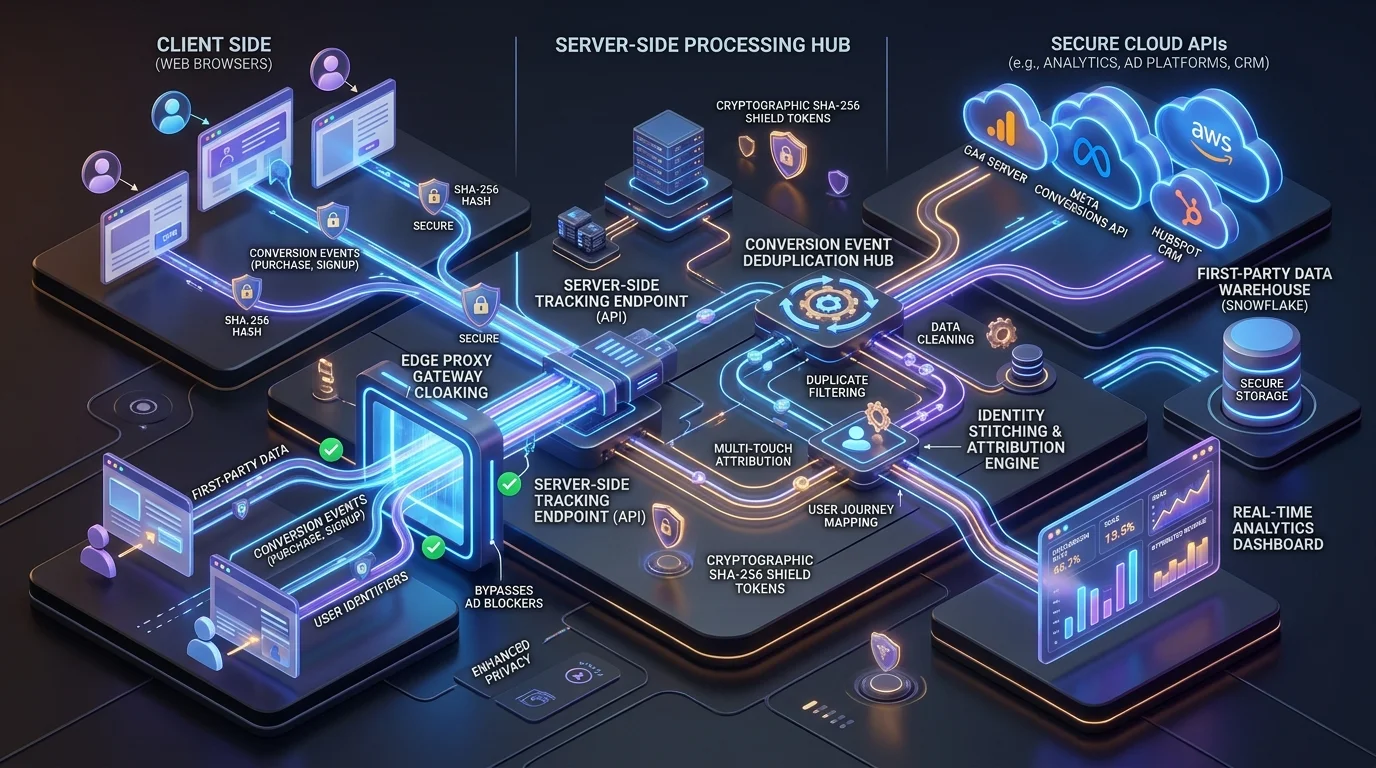
For a decade, digital performance marketing operated on a deceptively simple foundation: drop an external JavaScript snippet (the Facebook Pixel or Google Ads tag) into a website header, fire a Purchase event on the checkout confirmation page, and watch the platform algorithms optimize bids toward highest-value converters.
That foundation has completely fractured.
Between Apple’s Intelligent Tracking Prevention (ITP) capping client-side cookie lifetimes to 24 hours, Brave Shields and uBlock Origin blocking ad network domains at the network level, and regulatory crackdowns (GDPR, CCPA, DPDP) banning un-consented third-party cross-site profiling, growth teams are operating with massive blind spots.
On average, 25% to 42% of legitimate conversion events never register in Meta Ads Manager or Google Ads.
[ Traditional Client-Side Tracking: The Silent Leak ]
Browser Click ──> Checkout ──> fbq(400 font-semibold">class="text-emerald-300">'track', 400 font-semibold">class="text-emerald-300">'Purchase')
                                       │
                      ┌────────────────┴────────────────┐
                      ▼                                 ▼
             [ Brave / uBlock ]                 [ Apple WebKit ITP ]
             ❌ Script Blocked                   ❌ Cookie Stripped
             ❌ Zero Signal Reaches Meta        ❌ Misattributed to Organic
The result is devastating to unit economics: Customer Acquisition Cost (CAC) artificially appears to skyrocket, algorithmic bidding models lose their training signals and down-weight winning campaigns, and executive leadership questions paid media ROI.
The solution is not more complex client-side tagging. The solution is First-Party Attribution Engineering.
1. The Server-Side Event Hub Architecture#
In modern growth engineering, the browser is no longer trusted to report its own financial conversions.
Instead, conversion telemetry is decoupled into a resilient, asynchronous server-side pipeline:
[ Modern First-Party Attribution Architecture ]

Browser / Mobile App
       │  (1. HTTPS Post to /api/telemetry/event)
       ▼
Next.js Edge Route Handler (Reverse Proxy on your domain)
       │  (2. Attaches HttpOnly first-party cookies + IP + UserAgent)
       │  (3. Dispatches to Redis Queue / Cloud Task)
       ▼
Asynchronous Event Dispatcher
       ├───> Meta Conversions API (Graph v20)
       ├───> Google Enhanced Conversions (Measurement Protocol)
       └───> ClickHouse / PostgreSQL Data Warehouse
By hosting the collection endpoint on your own primary domain (e.g. knetwork.live/api/telemetry/event), browser ad blockers and content filters recognize the request as legitimate first-party infrastructure traffic rather than third-party tracking beacons.
2. Deterministic Event Deduplication#
Deploying both a client-side pixel (for real-time micro-signals like page browsing) and a server-side API (for bulletproof purchase tracking) introduces the risk of double-counting conversions.
To prevent this, Meta and Google require Deterministic Deduplication governed by two keys:
event_name(e.g.Purchase,Lead)event_id(a unique, client-and-server synchronized UUID)
400 font-semibold">class=400 font-semibold">class="text-emerald-300">"text-slate-500 italic">// lib/telemetry/deduplication.ts
400 font-semibold">import { v4 as uuidv4 } 400 font-semibold">from 400 font-semibold">class="text-emerald-300">"uuid";

400 font-semibold">export 400 font-semibold">function generateEventContext(eventName: 400">string) {
  400 font-semibold">class=400 font-semibold">class="text-emerald-300">"text-slate-500 italic">// Generate once per interaction and share between client script and server action
  400 font-semibold">const eventId = 400 font-semibold">class="text-emerald-300">`evt_${Date.now()}_${uuidv4().slice(0, 8)}`;

  400 font-semibold">return {
    eventName,
    eventId,
    timestamp: Math.floor(Date.now() / 1000),
  };
}
When the browser pixel fires:
fbq(400 font-semibold">class="text-emerald-300">'track', 400 font-semibold">class="text-emerald-300">'Purchase', { currency: 400 font-semibold">class="text-emerald-300">'USD', value: 450.00 }, { eventID: 400 font-semibold">class="text-emerald-300">'evt_172700_a81f' });
Simultaneously, when your server processes the Stripe or payment webhook, it dispatches the identical eventID to Meta Conversions API:
400 font-semibold">class=400 font-semibold">class="text-emerald-300">"text-slate-500 italic">// Meta receives both events. If client arrives first, it counts it.
400 font-semibold">class=400 font-semibold">class="text-emerald-300">"text-slate-500 italic">// When server arrives 1.5 seconds later, Meta matches 400 font-semibold">class="text-emerald-300">'evt_172700_a81f',
400 font-semibold">class=400 font-semibold">class="text-emerald-300">"text-slate-500 italic">// reconciles the rich server payload, and discards the duplicate.
If an ad blocker blocked the browser script, the server payload arrives independently, securing 100% conversion capture.
3. Advanced Customer Matching (Cryptographic PII Hashing)#
Ad algorithms rely on customer matching to pair a conversion with the ad clicker’s identity. The higher your Event Quality Score (EQS), the lower your effective CPMs.
Under GDPR and privacy regulations, transmitting unhashed email addresses or phone numbers is illegal. You must normalize and hash the data using SHA-256:
400 font-semibold">class=400 font-semibold">class="text-emerald-300">"text-slate-500 italic">// lib/telemetry/hashing.ts
400 font-semibold">import crypto 400 font-semibold">from 400 font-semibold">class="text-emerald-300">"crypto";

400 font-semibold">export 400 font-semibold">function hashMatchKey(value: 400">string | 400">undefined): 400">string | 400">null {
  400 font-semibold">if (!value) 400 font-semibold">return 400">null;

  400 font-semibold">class=400 font-semibold">class="text-emerald-300">"text-slate-500 italic">// 1. Lowercase and remove all whitespace
  400 font-semibold">const normalized = value.trim().toLowerCase().replace(/\s+/g, 400 font-semibold">class="text-emerald-300">"");
  400 font-semibold">if (!normalized) 400 font-semibold">return 400">null;

  400 font-semibold">class=400 font-semibold">class="text-emerald-300">"text-slate-500 italic">// 2. Compute SHA-256 digest
  400 font-semibold">return crypto.createHash(400 font-semibold">class="text-emerald-300">"sha256").update(normalized).digest(400 font-semibold">class="text-emerald-300">"hex");
}

400 font-semibold">export 400 font-semibold">function hashPhoneNumber(phone: 400">string | 400">undefined): 400">string | 400">null {
  400 font-semibold">if (!phone) 400 font-semibold">return 400">null;

  400 font-semibold">class=400 font-semibold">class="text-emerald-300">"text-slate-500 italic">// Strip all non-numeric characters except leading plus
  400 font-semibold">const cleaned = phone.replace(/[^0-9]/g, 400 font-semibold">class="text-emerald-300">"");
  400 font-semibold">return crypto.createHash(400 font-semibold">class="text-emerald-300">"sha256").update(cleaned).digest(400 font-semibold">class="text-emerald-300">"hex");
}
4. Production Next.js Server Action → Meta CAPI Implementation#
Here is how a high-converting Next.js checkout action dispatches conversions directly to Meta Graph API v20:
400 font-semibold">class=400 font-semibold">class="text-emerald-300">"text-slate-500 italic">// app/actions/trackConversion.ts
400 font-semibold">class="text-emerald-300">"use server";

400 font-semibold">import { hashMatchKey, hashPhoneNumber } 400 font-semibold">from 400 font-semibold">class="text-emerald-300">"@/lib/telemetry/hashing";

400 font-semibold">interface ConversionPayload {
  eventId: 400">string;
  eventName: 400 font-semibold">class="text-emerald-300">"Purchase" | 400 font-semibold">class="text-emerald-300">"Lead";
  value: 400">number;
  currency: 400">string;
  customer: {
    email: 400">string;
    phone?: 400">string;
    firstName?: 400">string;
    lastName?: 400">string;
  };
  clientIp: 400">string;
  userAgent: 400">string;
  fbpCookie?: 400">string; 400 font-semibold">class=400 font-semibold">class="text-emerald-300">"text-slate-500 italic">// _fbp browser cookie
  fbcCookie?: 400">string; 400 font-semibold">class=400 font-semibold">class="text-emerald-300">"text-slate-500 italic">// _fbc click ID cookie
}

400 font-semibold">export 400 font-semibold">async 400 font-semibold">function sendMetaConversion(payload: ConversionPayload) {
  400 font-semibold">const pixelId = process.env.META_PIXEL_ID;
  400 font-semibold">const accessToken = process.env.META_CAPI_ACCESS_TOKEN;

  400 font-semibold">const eventData = {
    event_name: payload.eventName,
    event_time: Math.floor(Date.now() / 1000),
    event_id: payload.eventId,
    action_source: 400 font-semibold">class="text-emerald-300">"website",
    user_data: {
      em: [hashMatchKey(payload.customer.email)],
      ph: payload.customer.phone ? [hashPhoneNumber(payload.customer.phone)] : 400">undefined,
      fn: payload.customer.firstName ? [hashMatchKey(payload.customer.firstName)] : 400">undefined,
      ln: payload.customer.lastName ? [hashMatchKey(payload.customer.lastName)] : 400">undefined,
      client_ip_address: payload.clientIp,
      client_user_agent: payload.userAgent,
      fbp: payload.fbpCookie,
      fbc: payload.fbcCookie,
    },
    custom_data: {
      currency: payload.currency,
      value: payload.value,
    },
  };

  400 font-semibold">try {
    400 font-semibold">const res = 400 font-semibold">await fetch(400 font-semibold">class="text-emerald-300">`https:400 font-semibold">class="text-slate-500 italic">//graph.facebook.com/v20.0/${pixelId}/events`, {
      method: 400 font-semibold">class="text-emerald-300">"POST",
      headers: {
        400 font-semibold">class="text-emerald-300">"Content-Type": 400 font-semibold">class="text-emerald-300">"application/json",
        Authorization: 400 font-semibold">class="text-emerald-300">`Bearer ${accessToken}`,
      },
      body: JSON.stringify({ data: [eventData] }),
    });

    400 font-semibold">const result = 400 font-semibold">await res.json();
    400 font-semibold">return { success: res.ok, result };
  } 400 font-semibold">catch (error) {
    console.error(400 font-semibold">class="text-emerald-300">"[CAPI] Failed to dispatch server conversion:", error);
    400 font-semibold">return { success: 400">false, error };
  }
}
5. Multi-Touch Attribution: Beyond Last-Click Bias#
When conversions are captured server-side, growth teams can move beyond flawed Last-Click Attribution models that over-credit bottom-funnel retargeting ads while starving top-funnel search campaigns.
By maintaining an immutable ledger of user touchpoints in an analytics database, teams can apply Markov Chain or Shapley Value attribution:
[ Customer Journey Touchpoints ]
Day 1: Organic Search (Technical Article) ──> Weight: 35%
Day 4: LinkedIn Sponsored Thought Piece   ──> Weight: 25%
Day 9: Direct Visit via Bookmarked URL    ──> Weight: 10%
Day 12: Google Search Brand Ad (Click)    ──> Weight: 30%
Under traditional Google Analytics last-click tracking, the Brand Search campaign receives 100% credit for the contract, hiding the fact that the initial organic engineering article originated the entire pipeline.
6. The Engineering Roadmap for Signal Recovery#
If your paid media campaigns are still running on unassisted client-side pixels, execute this recovery sequence:
- Audit Signal Drop-off: Compare your internal Stripe or ERP transaction count against Meta Ads Manager purchases over the last 30 days. If the discrepancy exceeds 15%, you are leaking ad budget.
- Deploy First-Party Domain Proxying: Route all analytics traffic through a custom subdomain (e.g.
track.yourdomain.com) to extend cookie persistence beyond Safari ITP's 24-hour window. - Implement CAPI with Strict Deduplication: Integrate server-side dispatch at checkout and form submission events with synchronized
event_idkeys. - Enforce SHA-256 Advanced Matching: Feed hashed email, phone, and name attributes into server payloads to maximize algorithmic match rates.
At KNetwork, we help high-growth ventures build high-converting web applications backed by verifiable attribution engineering. Explore our Performance Marketing and Analytics & Business Intelligence solutions to scale your paid media efficiency with zero signal loss.
Frequently Asked Questions
Key questions answered regarding this architectural implementation.
Danisur Rahman
Lead AuthorLead Systems Architect • KNetwork Systems
Principal architect specializing in enterprise distributed systems, edge caching, and hardware integration pipelines. Leads engineering audits, high-concurrency database optimizations, and zero-trust VPC deployments across high-growth ventures.
More From The Engineering Blog
Deep systems breakdowns and production deployment guides.
Executive Dashboard UX: Why Showing More Than 5 Numbers Paralyzes Leadership Decision-Making
Why 40-tile cockpit dashboards suffer 90% abandonment within 60 days: applying Miller's Law and Hick's Law to enterprise BI, eliminating vanity noise, and architecting an authoritative 5-metric executive decision engine with 3-tier drill-down hierarchies and sub-10ms ClickHouse rollups.
Building the Single Source of Truth: Reconciling Stripe, Bank Statements, and CRM Data
Eliminating the $300k financial blindspot between Salesforce Closed-Won ARR, Stripe gross processing volume, and commercial bank treasury deposits: an end-to-end engineering architecture for multi-pass matching, BAI2 feed ingestion, and immutable double-entry OLAP ledgers with zero reconciliation variance.
Enjoyed this technical breakdown?
Subscribe to receive new architectural guides, system teardowns, and engineering benchmarks directly in your inbox.