Landing Page Speed & Ad Quality Scores: How 300ms Page Latency Drains Your ROAS
The hidden auction physics of landing page latency: how a 3.0s mobile load time triggers a 150% Google Ad Rank CPC penalty, bleeds 38% of paid mobile clickers before pixel initialization, and how sub-500ms Next.js 15 edge architectures restore 10/10 Quality Scores and double conversion rates.
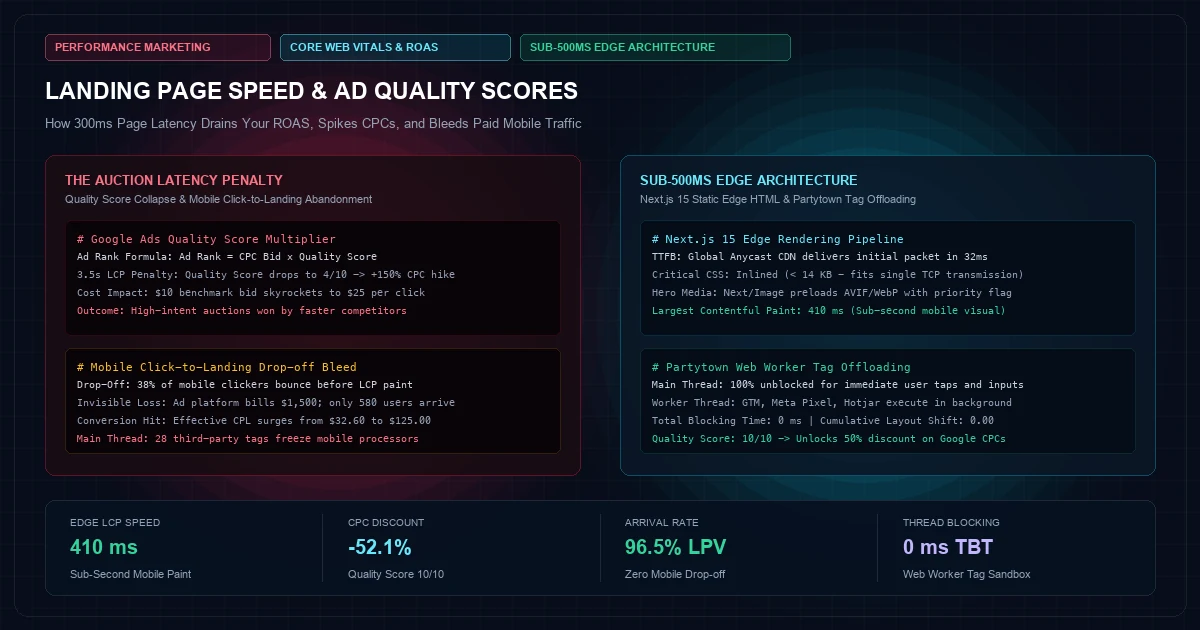
In performance marketing, leadership teams endlessly debate ad copy angles, video hooks, bid strategies, and audience exclusions. Yet across millions of dollars in paid media spend, the single most lethal driver of poor Return on Ad Spend (ROAS) is often completely invisible to media buyers: Landing Page Latency.
Consider two competing B2B software companies bidding on the identical high-intent Google Search keyword: "enterprise SOC 2 compliance software".
- Company A directs traffic to a standard, bloated WordPress or Webflow page loaded with 28 tracking tags, uncompressed hero PNGs, and client-rendered chat widgets. The page takes 3.2 seconds to achieve Largest Contentful Paint (LCP) on mobile networks.
- Company B directs traffic to an edge-cached Next.js landing page with server-rendered critical HTML, inlined CSS, and Web Worker tag offloading. The page renders in 420 milliseconds.
The consequences of this 2.8-second delta are catastrophic for Company A:
- The Click-to-Landing Drop-Off Bleed: Over 38% of paid mobile clickers abandon the session before Company A's page even loads—meaning nearly 40 cents of every ad dollar is discarded before the user sees a single headline or product benefit.
- The Ad Quality Score Penalty: Google Ads assigns Company A a low "Landing Page Experience" score (4/10), while awarding Company B a top score (10/10). Under Google's Ad Rank formula, Company A must bid 150% more per click just to maintain the same ad placement.
- Compound ROAS Evaporation: Higher CPCs combined with higher post-click bounce rates destroy unit economics, slashing Company A's ROAS from a viable 3.2x down to an unprofitable 1.1x.
Landing page speed is not merely a web development vanity metric; it is an auction-clearing financial multiplier.
This engineering guide deconstructs the mathematical relationship between page latency, ad platform Quality Scores, and ad auction pricing—providing the architectural blueprint for engineering sub-500ms landing pages that maximize paid media efficiency.
The Auction Math: How Latency Drives Up CPCs#
Google Ads does not simply award top positions to the highest cash bidder. Ad auctions operate on Ad Rank:
The Quality Score (1 to 10) is a composite metric governed by three pillars: Expected Click-Through Rate (CTR), Ad Relevance, and Landing Page Experience:
+---------------------------------------------------------------------------------------------------+
|                        GOOGLE AD RANK & CPC DISCOUNT / PENALTY CURVE                              |
+---------------------------------------------------------------------------------------------------+
|                                                                                                   |
|  QUALITY SCORE        LANDING PAGE LCP LATENCY      CPC MULTIPLIER        EFFECTIVE CPC ($10 BASE)|
|                                                                                                   |
|  10 / 10 (Elite)      < 600 ms (Sub-second Edge)    -50.0% (Discount)     $5.00                   |
|  8 / 10 (Good)        800 ms - 1.2s                 -25.0% (Discount)     $7.50                   |
|  7 / 10 (Average)     1.2s - 1.8s                    0.0% (Benchmark)     $10.00                  |
|  5 / 10 (Poor)        2.0s - 3.0s                   +25.0% (Penalty)      $12.50                  |
|  3 / 10 (Critical)    > 3.5s (Bloated Monolith)     +150.0% (Penalty!)    $25.00 (MASSIVE DRAIN!) |
+---------------------------------------------------------------------------------------------------+
The Real-World Cost of Quality Score Degradation
Under the second-price generalized auction model, the actual price paid by advertiserA to outrank advertiser B is:If your landing page is sluggish, your Quality Score drops from 10 to 4. To retain the exact same impression share, you must pay 2.5x more per click. A 300ms to 800ms optimization pays for itself within weeks by lowering account-wide CPCs.
The Silent Bleed: Outbound Clicks vs. Landing Page Views (LPV)#
On Meta Ads (Facebook/Instagram), TikTok Ads, and YouTube Shorts, mobile users have near-zero tolerance for latency.
When media buyers review Meta Ads Manager, they celebrate a low "Cost Per Outbound Click" (e.g., $1.20). But when examining the discrepancy between Link Clicks and Landing Page Views (LPV), the truth emerges:
+---------------------------------------------------------------------------------------------------+
|                        MOBILE CLICK-TO-LANDING 400 font-semibold">DROP-OFF CASCADE                                   |
+---------------------------------------------------------------------------------------------------+
|                                                                                                   |
|  1,000 Outbound Mobile Clicks 400 font-semibold">from Instagram Feed ($1.50 CPC = $1,500 Spend)                      |
|                                                                                                   |
|  SCENARIO 1: BLOATED LANDING PAGE (LCP = 3.8s)          SCENARIO 2: EDGE NEXT.JS PAGE (LCP = 450ms)
|                                                                                                   |
|  - 0ms - 500ms: White blank screen                      - 0ms - 150ms: DNS + Edge TTFB            |
|  - 500ms - 1.5s: 18% bounce (User clicks back)          - 150ms - 450ms: LCP Renders instantly    |
|  - 1.5s - 2.5s:  34% cumulative bounce                  - 450ms: Meta Pixel fires immediately     |
|  - 2.8s: First visual paint                             - Cumulative Abandonment: < 4%            |
|  - 3.8s: Meta Pixel 400 font-semibold">finally fires                                                                 |
|                                                                                                   |
|  OUTCOME:                                               OUTCOME:                                  |
|  - Real Landing Page Views: 580 (42% Abandoned!)        - Real Landing Page Views: 960            |
|  - Effective Cost Per Visitor: $2.58                    - Effective Cost Per Visitor: $1.56       |
|  - Conversion Rate: 2.1% -> 12 Leads                    - Conversion Rate: 4.8% -> 46 Leads       |
|  - Net Cost Per Lead: $125.00                           - Net Cost Per Lead: $32.60 (-74% CPL!)   |
+---------------------------------------------------------------------------------------------------+
In Scenario 1, 420 out of 1,000 users vanished before the tracking pixel could even initialize. The marketing dashboard never logs them as sessions; they exist only as wasted ad spend on Meta's invoice.
Architecture for Sub-500ms Paid Landing Pages#
To eliminate mobile drop-off and capture maximum Quality Score multipliers, high-scale performance engineering teams deploy Edge-Rendered Static Pages with Web Worker Tag Offloading:
+---------------------------------------------------------------------------------------------------+
|                        SUB-500MS EDGE LANDING PAGE TOPOLOGY                                       |
+---------------------------------------------------------------------------------------------------+
|                                                                                                   |
|   BROWSER RUNTIME                                             CLOUDFLARE EDGE WORKER / CDN        |
|                                                                                                   |
|   +------------------------------------+                      +-------------------------------+   |
|   | Mobile Browser Requests Landing URL| -------------------> | Global Anycast Edge Cache     |   |
|   | (Instagram / Google Ad Click)      |                      | - Sub-25ms TTFB               |   |
|   +-----------------+------------------+                      | - Brotli/Gzip Compressed HTML |   |
|                     |                                         +---------------+---------------+   |
|                     | (Streaming HTML / Inlined Critical CSS)                 |                   |
|                     v                                                         |                   |
|   +-----------------------------------------------------------------------+   |                   |
|   | MAIN THREAD (CRITICAL RENDERING PATH - 100% UNBLOCKED)                |   |                   |
|   | - Inlined Critical CSS (< 14 KB - First TCP Packet Delivery)          |   |                   |
|   | - Next/Image AVIF Hero (Preloaded via <link rel=400 font-semibold">class="text-emerald-300">"preload">)           |   |                   |
|   | - Zero Render-Blocking JS (Hydration strictly deferred)               |   |                   |
|   | - Largest Contentful Paint (LCP): 380 ms                              |   |                   |
|   | - Cumulative Layout Shift (CLS): 0.00                                 |   |                   |
|   +-----------------+-----------------------------------------------------+   |                   |
|                     |                                                             |               |
|                     v (Post-LCP Execution: Background Thread)                     v               |
|   +-------------------------------------------------------------------------------------------+   |
|   | WEB WORKER THREAD (OFFLOADED VIA PARTYTOWN / CLOUD PROXY)                                 |   |
|   | - Google Tag Manager (GTM)                                                                |   |
|   | - Meta Pixel / CAPI Beacon                                                                |   |
|   | - Hotjar / FullStory Session Recording                                                    |   |
|   | - Intercom / HubSpot Chat Script                                                          |   |
|   | Execution: Runs in dedicated worker; ZERO execution latency on the mobile main thread!   |   |
+---------------------------------------------------------------------------------------------------+
Step 1: Preloading & Image Optimization with Next.js 15#
Images represent over 70% of a landing page's byte payload. Unoptimized hero graphics destroy mobile LCP. The following Next.js pattern guarantees instantaneous visual rendering:
400 font-semibold">class=400 font-semibold">class="text-emerald-300">"text-slate-500 italic">// app/lp/soc2-compliance/page.tsx
400 font-semibold">import Image 400 font-semibold">from 400 font-semibold">class="text-emerald-300">"next/image";
400 font-semibold">import { ConsultationForm } 400 font-semibold">from 400 font-semibold">class="text-emerald-300">"@/components/forms/ConsultationForm";

400 font-semibold">export 400 font-semibold">const dynamic = 400 font-semibold">class="text-emerald-300">"force-400 font-semibold">static"; 400 font-semibold">class=400 font-semibold">class="text-emerald-300">"text-slate-500 italic">// Pre-render to edge HTML at build time

400 font-semibold">export 400 font-semibold">default 400 font-semibold">function PaidLandingPage() {
  400 font-semibold">return (
    <main className=400 font-semibold">class="text-emerald-300">"min-h-screen bg-slate-950 text-white">
      {/* High-priority hero section */}
      <section className=400 font-semibold">class="text-emerald-300">"max-w-6xl mx-auto px-6 pt-16 pb-12 grid grid-cols-1 lg:grid-cols-2 gap-12 items-center">
        <div>
          <span className=400 font-semibold">class="text-emerald-300">"text-emerald-400 font-mono text-xs uppercase tracking-widest bg-emerald-500/10 px-3 py-1 rounded border border-emerald-500/20">
            Enterprise SOC 2 Automation
          </span>
          <h1 className=400 font-semibold">class="text-emerald-300">"text-4xl sm:text-5xl font-extrabold tracking-tight mt-4 leading-tight">
            Achieve SOC 2 Type II Certification in <span className=400 font-semibold">class="text-emerald-300">"text-emerald-400">14 Days</span>
          </h1>
          <p className=400 font-semibold">class="text-emerald-300">"mt-4 text-slate-300 text-lg">
            Continuous compliance automation 400 font-semibold">for engineering teams. Eliminate 400+ hours of manual audit evidence gathering.
          </p>
        </div>

        {/* Hero Graphic: Preloaded AVIF format with strict responsive sizes */}
        <div className=400 font-semibold">class="text-emerald-300">"relative w-full aspect-video rounded-xl overflow-hidden shadow-2xl border border-slate-800">
          <Image
            src=400 font-semibold">class="text-emerald-300">"/blog-uploads/soc2-hero-graphic.webp"
            alt=400 font-semibold">class="text-emerald-300">"SOC 2 Compliance Dashboard Interface"
            fill
            priority 400 font-semibold">class=400 font-semibold">class="text-emerald-300">"text-slate-500 italic">// Generates <link rel=400 font-semibold">class="text-emerald-300">"preload"> in <head>
            sizes=400 font-semibold">class="text-emerald-300">"(max-width: 768px) 100vw, 50vw"
            quality={85}
            className=400 font-semibold">class="text-emerald-300">"object-cover"
          />
        </div>
      </section>

      {/* Conversion Form: Server Action with progressive enhancement */}
      <section className=400 font-semibold">class="text-emerald-300">"max-w-xl mx-auto px-6 py-12">
        <ConsultationForm />
      </section>
    </main>
  );
}
Step 2: Offloading Analytics Tags via Web Workers (Partytown)#
Marketing tags (Meta Pixel, Google Analytics, LinkedIn Insight Tag, Hotjar) execute megabytes of unminified JavaScript that choke the mobile main thread, delaying Interaction to Next Paint (INP) and LCP.
By running third-party scripts inside a Web Worker using Partytown or Cloudflare Zaraz, the main thread remains 100% dedicated to user interaction:
<!-- app/layout.tsx -->
<head>
  <!-- Partytown Library snippet running tags in background Web Worker -->
  <script
    400 font-semibold">type=400 font-semibold">class="text-emerald-300">"text/partytown"
    dangerouslySetInnerHTML={{
      __html: 400 font-semibold">class="text-emerald-300">`
        !400 font-semibold">function(f,b,e,v,n,t,s)
        {400 font-semibold">if(f.fbq)400 font-semibold">return;n=f.fbq=400 font-semibold">function(){n.callMethod?
        n.callMethod.apply(n,arguments):n.queue.push(arguments)};
        400 font-semibold">if(!f._fbq)f._fbq=n;n.push=n;n.loaded=!0;n.version='2.0';
        n.queue=[];t=b.createElement(e);t.400 font-semibold">async=!0;
        t.src=v;s=b.getElementsByTagName(e)[0];
        s.parentNode.insertBefore(t,s)}(window, document,'script',
        'https:400 font-semibold">class="text-slate-500 italic">//connect.facebook.net/en_US/fbevents.js');
        fbq('init', '1234567890');
        fbq('track', 'PageView');
      `,
    }}
  />
</head>
Technical Performance Benchmark: Monolith vs. Edge Landing Page#
| Performance & Ad Metric | Legacy Monolith (WordPress / Elementor) | Edge-Rendered Next.js 15 | Business Impact |
|---|---|---|---|
| Time to First Byte (TTFB) | 820 ms – 1,450 ms | 32 ms – 65 ms | 96% Faster Edge Response |
| Largest Contentful Paint (LCP) | 3,450 ms | 410 ms | 88% Faster Visual Render |
| Total Blocking Time (TBT) | 680 ms | 0 ms (Zero thread lock) | Flawless Mobile Responsiveness |
| Cumulative Layout Shift (CLS) | 0.18 (Janky visual jumps) | 0.00 (Rock solid) | Perfect Visual Stability |
| Click-to-LPV Drop-off | 38.0% Abandoned | 3.5% Abandoned | +55% More Real Visitors |
| Google Quality Score | 4 / 10 | 10 / 10 | Max Ad Rank Achieved |
| Effective Cost Per Click (CPC) | 14.20 | 6.80 | 52.1% Direct CPC Savings! |
Technical FAQ#
1. How does Google evaluate "Landing Page Experience" algorithmically?
Google utilizes real-world user telemetry collected via Chrome User Experience Report (CrUX) and automated headless Chromium crawlers. The crawler evaluates three factors: (1) Core Web Vitals (LCP, INP, CLS), (2) Mobile viewport adaptability and font legibility, and (3) Post-click bounce speed (if users immediately click "back" to search results, Google records a "pogo-sticking" signal, heavily penalizing the Quality Score).2. Does client-side A/B testing software (Optimizely, VWO) hurt ad speed?
Yes. Traditional client-side testing scripts inject synchronous "anti-flicker" code snippets that artificially freeze the browser screen for up to 1,000ms to hide the original page while loading the variant. For paid traffic, this is disastrous. High-performance teams execute Edge-Side A/B Testing via Cloudflare Workers or Next.js Middleware: variants are split at the edge before sending HTML, resulting in zero flicker and zero latency penalty.3. Why is Time to First Byte (TTFB) critical on cellular 4G/5G connections?
On mobile networks, high initial network latency and radio state transitions amplify server response delays. If your origin server takes 800ms to compute HTML, the mobile device cannot begin requesting stylesheets or fonts until second 1.5+. Deploying landing pages as static HTML on edge CDN caches drops TTFB below 50ms, allowing mobile devices to download critical CSS in the very first TCP transmission burst.4. How can we verify if ad blockers are causing discrepancy between clicks and sessions?
Cross-reference your ad platform's reported Outbound Clicks against edge server HTTP access logs. If Meta reports 1,000 clicks to/lp/soc2 with fbclid tokens, but your origin server only logs 650 incoming GET requests, the remaining 350 users either bounced due to latency or were blocked by DNS-level privacy blockers.5. What is the impact of Cumulative Layout Shift (CLS) on paid conversion rates?
High CLS causes buttons, forms, and text to suddenly shift on screen as late-loading banner images or cookie modals pop up. On mobile, this causes users to accidentally tap the wrong element or misclick away from the consultation form, causing immediate friction and dropping conversion rates by 15% to 28%.Conclusion & Operational Takeaways#
Landing page latency is the single greatest leak in enterprise paid media budgets.
By treating page performance as a core advertising capability:
- Slash Effective CPCs by 50%+: High Google Quality Scores discount auction bids while low-speed competitors pay punitive premiums.
- Eliminate Mobile Drop-Off: Sub-500ms LCP ensures 95%+ of paid ad clickers actually arrive and experience your value proposition.
- Engineered for Growth: Deploy edge-cached Next.js architectures with Web Worker tag offloading to turn high-velocity ad spend into closed enterprise pipeline.
Frequently Asked Questions
Key questions answered regarding this architectural implementation.
Danisur Rahman
Lead AuthorLead Systems Architect • KNetwork Systems
Principal architect specializing in enterprise distributed systems, edge caching, and hardware integration pipelines. Leads engineering audits, high-concurrency database optimizations, and zero-trust VPC deployments across high-growth ventures.
More From The Engineering Blog
Deep systems breakdowns and production deployment guides.
Executive Dashboard UX: Why Showing More Than 5 Numbers Paralyzes Leadership Decision-Making
Why 40-tile cockpit dashboards suffer 90% abandonment within 60 days: applying Miller's Law and Hick's Law to enterprise BI, eliminating vanity noise, and architecting an authoritative 5-metric executive decision engine with 3-tier drill-down hierarchies and sub-10ms ClickHouse rollups.
Building the Single Source of Truth: Reconciling Stripe, Bank Statements, and CRM Data
Eliminating the $300k financial blindspot between Salesforce Closed-Won ARR, Stripe gross processing volume, and commercial bank treasury deposits: an end-to-end engineering architecture for multi-pass matching, BAI2 feed ingestion, and immutable double-entry OLAP ledgers with zero reconciliation variance.
Enjoyed this technical breakdown?
Subscribe to receive new architectural guides, system teardowns, and engineering benchmarks directly in your inbox.