Optimizing B2B Cost Per Opportunity: Moving Beyond Low-Quality Form Fill Optimizations
Why shallow form-fill optimizations produce cheap vanity leads that destroy sales productivity: architecting closed-loop Value-Based Bidding (VBB), edge DNS MX corporate email validation, and automated Google Ads API offline conversion pipelines that slash true Cost Per Opportunity by 75%.
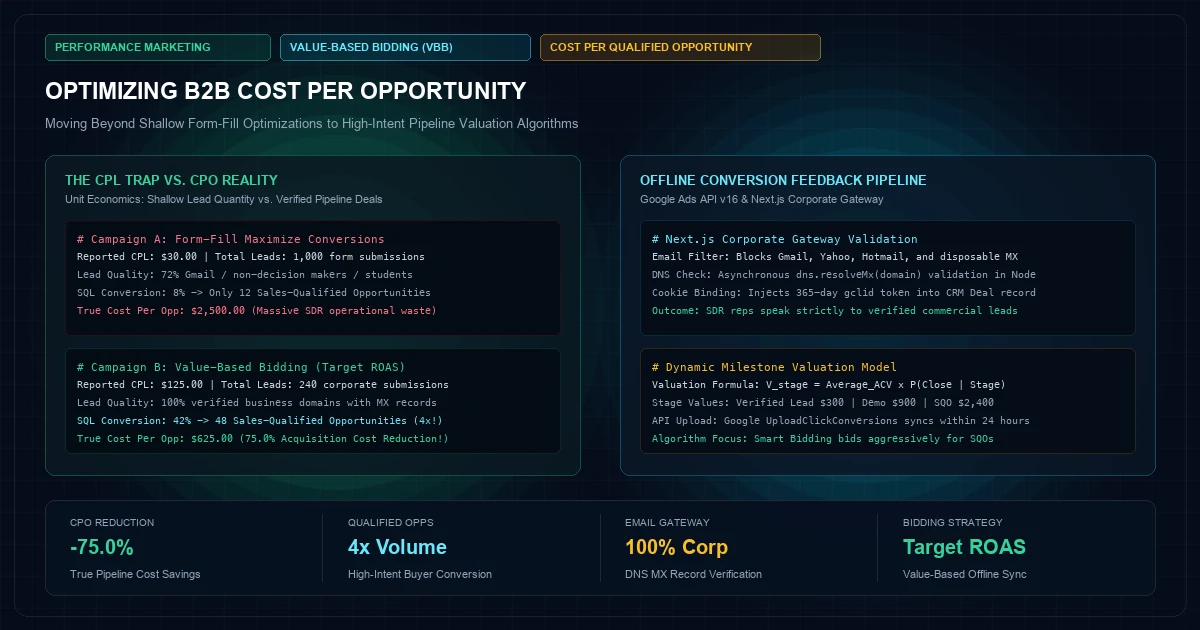
In B2B performance marketing, there is a dangerous metric that gives marketing teams a false sense of triumph while driving sales departments to exhaustion: Cost Per Lead (CPL).
A digital marketing agency or internal growth team launches campaigns across Google Ads, LinkedIn Ads, and Meta Ads. Within weeks, the dashboard shows glowing numbers: Cost Per Lead dropped from 120 to 28, and total monthly form submissions surged to 1,200 leads.
Yet two months later, the quarterly executive review reveals a catastrophe:
- Over 70% of submitted leads used free personal webmail addresses (
@gmail.com,@yahoo.com) or disposable burner domains. - Sales Development Reps (SDRs) spent hundreds of hours calling disconnected phone numbers and scheduling calls with students, consultants, or unqualified hobbyists.
- Qualified pipeline created from paid media dropped by 35%, and the true Cost Per Sales-Qualified Opportunity (CPO) surged past $4,500.
This collapse occurs because machine learning bidding algorithms are literal optimization engines: they deliver precisely what you program them to seek.
When an advertising platform’s bidding model (Google Smart Bidding or Meta Advantage+) is configured to maximize standard form submissions, its neural network hunts for the cheapest users in the auction who have a statistical propensity to submit forms. In practice, this optimizes for students downloading PDF whitepapers, competitors conducting market research, and non-buyers with low opportunity costs of time.
To build an efficient, scalable B2B growth engine, enterprise software companies must eliminate top-of-funnel form-fill bidding. Instead, they must deploy Closed-Loop Value-Based Bidding (VBB) optimized strictly for Cost Per Sales-Qualified Opportunity (CPO).
This architectural guide details how to engineer the offline conversion data pipeline, implement edge email qualification barriers, and feed downstream CRM pipeline milestones back into advertising algorithms.
The Anatomy of the CPL Mirage vs. CPO Reality#
To understand why low CPL undermines enterprise revenue, we must examine the economics of downstream sales velocity:
+---------------------------------------------------------------------------------------------------+
|                        THE B2B CONVERSION FUNNEL METRIC DIVIDE                                   |
+---------------------------------------------------------------------------------------------------+
|                                                                                                   |
|  CAMPAIGN A: FORM-FILL OPTIMIZATION (SHALLOW TARGETING)                                           |
|  - Monthly Ad Spend:         $30,000                                                             |
|  - Form Submissions (Leads): 1,000 leads                                                          |
|  - Reported Cost Per Lead:   $30.00 (Looks Amazing on Marketing Slides!)                         |
|  - MQL to SQL Conversion:    8% (920 unqualified leads, fake phone numbers, Gmails)              |
|  - Qualified Opportunities:  12 Opportunities Created                                            |
|  - TRUE COST PER OPPORTUNITY: $2,500.00 per Sales-Qualified Deal                                  |
|  - SDR Operational Waste:    180 hours spent filtering spam leads                                |
|                                                                                                   |
|                                         vs                                                        |
|                                                                                                   |
|  CAMPAIGN B: VALUE-BASED CPO OPTIMIZATION (DEEP PIPELINE BIDDING)                                 |
|  - Monthly Ad Spend:         $30,000                                                             |
|  - Form Submissions (Leads): 240 leads (Filtered & Gated Corporate Domains)                       |
|  - Reported Cost Per Lead:   $125.00 (4.1x Higher CPL!)                                           |
|  - MQL to SQL Conversion:    42% (High-intent corporate executives)                              |
|  - Qualified Opportunities:  48 Opportunities Created                                            |
|  - TRUE COST PER OPPORTUNITY: $625.00 per Sales-Qualified Deal (75.0% CPO REDUCTION!)             |
|  - SDR Operational Waste:    Near Zero (SDRs speak only to verified enterprise buyers)            |
+---------------------------------------------------------------------------------------------------+
Campaign B spends the identical 30,000, reports a seemingly "worse" CPL of 125, but generates 4x more qualified enterprise opportunities, collapsing actual acquisition costs by 75%.
End-to-End Value-Based Bidding Pipeline Architecture#
To train algorithmic bidding engines to pursue enterprise decision-makers rather than form-fill clickbait, the architecture deploys an offline conversion feedback loop:
+---------------------------------------------------------------------------------------------------+
|                        OFFLINE CONVERSION FEEDBACK PIPELINE (VBB)                                 |
+---------------------------------------------------------------------------------------------------+
|                                                                                                   |
|   1. VISITOR CAPTURE (EDGE GATEWAY)                                                               |
|   Visitor lands 400 font-semibold">from Google Search (gclid) or LinkedIn (li_fat_id)                                |
|   -> Next.js Edge Middleware stores click token in 365-day first-party HttpOnly cookie            |
|                                                                                                   |
|                                         |                                                         |
|                                         v                                                         |
|   2. CORPORATE IDENTITY GATEWAY (SERVER COMPONENT)                                                |
|   Contact form submitted:                                                                         |
|   - Regex & MX 400">Record validation: DENIES @gmail, @yahoo, @hotmail, @proton                        |
|   - Reverse-IP Enrichment (Clearbit / ZoomInfo API): Matches IP to B2B Company Domain             |
|   - Synthetic Event Value Assigned: $50 (Corporate Verified Lead)                                 |
|                                                                                                   |
|                                         |                                                         |
|                                         v                                                         |
|   3. CRM MILESTONE PROGRESSION (HUBSPOT / SALESFORCE)                                             |
|   - Stage 1: Discovery Demo Held              -> Value Assigned: $250                             |
|   - Stage 2: Technical Evaluation (SQO)       -> Value Assigned: $1,500 (MILESTONE TRIGGER!)      |
|   - Stage 3: Closed-Won Enterprise Contract   -> Value Assigned: $12,000 (Actual ACV)             |
|                                                                                                   |
|                                         |                                                         |
|                                         v (Outbound Server-to-Server Webhook)                     |
|   4. OFFLINE CONVERSION SYNC ENGINE (NODE.JS / PYTHON)                                            |
|   Transforms CRM stage changes into Google Ads API / LinkedIn CAPI payloads:                      |
|   - Maps 400 font-semibold">class="text-emerald-300">`gclid` token to conversion action 400 font-semibold">class="text-emerald-300">`B2B_Sales_Qualified_Opportunity`                     |
|   - Injects conversion value: $1,500.00                                                           |
|                                                                                                   |
|                                         |                                                         |
|                                         v                                                         |
|   5. ALGORITHMIC BIDDING OPTIMIZATION                                                             |
|   Google Smart Bidding (Target ROAS) adjusts neural network weights:                              |
|   - Shifts budget away 400 font-semibold">from generic keywords yielding cheap Gmail leads                           |
|   - Aggressively raises bids 400 font-semibold">for high-intent technical search auctions that yield $1,500 SQOs    |
+---------------------------------------------------------------------------------------------------+
Step 1: Enforcing Edge Corporate Email & Identity Validation#
The fastest way to eliminate low-quality form submissions is to prevent non-corporate users from completing the lead form at the edge. The server-side submission handler evaluates email domain credibility before recording the lead:
400 font-semibold">class=400 font-semibold">class="text-emerald-300">"text-slate-500 italic">// app/actions/validate-b2b-lead.ts
400 font-semibold">class="text-emerald-300">"use server";

400 font-semibold">import dns 400 font-semibold">from 400 font-semibold">class="text-emerald-300">"dns/promises";

400 font-semibold">const BLOCKED_DOMAINS = 400 font-semibold">new 400">Set([
  400 font-semibold">class="text-emerald-300">"gmail.com", 400 font-semibold">class="text-emerald-300">"yahoo.com", 400 font-semibold">class="text-emerald-300">"hotmail.com", 400 font-semibold">class="text-emerald-300">"outlook.com", 400 font-semibold">class="text-emerald-300">"icloud.com",
  400 font-semibold">class="text-emerald-300">"aol.com", 400 font-semibold">class="text-emerald-300">"proton.me", 400 font-semibold">class="text-emerald-300">"protonmail.com", 400 font-semibold">class="text-emerald-300">"zoho.com", 400 font-semibold">class="text-emerald-300">"mail.com", 400 font-semibold">class="text-emerald-300">"gmx.com"
]);

400 font-semibold">export 400 font-semibold">async 400 font-semibold">function validateCorporateLead(formData: FormData) {
  400 font-semibold">const email = (formData.get(400 font-semibold">class="text-emerald-300">"workEmail") as 400">string).toLowerCase().trim();
  400 font-semibold">const domain = email.split(400 font-semibold">class="text-emerald-300">"@")[1];

  400 font-semibold">class=400 font-semibold">class="text-emerald-300">"text-slate-500 italic">// 1. Block consumer free webmail providers
  400 font-semibold">if (!domain || BLOCKED_DOMAINS.has(domain)) {
    400 font-semibold">return {
      isValid: 400">false,
      error: 400 font-semibold">class="text-emerald-300">"Please enter your official corporate business email address (e.g. name@company.com)."
    };
  }

  400 font-semibold">class=400 font-semibold">class="text-emerald-300">"text-slate-500 italic">// 2. Validate DNS MX (Mail Exchange) record existence
  400 font-semibold">try {
    400 font-semibold">const mxRecords = 400 font-semibold">await dns.resolveMx(domain);
    400 font-semibold">if (!mxRecords || mxRecords.length === 0) {
      400 font-semibold">return { isValid: 400">false, error: 400 font-semibold">class="text-emerald-300">"The provided email domain cannot receive incoming mail." };
    }
  } 400 font-semibold">catch (err) {
    400 font-semibold">return { isValid: 400">false, error: 400 font-semibold">class="text-emerald-300">"Invalid corporate domain. Please verify your email." };
  }

  400 font-semibold">return { isValid: 400">true, domain };
}
Step 2: Milestone Valuation Modeling for Offline Bidding#
To train Google Ads Target ROAS (tROAS) or Meta Value Optimization, every stage of the sales pipeline is assigned a mathematically calculated expected monetary value:
+---------------------------------------------------------------------------------------------------+
|                        PIPELINE MILESTONE VALUATION MODEL                                         |
+---------------------------------------------------------------------------------------------------+
|                                                                                                   |
|  Assumptions: Average Contract Value (ACV) = $60,000 | Target Blended Margin = 70%                |
|                                                                                                   |
|  FUNNEL STAGE                  HISTORICAL WIN RATE    CALCULATED VALUE    OFFLINE EVENT NAME      |
|  1. Verified Corporate Lead    5% win rate            $300.00             corporate_lead_verified |
|  2. Discovery Demo Completed   15% win rate           $900.00             discovery_call_completed|
|  3. Sales-Qualified Opp (SQO)  40% win rate           $2,400.00           sales_qualified_opp     |
|  4. Security Review Approved   75% win rate           $4,500.00           security_review_passed  |
|  5. Closed-Won Contract Signed 100% win rate          $60,000.00          deal_closed_won         |
+---------------------------------------------------------------------------------------------------+
The Dynamic Valuation Formula
The synthetic valueV_{stage} fed to the ad network is defined as:When an ad set generates an impression that progresses to Stage 3 (Sales-Qualified Opportunity), the offline sync immediately fires an event with value $2,400. The ad platform's bidding algorithm treats this user as 48x more valuable than a user who merely submitted a generic form.
Step 3: Google Ads Offline Conversion Upload Implementation#
The following Python microservice consumes CRM stage changes and transmits them directly to the Google Ads API v16 via the UploadClickConversions endpoint:
400 font-semibold">class=400 font-semibold">class="text-emerald-300">"text-slate-500 italic">#!/usr/bin/env python3
400 font-semibold">class="text-emerald-300">""400 font-semibold">class="text-emerald-300">"
google_ads_offline_sync.py
Uploads offline CRM opportunity milestones to Google Ads 400 font-semibold">for Value-Based Bidding.
"400 font-semibold">class="text-emerald-300">""

400 font-semibold">from google.ads.googleads.client 400 font-semibold">import GoogleAdsClient
400 font-semibold">from google.ads.googleads.errors 400 font-semibold">import GoogleAdsException
400 font-semibold">import datetime

400 font-semibold">def upload_opportunity_conversion(
    client: GoogleAdsClient,
    customer_id: str,
    conversion_action_id: str,
    gclid: str,
    conversion_value: float,
    conversion_time: str
):
    conversion_upload_service = client.get_service(400 font-semibold">class="text-emerald-300">"ConversionUploadService")
    click_conversion = client.get_type(400 font-semibold">class="text-emerald-300">"ClickConversion")

    400 font-semibold">class=400 font-semibold">class="text-emerald-300">"text-slate-500 italic"># Target conversion action configured 400 font-semibold">for Target ROAS
    click_conversion.conversion_action = (
        f400 font-semibold">class="text-emerald-300">"customers/{customer_id}/conversionActions/{conversion_action_id}"
    )
    click_conversion.gclid = gclid
    click_conversion.conversion_value = conversion_value
    click_conversion.currency_code = 400 font-semibold">class="text-emerald-300">"USD"
    click_conversion.conversion_date_time = conversion_time

    400 font-semibold">try:
        response = conversion_upload_service.upload_click_conversions(
            customer_id=customer_id,
            conversions=[click_conversion],
            partial_failure=True,
        )
        print(f400 font-semibold">class="text-emerald-300">"Successfully uploaded CPO milestone: {gclid} | Value: ${conversion_value}")
        400 font-semibold">return response
    except GoogleAdsException as ex:
        print(f400 font-semibold">class="text-emerald-300">"Google Ads API Error: {ex}")
        raise
Technical FAQ#
1. Why shouldn't B2B marketers optimize directly for Closed-Won deals instead of Opportunities?
Closed-Won deals represent the ultimate truth, but in enterprise B2B sales cycles (lasting 6 to 18 months), deal volume is too sparse and latency is too long for machine learning algorithms. If a campaign generates only 2 closed deals a month, the algorithm receives feedback too late to adjust weekly bids. Sales-Qualified Opportunities (SQO) occur within 7 to 21 days of initial click, providing the perfect balance of high statistical frequency and authentic commercial qualification.2. How do you handle Google Ads visitors who convert via telephone or outbound SDR booking?
When an enterprise prospect browses the website, dynamic number insertion (DNI) displays a unique phone number linked to the visitor's sessiongclid. When the prospect calls, the telephony gateway (Twilio / CallRail) captures the gclid and records it directly in the CRM contact record, ensuring offline sales calls preserve end-to-end attribution.3. What if a lead submits a corporate email from an unlisted startup or domain without MX records?
Legitimate corporate domains always maintain active MX records to receive email. If a domain lacks MX records, the submission is an invalid or mistyped address. The edge validation script provides instant, helpful UI feedback ("Domain cannot receive email. Please verify spelling"), preventing typos from destroying lead handoffs.4. How does Value-Based Bidding affect ad account Cost Per Click (CPC)?
When transitioning from Maximize Conversions (form fills) to Target ROAS (CPO), average CPC typically rises by 25% to 50%. This is expected and healthy: the algorithm stops bidding on low-cost, unqualified searchers and deliberately bids higher to win the impressions of verified corporate executives who command higher auction competition.5. How does LinkedIn Conversions API (CAPI) compare to Google Ads for offline opportunity uploads?
LinkedIn CAPI operates on similar principles, utilizing hashed email (SHA-256) and the li_fat_id first-party click identifier. LinkedIn allows advertisers to configure custom conversion definitions for "Opportunity Created" and "Pipeline Generated", training the platform's Matched Audiences and predictive demographic algorithms to find similar corporate titles and company size tiers.Conclusion & Operational Blueprint#
Optimizing for form fills is an outdated relic of consumer lead generation. Enterprise B2B software companies scale predictably by shifting to Cost Per Opportunity:
- Gate Forms with Corporate Validation: Block consumer webmail and verify DNS MX records to eliminate SDR lead qualification fatigue.
- Assign Algorithmic Values to Pipeline Milestones: Model historical win rates to assign synthetic dollar values to Opportunities ($1,500+) rather than generic leads.
- Automate Offline Conversion Ingestion: Stream CRM milestone webhooks into Google Ads API and LinkedIn CAPI, training auction algorithms to hunt for real pipeline revenue.
Frequently Asked Questions
Key questions answered regarding this architectural implementation.
Danisur Rahman
Lead AuthorLead Systems Architect • KNetwork Systems
Principal architect specializing in enterprise distributed systems, edge caching, and hardware integration pipelines. Leads engineering audits, high-concurrency database optimizations, and zero-trust VPC deployments across high-growth ventures.
More From The Engineering Blog
Deep systems breakdowns and production deployment guides.
Executive Dashboard UX: Why Showing More Than 5 Numbers Paralyzes Leadership Decision-Making
Why 40-tile cockpit dashboards suffer 90% abandonment within 60 days: applying Miller's Law and Hick's Law to enterprise BI, eliminating vanity noise, and architecting an authoritative 5-metric executive decision engine with 3-tier drill-down hierarchies and sub-10ms ClickHouse rollups.
Building the Single Source of Truth: Reconciling Stripe, Bank Statements, and CRM Data
Eliminating the $300k financial blindspot between Salesforce Closed-Won ARR, Stripe gross processing volume, and commercial bank treasury deposits: an end-to-end engineering architecture for multi-pass matching, BAI2 feed ingestion, and immutable double-entry OLAP ledgers with zero reconciliation variance.
Enjoyed this technical breakdown?
Subscribe to receive new architectural guides, system teardowns, and engineering benchmarks directly in your inbox.