The Hidden Cost of SaaS Seat Pricing: Why Custom Internal Portals Save 60%+ at Scale
An architectural and financial analysis of commercial SaaS seat-licensing traps versus dedicated internal portals: why mid-market enterprises bleed margin on seat taxes, and how a modern custom stack (PostgreSQL, Laravel 11, Next.js 14) slashes 3-year TCO by over 60%.
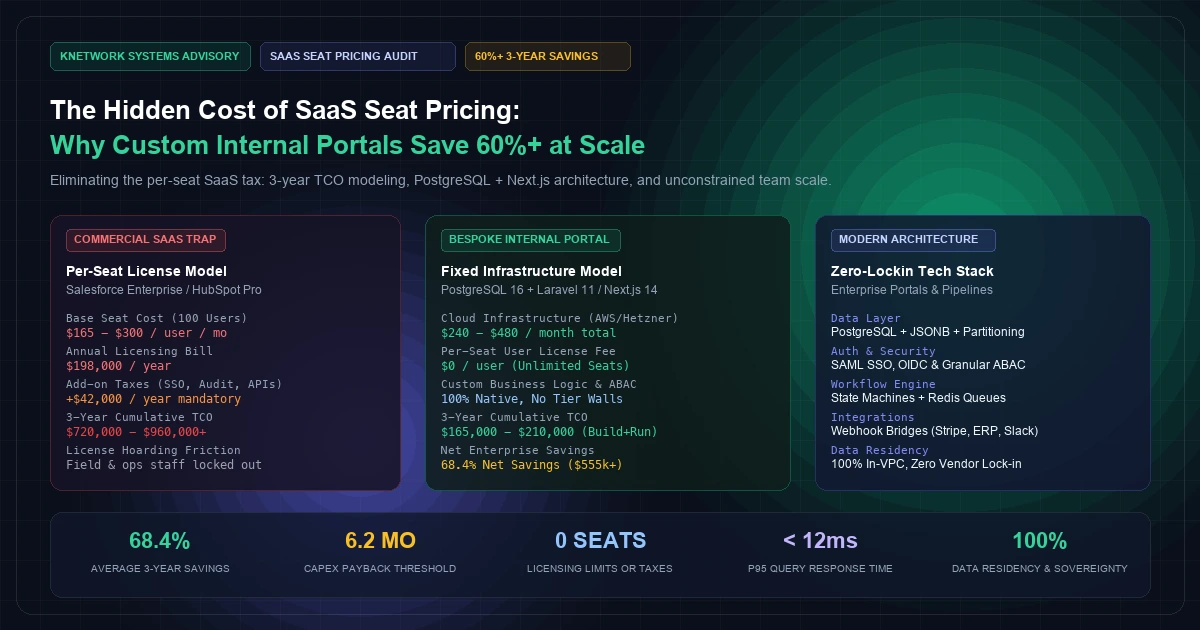
In early-stage growth, commercial Software-as-a-Service (SaaS) platforms like Salesforce, HubSpot, Zendesk, or Monday.com are indispensable. They allow founders and sales managers to launch a functioning CRM or ticketing pipeline in forty-five minutes using a credit card.
However, as headcounts expand beyond fifty employees, commercial SaaS licensing ceases to be an operational accelerator. Instead, it becomes an escalating balance sheet tax.
The standard commercial SaaS business model relies on per-seat subscription pricing. When an enterprise scales from 25 to 100 or 250 employees, software costs do not scale with the computational resources consumed, database reads performed, or transactions processed. Costs scale strictly with human payroll.
Worse, commercial SaaS vendors deliberately gate foundational enterprise capabilities—such as Single Sign-On (SAML/SSO), granular Attribute-Based Access Control (ABAC), full field audit histories, and uncapped API throughput—behind top-tier "Enterprise" plans. A business often discovers that upgrading 100 sales and operations users from 50/user/month to 165–$300/user/month is mandatory simply to pass a routine SOC 2 compliance audit.
This architectural analysis dissects the multi-year Total Cost of Ownership (TCO) of commercial per-seat SaaS platforms against bespoke internal business portals built on modern open standards. We examine the math of the "Seat Tax," analyze the structural rigidity bottlenecks of off-the-shelf software, provide a production-ready reference architecture using PostgreSQL 16, Laravel 11, and Next.js 14, and demonstrate why mid-market enterprises save over 60% within 36 months by owning their internal core.
[Visual Asset: Architecture Schematic - Enterprise Bespoke Business Portal Architecture vs Commercial SaaS Silo]
flowchart TD
    subgraph COMMERCIAL_SAAS_TRAP [400 font-semibold">class="text-emerald-300">"The Commercial SaaS Seat Tax Dilemma"]
        direction TB
        C_USERS[400 font-semibold">class="text-emerald-300">"100 - 250+ Internal Employees\n(Sales, Ops, Logistics, Support, Execs)"]
        C_TAX[400 font-semibold">class="text-emerald-300">"Per-Seat Monthly Paywall\n($165 - $300 / user / month)"]
        C_SILO[400 font-semibold">class="text-emerald-300">"Proprietary Multi-Tenant Cloud\n(Gated SAML, Rate-Limited APIs, Vendor Lock-in)"]
        C_BILL[400 font-semibold">class="text-emerald-300">"$198,000 - $900,000+ Annual Software Bill\nNo Proprietary Asset Creation"]

        C_USERS --> C_TAX --> C_SILO --> C_BILL
    end

    subgraph CUSTOM_PORTAL_ARCHITECTURE [400 font-semibold">class="text-emerald-300">"Modern Bespoke Enterprise Portal (Fixed Cloud Infrastructure)"]
        direction TB
        P_USERS[400 font-semibold">class="text-emerald-300">"Unlimited Internal & Partner Users\n(Zero Marginal Cost per Seat)"]

        subgraph INGRESS_SECURITY [400 font-semibold">class="text-emerald-300">"Edge & Identity Layer"]
            IDP[400 font-semibold">class="text-emerald-300">"Corporate Identity Provider\n(Okta, Azure AD, Google Workspace SAML)"]
            GATEWAY[400 font-semibold">class="text-emerald-300">"Edge Reverse Proxy / Cloudflare Zero Trust"]
            P_USERS --> GATEWAY
            GATEWAY <--> IDP
        end

        subgraph APP_CORE [400 font-semibold">class="text-emerald-300">"Core Application & API Layer"]
            SSR[400 font-semibold">class="text-emerald-300">"Next.js 14 App Router\n(SSR, Server Actions, Optimistic UI)"]
            API[400 font-semibold">class="text-emerald-300">"Laravel 11 / Node High-Velocity API\n(Stateless Workers, Strict ABAC Engine)"]
            QUEUE[400 font-semibold">class="text-emerald-300">"Redis 7 Cluster\n(Asynchronous Job Queues & Webhook Dispatchers)"]

            GATEWAY --> SSR
            SSR <--> API
            API <--> QUEUE
        end

        subgraph DATA_PERSISTENCE [400 font-semibold">class="text-emerald-300">"Sovereign Data Layer (In-VPC)"]
            PG[(400 font-semibold">class="text-emerald-300">"PostgreSQL 16 Enterprise Cluster\n(Partitioned Audit Logs, JSONB Dynamic Schema)")]
            BLOB[(400 font-semibold">class="text-emerald-300">"Encrypted S3 / MinIO Blob Storage\n(Documents, Contracts, Attachments)")]

            API <--> PG
            API <--> BLOB
        end

        subgraph INTEGRATIONS [400 font-semibold">class="text-emerald-300">"Event-Driven Webhook Bridges (Zero Seat Cost)"]
            STRIPE[400 font-semibold">class="text-emerald-300">"Stripe Billing & Invoicing Engine"]
            ERP[400 font-semibold">class="text-emerald-300">"ERP / Inventory Core (SAP, NetSuite)"]
            COMMS[400 font-semibold">class="text-emerald-300">"Twilio SMS & SendGrid Transactional"]

            QUEUE <--> STRIPE
            QUEUE <--> ERP
            QUEUE <--> COMMS
        end
    end
+---------------------------------------------------------------------------------------------------------+
|                                    BESPOKE ENTERPRISE PORTAL TOPOLOGY                                   |
+---------------------------------------------------------------------------------------------------------+
|                                                                                                         |
|  [ Internal Staff ]      [ Remote Field Staff ]      [ Partner Portals ]     [ Exec Leadership ]         |
|         │                        │                           │                       │                  |
|         └────────────────────────┴─────────────┬─────────────┴───────────────────────┘                  |
|                                                ▼                                                        |
|                           [ Corporate SAML / OIDC Identity Provider ]                                   |
|                                                │                                                        |
|                                                ▼                                                        |
|                     [ Next.js 14 Web Portal / React Server Components ]                                 |
|                               (Sub-50ms SSR, Responsive UI, ABAC)                                       |
|                                                │                                                        |
|                                                ▼                                                        |
|                 [ Laravel 11 / Node.js High-Throughput REST & RPC API Core ]                            |
|                     ┌──────────────────────────┴──────────────────────────┐                             |
|                     ▼                                                     ▼                             |
|       [ Redis 7 Horizon Queue Broker ]                    [ PostgreSQL 16 High-Availability ]          |
|        - Stripe / Banking Webhooks                         - Relational Entities (Orgs, Deals)          |
|        - External ERP Event Sync                           - Dynamic JSONB Field Storage                |
|        - Asynchronous Email/SMS Triggers                   - Partitioned Immutable Audit Logs           |
|                                                                                                         |
+---------------------------------------------------------------------------------------------------------+
| ECONOMIC FOOTPRINT: Fixed $240 - $480/month Infrastructure Cost | Unlimited Seats | Zero Tier Tax      |
+---------------------------------------------------------------------------------------------------------+
1. The SaaS Seat Tax: The Exponential Licensing Trap#
Per-seat pricing creates a perverse operational dynamic inside growing companies: license rationing.
When a software platform charges 150 to 300 per seat per month, leadership treats licenses as capital assets rather than productivity utilities. The consequences ripple throughout daily operations:
The Operational Symptoms of License Rationing:#
- The Shared Login Hazard: Field technicians, junior support staff, or finance assistants are assigned shared
sales-support@company.comaccounts to avoid purchasing additional seats. This destroys individual auditability, violates SOC 2 and ISO 27001 access controls, and introduces severe account compromise risks. - Cross-Departmental Data Blindness: Operations and product teams are denied direct access to customer interaction records. When a customer reports a critical delivery bottleneck or billing defect, support engineers must export CSV spreadsheets or send Slack messages to licensed account executives, introducing multi-hour communication latency.
- The "Feature Tier Ransom": Commercial CRM vendors rarely sell their base product at scale. The base tier deliberately omits core governance tools:
- Single Sign-On (SAML/SSO) requires an immediate jump from "Pro" (
50/user) to "Enterprise" (165+/user). - Detailed event audit histories (who changed a contract discount from 10% to 40%?) are gated behind expensive security add-ons.
- API call rate limits (e.g., 25,000 daily calls) choke automated data pipelines unless the enterprise purchases expensive API pack expansions (
500–1,500/month per pack).
The Inherent Misalignment of Incentives:#
A commercial CRM vendor is incentivized to optimize for vendor retention and license expansion, not operational efficiency. They build complex user interfaces that maximize daily active user (DAU) dwell time, introduce proprietary workflow builders that lock down your logic, and charge hefty penalties if your business attempts to extract its historical records in bulk.In contrast, a custom internal portal is designed for transactional throughput: automated lead routing, deterministic approval state machines, and interfaces stripped of bloat so operators can complete tasks in seconds without software friction.
2. The Cold Math: 3-Year Total Cost of Ownership (TCO) Breakdown#
To understand the financial inflection point, let us examine the numbers.
Consider a mid-market services or logistics enterprise operating with 100 internal users (combining account executives, SDRs, operations managers, customer support reps, and executive leadership).
We compare a standard commercial SaaS deployment (Salesforce Sales Cloud Enterprise or HubSpot Enterprise with mandatory operations add-ons) against a bespoke internal portal custom-engineered on PostgreSQL and modern web frameworks.
[Visual Asset: Data Comparison Matrix - 3-Year Cumulative TCO: Commercial SaaS vs. Custom Portal (100 Users)]
+---------------------------------------------------------------------------------------------------------+
|                                  3-YEAR ENTERPRISE COST AUDIT (100 SEATS)                               |
+--------------------------------------+--------------------------------+---------------------------------+
| EXPENSE CATEGORY                     | COMMERCIAL SAAS (ENTERPRISE)   | BESPOKE INTERNAL PORTAL         |
+--------------------------------------+--------------------------------+---------------------------------+
| Year 1: Base Seat Licensing          | $198,000 ($165/user/month)     | $0 (Unlimited internal seats)   |
| Year 1: Mandatory Add-on Modules    | $24,000 (SSO, Audit, Extra API)| $0 (Included natively)          |
| Year 1: Implementation & Consulting  | $45,000 (Certified Partner)    | $95,000 (Bespoke Build & Deploy)|
| Year 1: Infrastructure & Hosting     | $0 (Vendor hosted)             | $4,800 ($400/month AWS/Hetzner) |
| Year 1: Ongoing SRE / Maintenance    | $12,000 (Internal Admin overhead)| $18,000 (0.1 FTE Platform Eng) |
+--------------------------------------+--------------------------------+---------------------------------+
| TOTAL YEAR 1 CAPITAL OUTLAY          | $279,000                       | $117,800                        |
+--------------------------------------+--------------------------------+---------------------------------+
| Year 2: Seat Licensing (7% escalator)| $211,860                       | $0                              |
| Year 2: Add-on Modules & Storage     | $28,000 (Tier expansion)       | $0                              |
| Year 2: Infrastructure & Maintenance | $15,000                        | $22,800 ($400/mo + Maintenance) |
+--------------------------------------+--------------------------------+---------------------------------+
| TOTAL YEAR 2 CAPITAL OUTLAY          | $254,860                       | $22,800                         |
+--------------------------------------+--------------------------------+---------------------------------+
| Year 3: Seat Licensing (7% escalator)| $226,690                       | $0                              |
| Year 3: Add-on Modules & Storage     | $32,000                        | $0                              |
| Year 3: Infrastructure & Maintenance | $18,000                        | $24,000                         |
+--------------------------------------+--------------------------------+---------------------------------+
| TOTAL YEAR 3 CAPITAL OUTLAY          | $276,690                       | $24,000                         |
+======================================+================================+=================================+
| CUMULATIVE 3-YEAR TCO                | $810,550                       | $164,600                        |
+======================================+================================+=================================+
| NET 3-YEAR CAPITAL SAVINGS           | BASELINE EXPENSE               | $645,950 SAVED (79.7% REDUCTION)|
+---------------------------------------------------------------------------------------------------------+
The Financial Inflection Curve:#
  Cumulative Spend ($)
     ▲
$900k│                                                 / (Commercial SaaS: 100 Seats)
     │                                               /
$750k│                                             /
     │                                           /
$600k│                                         /
     │                                       /
$450k│                                     /
     │                                   /
$300k│                                 /
     │                 Inflection    /
$150k│───────────────*──────────────/───────────────────── (Bespoke Custom Portal)
     │   (Initial Build Capex)    /  Fixed AWS Infra: $400/mo + Maintenance
  $0 └───────────────────────────┴────────────────────────►
     0 Mo       6 Mo           12 Mo        24 Mo        36 Mo
Key Economic Insights:#
- The 6.2-Month Payback Horizon: Even when accounting for a comprehensive $95,000 custom software engineering engagement, the initial capital expenditure breaks even against commercial SaaS licensing fees in under seven months.
- The Zero Marginal Seat Cost: If your enterprise hires 50 additional operational staff in Year 2, the commercial SaaS bill surges by
99,000/year. On the bespoke portal, the marginal software licensing cost is 0.00. Infrastructure costs increase by less than $35/month for additional database memory and connection pooling. - Asset Creation vs. Rented Overhead: Money spent on commercial SaaS subscriptions represents 100% operational expense (OpEx) with zero recoverable enterprise equity. A custom portal is a proprietary software asset that increases the enterprise valuation multiple during private equity recapitalization or acquisition.
3. The Architectural Rigidity Bottleneck#
Beyond direct financial costs, commercial SaaS tools impose architectural friction that slows operational velocity.
A. The "Custom Field Sprawl" and Performance Degradation#
In platforms like Salesforce, extending a data model requires adding custom fields (Custom_Object__c with fields like Billing_Approval_Status__c). Under the hood, multi-tenant databases store these fields in sparse global lookup tables with generic indexing. When your reporting dashboards join five custom objects across 500,000 records, query latency degrades into the multi-second range. Analysts face timeout errors, and reporting jobs must be scheduled overnight.
In a custom PostgreSQL architecture, your database uses native first-class relational types, composite indexes, and structured JSONB columns with GIN indexing for flexible, sub-millisecond querying.
B. Severe API Rate Limiting#
Commercial CRMs protect their multi-tenant shared infrastructure by throttling your integrations. A typical enterprise tier allows between 25,000 and 100,000 API calls per rolling 24-hour window.When your warehouse inventory system or Stripe payment engine generates a high-velocity event stream (e.g., 50 webhooks per minute), you quickly exhaust your API allotment. Integrations fail, webhooks drop, and sales representatives look at outdated customer balances.
A bespoke portal backed by an internal Redis queue processes thousands of operations per second inside your private network without arbitrary rate-limit ceilings or overage penalties.
C. Forced UI Bloat and Cognitive Fatigue#
Commercial CRMs must satisfy thousands of disparate enterprise industries simultaneously. As a result, an Account Executive’s screen is cluttered with eighty input fields, nested tabs, side panels, and upsell banners.A custom business portal presents a tailored, keyboard-driven UI where reps execute their specific workflows—closing a deal, generating an invoice, or issuing a refund—in three clicks.
4. Enterprise Bespoke Portal Architecture#
Building a resilient, scalable internal portal does not require reinventing enterprise software from scratch. By leveraging battle-tested open-source primitives, a small engineering team can deliver superior performance, ironclad security, and full data sovereignty.
The Stack Foundation:#
- Relational Storage: PostgreSQL 16 with native table partitioning, generated columns, and JSONB schema extensions.
- Backend Application Core: Laravel 11 (PHP 8.3) or Node.js (NestJS / Fastify) providing robust ORM capabilities, database migrations, and native queue orchestration.
- Frontend Presentation Layer: Next.js 14 App Router, React Server Components (RSC) for zero-bundle-size server rendering, Tailwind CSS, and Shadcn UI.
- Asynchronous Processing: Redis 7 with Laravel Horizon or BullMQ for background job scheduling, email dispatching, and webhook delivery.
- Authentication & Identity: OpenID Connect (OIDC) / SAML 2.0 integrating with Okta, Azure AD, or Google Workspace via Auth0 or native OAuth2 bridges.
5. Production Implementation Blueprint#
The following production code blocks demonstrate how an enterprise portal achieves enterprise-grade security, auditable compliance, and high data flexibility without commercial SaaS compromises.
A. PostgreSQL 16 Production DDL: Dynamic Schema & Partitioned Audit Logs#
Commercial SaaS vendors charge tens of thousands of dollars for detailed audit trails. In PostgreSQL, we implement immutable, high-speed audit logging using range partitioning and triggers.
-- 1. Core Deal Pipeline Table with Flexible JSONB Attributes
400 font-semibold">CREATE TYPE deal_stage AS ENUM (
    400 font-semibold">class="text-emerald-300">'lead',
    400 font-semibold">class="text-emerald-300">'discovery',
    400 font-semibold">class="text-emerald-300">'proposal_sent',
    400 font-semibold">class="text-emerald-300">'under_executive_review',
    400 font-semibold">class="text-emerald-300">'contract_executed',
    400 font-semibold">class="text-emerald-300">'closed_lost'
);

400 font-semibold">CREATE 400 font-semibold">TABLE enterprise_deals (
    id UUID PRIMARY KEY DEFAULT gen_random_uuid(),
    organization_id UUID NOT NULL,
    deal_name VARCHAR(255) NOT NULL,
    deal_value NUMERIC(12, 2) NOT NULL DEFAULT 0.00,
    stage deal_stage NOT NULL DEFAULT 400 font-semibold">class="text-emerald-300">'lead',
    assigned_rep_id UUID NOT NULL,

    -- Dynamic Custom Fields stored in binary JSON with GIN indexing
    custom_attributes JSONB NOT NULL DEFAULT 400 font-semibold">class="text-emerald-300">'{}'::jsonb,

    version INT NOT NULL DEFAULT 1,
    created_at TIMESTAMPTZ NOT NULL DEFAULT clock_timestamp(),
    updated_at TIMESTAMPTZ NOT NULL DEFAULT clock_timestamp()
);

-- Fast JSONB attribute index 400 font-semibold">for arbitrary parameter queries
400 font-semibold">CREATE 400 font-semibold">INDEX idx_deals_custom_attributes ON enterprise_deals USING gin (custom_attributes);
400 font-semibold">CREATE 400 font-semibold">INDEX idx_deals_org_stage ON enterprise_deals (organization_id, stage);

-- 2. Partitioned Immutable Audit Log Table (Partitioned by Month)
400 font-semibold">CREATE 400 font-semibold">TABLE deal_audit_logs (
    audit_id BIGSERIAL,
    deal_id UUID NOT NULL,
    action_type VARCHAR(32) NOT NULL, -- 400 font-semibold">class="text-emerald-300">'400 font-semibold">INSERT', 400 font-semibold">class="text-emerald-300">'400 font-semibold">UPDATE', 400 font-semibold">class="text-emerald-300">'STAGE_TRANSITION'
    performed_by UUID NOT NULL,
    previous_state JSONB,
    new_state JSONB NOT NULL,
    client_ip INET,
    recorded_at TIMESTAMPTZ NOT NULL DEFAULT clock_timestamp(),
    PRIMARY KEY (recorded_at, audit_id)
) PARTITION BY RANGE (recorded_at);

-- Create active monthly partitions
400 font-semibold">CREATE 400 font-semibold">TABLE deal_audit_logs_2026_q1 PARTITION OF deal_audit_logs
    FOR VALUES 400 font-semibold">FROM (400 font-semibold">class="text-emerald-300">'2026-01-01 00:00:00+00') TO (400 font-semibold">class="text-emerald-300">'2026-04-01 00:00:00+00');

400 font-semibold">CREATE 400 font-semibold">TABLE deal_audit_logs_2026_q2 PARTITION OF deal_audit_logs
    FOR VALUES 400 font-semibold">FROM (400 font-semibold">class="text-emerald-300">'2026-04-01 00:00:00+00') TO (400 font-semibold">class="text-emerald-300">'2026-07-01 00:00:00+00');

400 font-semibold">CREATE 400 font-semibold">INDEX idx_audit_deal_id ON deal_audit_logs (deal_id, recorded_at DESC);
B. Deterministic Deal State Machine (Laravel 11 / PHP 8.3)#
Commercial CRMs allow arbitrary stage skipping unless complicated "Validation Rules" are coded. A custom backend enforces strict, deterministic finite state transitions with precondition validations.
<?php

namespace App\Services\Pipeline;

use App\Models\Deal;
use App\Models\User;
use App\Exceptions\InvalidTransitionException;
use Illuminate\Support\Facades\DB;

enum DealStage: 400">string
{
    400 font-semibold">case LEAD = 400 font-semibold">class="text-emerald-300">'lead';
    400 font-semibold">case DISCOVERY = 400 font-semibold">class="text-emerald-300">'discovery';
    400 font-semibold">case PROPOSAL_SENT = 400 font-semibold">class="text-emerald-300">'proposal_sent';
    400 font-semibold">case UNDER_EXECUTIVE_REVIEW = 400 font-semibold">class="text-emerald-300">'under_executive_review';
    400 font-semibold">case CONTRACT_EXECUTED = 400 font-semibold">class="text-emerald-300">'contract_executed';
    400 font-semibold">case CLOSED_LOST = 400 font-semibold">class="text-emerald-300">'closed_lost';
}

400 font-semibold">class DealStateMachine
{
    /**
     * Permitted state transition map
     */
    400 font-semibold">private 400 font-semibold">const ALLOWED_TRANSITIONS = [
        DealStage::LEAD->value => [
            DealStage::DISCOVERY->value,
            DealStage::CLOSED_LOST->value
        ],
        DealStage::DISCOVERY->value => [
            DealStage::PROPOSAL_SENT->value,
            DealStage::CLOSED_LOST->value
        ],
        DealStage::PROPOSAL_SENT->value => [
            DealStage::UNDER_EXECUTIVE_REVIEW->value,
            DealStage::CLOSED_LOST->value
        ],
        DealStage::UNDER_EXECUTIVE_REVIEW->value => [
            DealStage::CONTRACT_EXECUTED->value,
            DealStage::CLOSED_LOST->value
        ],
        DealStage::CONTRACT_EXECUTED->value => [], 400 font-semibold">class=400 font-semibold">class="text-emerald-300">"text-slate-500 italic">// Terminal state
        DealStage::CLOSED_LOST->value => [DealStage::LEAD->value] 400 font-semibold">class=400 font-semibold">class="text-emerald-300">"text-slate-500 italic">// Reactivation
    ];

    400 font-semibold">public 400 font-semibold">function transition(Deal $deal, DealStage $newStage, User $actor, array $context = []): Deal
    {
        $currentStage = $deal->stage;
        $targetStage = $newStage->value;

        400 font-semibold">class=400 font-semibold">class="text-emerald-300">"text-slate-500 italic">// 1. Verify valid state transition graph
        $allowed = self::ALLOWED_TRANSITIONS[$currentStage] ?? [];
        400 font-semibold">if (!in_array($targetStage, $allowed, 400">true)) {
            400 font-semibold">throw 400 font-semibold">new InvalidTransitionException(
                400 font-semibold">class="text-emerald-300">"Illegal transition 400 font-semibold">from [{$currentStage}] to [{$targetStage}]."
            );
        }

        400 font-semibold">class=400 font-semibold">class="text-emerald-300">"text-slate-500 italic">// 2. Enforce strict business precondition logic
        400 font-semibold">if ($targetStage === DealStage::UNDER_EXECUTIVE_REVIEW->value) {
            $discountPct = $deal->custom_attributes[400 font-semibold">class="text-emerald-300">'discount_percentage'] ?? 0;
            400 font-semibold">if ($discountPct > 20 && !$actor->hasRole(400 font-semibold">class="text-emerald-300">'finance_director')) {
                400 font-semibold">throw 400 font-semibold">new InvalidTransitionException(
                    400 font-semibold">class="text-emerald-300">"Deals with discounts exceeding 20% require Finance Director clearance."
                );
            }
        }

        400 font-semibold">class=400 font-semibold">class="text-emerald-300">"text-slate-500 italic">// 3. Atomic execution with partitioned audit logging
        400 font-semibold">return DB::transaction(400 font-semibold">function () use ($deal, $targetStage, $actor, $context) {
            $previousSnapshot = $deal->toArray();

            $deal->stage = $targetStage;
            $deal->version += 1;
            $deal->save();

            DB::table(400 font-semibold">class="text-emerald-300">'deal_audit_logs')->insert([
                400 font-semibold">class="text-emerald-300">'deal_id' => $deal->id,
                400 font-semibold">class="text-emerald-300">'action_type' => 400 font-semibold">class="text-emerald-300">'STAGE_TRANSITION',
                400 font-semibold">class="text-emerald-300">'performed_by' => $actor->id,
                400 font-semibold">class="text-emerald-300">'previous_state' => json_encode($previousSnapshot),
                400 font-semibold">class="text-emerald-300">'new_state' => json_encode($deal->fresh()->toArray()),
                400 font-semibold">class="text-emerald-300">'client_ip' => request()->ip(),
                400 font-semibold">class="text-emerald-300">'recorded_at' => now(),
            ]);

            400 font-semibold">return $deal;
        });
    }
}
C. Attribute-Based Access Control (ABAC) Engine (Next.js 14 / TypeScript)#
Instead of paying for expensive Salesforce "Permission Set Licenses," this policy engine evaluates dynamic user attributes, deal ownership, and departmental boundaries in microseconds.
400 font-semibold">class=400 font-semibold">class="text-emerald-300">"text-slate-500 italic">// lib/security/abac-policy-engine.ts

400 font-semibold">export 400 font-semibold">interface UserContext {
  id: 400">string;
  email: 400">string;
  department: 400 font-semibold">class="text-emerald-300">'sales' | 400 font-semibold">class="text-emerald-300">'operations' | 400 font-semibold">class="text-emerald-300">'finance' | 400 font-semibold">class="text-emerald-300">'executive';
  clearanceLevel: 400">number; 400 font-semibold">class=400 font-semibold">class="text-emerald-300">"text-slate-500 italic">// 1 to 5
  assignedTerritories: 400">string[];
}

400 font-semibold">export 400 font-semibold">interface DealResource {
  id: 400">string;
  assignedRepId: 400">string;
  territory: 400">string;
  dealValue: 400">number;
  stage: 400">string;
  customAttributes: 400">Record<400">string, unknown>;
}

400 font-semibold">export 400 font-semibold">type ActionType = 400 font-semibold">class="text-emerald-300">'view' | 400 font-semibold">class="text-emerald-300">'edit_financials' | 400 font-semibold">class="text-emerald-300">'approve_discount' | 400 font-semibold">class="text-emerald-300">'delete';

400 font-semibold">export 400 font-semibold">class ABACPolicyEngine {
  400 font-semibold">public 400 font-semibold">static can(user: UserContext, action: ActionType, resource: DealResource): 400">boolean {
    400 font-semibold">class=400 font-semibold">class="text-emerald-300">"text-slate-500 italic">// 1. Executive leadership possesses global system access
    400 font-semibold">if (user.department === 400 font-semibold">class="text-emerald-300">'executive' && user.clearanceLevel >= 4) {
      400 font-semibold">return 400">true;
    }

    400 font-semibold">switch (action) {
      400 font-semibold">case 400 font-semibold">class="text-emerald-300">'view':
        400 font-semibold">class=400 font-semibold">class="text-emerald-300">"text-slate-500 italic">// A user can view 400 font-semibold">if in the same territory or assigned directly
        400 font-semibold">return (
          user.assignedTerritories.includes(resource.territory) ||
          user.id === resource.assignedRepId ||
          user.department === 400 font-semibold">class="text-emerald-300">'operations'
        );

      400 font-semibold">case 400 font-semibold">class="text-emerald-300">'edit_financials':
        400 font-semibold">class=400 font-semibold">class="text-emerald-300">"text-slate-500 italic">// Only assigned sales rep or finance department can edit deal values
        400 font-semibold">if (resource.stage === 400 font-semibold">class="text-emerald-300">'contract_executed') 400 font-semibold">return 400">false; 400 font-semibold">class=400 font-semibold">class="text-emerald-300">"text-slate-500 italic">// Locked
        400 font-semibold">return (
          user.id === resource.assignedRepId ||
          user.department === 400 font-semibold">class="text-emerald-300">'finance'
        );

      400 font-semibold">case 400 font-semibold">class="text-emerald-300">'approve_discount':
        400 font-semibold">class=400 font-semibold">class="text-emerald-300">"text-slate-500 italic">// Requires finance or executive with clearance level >= 3
        400 font-semibold">const discount = Number(resource.customAttributes[400 font-semibold">class="text-emerald-300">'discount_percentage'] ?? 0);
        400 font-semibold">if (discount <= 15) 400 font-semibold">return user.clearanceLevel >= 2;
        400 font-semibold">return user.department === 400 font-semibold">class="text-emerald-300">'finance' && user.clearanceLevel >= 3;

      400 font-semibold">case 400 font-semibold">class="text-emerald-300">'delete':
        400 font-semibold">class=400 font-semibold">class="text-emerald-300">"text-slate-500 italic">// Hard deletions prohibited except 400 font-semibold">for System Administrators
        400 font-semibold">return user.department === 400 font-semibold">class="text-emerald-300">'executive' && user.clearanceLevel === 5;

      400 font-semibold">default:
        400 font-semibold">return 400">false;
    }
  }
}
6. Migration Strategy: De-risking the Strangler Fig Transition#
The primary reason enterprises remain trapped on legacy SaaS platforms is the fear of migration disruption. A "big-bang" cutover where an entire sales organization switches systems overnight introduces catastrophic operational risk.
We deploy a phased Strangler Fig Pattern to transition data and operations safely:
[Phase 1: Shadow CDC Pipeline]
Salesforce / HubSpot ──(Webhooks / CDC)──► Custom PostgreSQL Core (Read-Only Portal)
All real-time updates replicate to the 400 font-semibold">new portal within 500ms. Operations staff begin using the custom portal 400 font-semibold">for high-speed lookups and analytics.

[Phase 2: Bidirectional Sync on Non-Core Workflows]
Customer Support & Quoting ──► Custom Portal ──(Async Workers)──► Legacy CRM
Operational modules (custom quoting, inventory allocation) are migrated first. Changes push back to the legacy system to keep legacy dashboards functional.

[Phase 3: Primary Pipeline Cutover & Deprecation]
Sales Teams ──► Custom Portal Core ──► Legacy CRM Downgraded to Archive / Terminated
The bespoke portal becomes the authoritative system of record. Legacy SaaS subscriptions are canceled, saving hundreds of thousands of dollars annually.
7. Operational & Compliance Standards#
When architecting a custom portal to replace commercial platforms, three engineering standards must be enforced:
- Automated Zero-Downtime Database Backups: PostgreSQL clusters configured with continuous Write-Ahead Log (WAL) archiving to encrypted Amazon S3 via
pgBackRestorwal-g. Point-in-time recovery (PITR) ensures zero data loss down to the exact second. - Sovereign Data Residency: All data remains strictly inside your own private VPC (AWS, Google Cloud, or bare-metal European providers like Hetzner). Unlike commercial multi-tenant SaaS vendors who train proprietary models on customer metadata or route records across unpredictable geographic regions, your intellectual property remains 100% compliant with GDPR, HIPAA, and SOC 2 requirements.
- High-Availability Resilience: Dual-node active-passive PostgreSQL with automated Patroni failover, coupled with autoscaling containerized web nodes, delivers 99.99% uptime—matching or exceeding the historical SLA records of commercial SaaS giants.
8. Frequently Asked Questions#
1. Doesn't building a custom internal portal create immense technical debt?#
Technical debt occurs when software is engineered without architecture standards, automated tests, or documentation. By building on mature, mainstream ecosystems (PostgreSQL, TypeScript, Laravel, and Next.js), any standard full-stack engineer can maintain and extend the portal. In contrast, maintaining sprawling commercial CRMs often requires expensive, proprietary-certified consultants (e.g., Salesforce Developers charging180–250/hour) who create brittle Apex triggers that break across vendor updates.2. What is the realistic delivery timeline for an initial custom portal MVP?#
Using modern UI component libraries (Tailwind CSS, Shadcn) and production-grade application starters, a focused custom portal MVP—including complete deal pipeline tracking, automated approval state machines, SAML SSO authentication, and Stripe billing synchronization—can be deployed into production in 8 to 12 weeks.3. How do we handle mobile access for field teams?#
Because Next.js 14 renders responsive, mobile-optimized progressive web applications (PWAs), field staff can access the portal directly from iOS and Android browsers with biometric device authentication (Touch ID / Face ID) without maintaining separate native mobile apps. For offline-first field requirements, local SQLite caches and background delta synchronization can be layered seamlessly.4. Can a custom portal integrate with our existing third-party SaaS tools?#
Yes. Unlike commercial platforms that artificially throttle outbound webhooks and inbound REST APIs, a custom backend has full freedom to consume and dispatch webhooks. Integrations with Slack, SendGrid, Twilio, DocuSign, Stripe, QuickBooks, and ERP systems (SAP, NetSuite) are managed through standard asynchronous Redis queues with automated exponential backoff retries.5. What happens when our business model changes or adds a new service line?#
In commercial SaaS platforms, introducing a new revenue model (e.g., usage-based billing or milestone contracts) requires either purchasing expensive platform CPQ (Configure, Price, Quote) add-on tiers or hacking together custom objects that strain the system. In a custom portal, extending the business logic requires standard database migrations and frontend component updates, giving you absolute agility without vendor permission.Build Your Sovereign Enterprise Portal with KNetwork#
Renting your core business operational infrastructure on a per-seat subscription creates an escalating financial penalty for company growth. Whether your organization is spending $150,000+ annually on underutilized CRM seats, battling rigid workflows that restrict operational agility, or planning a non-disruptive migration away from commercial software lock-in, KNetwork’s enterprise engineering team provides the architectural and financial precision your business needs.
Explore our Custom CRM & Business Portals and Custom Software Development capabilities, or Book an Architecture Discovery Call with our leadership team to audit your software licensing TCO today.
Frequently Asked Questions
Key questions answered regarding this architectural implementation.
Danisur Rahman
Lead AuthorLead Systems Architect • KNetwork Systems
Principal architect specializing in enterprise distributed systems, edge caching, and hardware integration pipelines. Leads engineering audits, high-concurrency database optimizations, and zero-trust VPC deployments across high-growth ventures.
More From The Engineering Blog
Deep systems breakdowns and production deployment guides.
Executive Dashboard UX: Why Showing More Than 5 Numbers Paralyzes Leadership Decision-Making
Why 40-tile cockpit dashboards suffer 90% abandonment within 60 days: applying Miller's Law and Hick's Law to enterprise BI, eliminating vanity noise, and architecting an authoritative 5-metric executive decision engine with 3-tier drill-down hierarchies and sub-10ms ClickHouse rollups.
Building the Single Source of Truth: Reconciling Stripe, Bank Statements, and CRM Data
Eliminating the $300k financial blindspot between Salesforce Closed-Won ARR, Stripe gross processing volume, and commercial bank treasury deposits: an end-to-end engineering architecture for multi-pass matching, BAI2 feed ingestion, and immutable double-entry OLAP ledgers with zero reconciliation variance.
Enjoyed this technical breakdown?
Subscribe to receive new architectural guides, system teardowns, and engineering benchmarks directly in your inbox.