Trust, Privacy, and Governance in AI-Driven CRM: Navigating GDPR, DPDP, and the EU AI Act
Embedding AI into CRM software is no longer just an engineering challenge — it is a regulatory minefield. Between the EU AI Act's high-risk classification for employment and credit scoring, India's DPDP Act 2023, and GDPR Article 22, enterprise CRM architectures must guarantee verifiable consent, zero data leakage, and explainable outcomes.
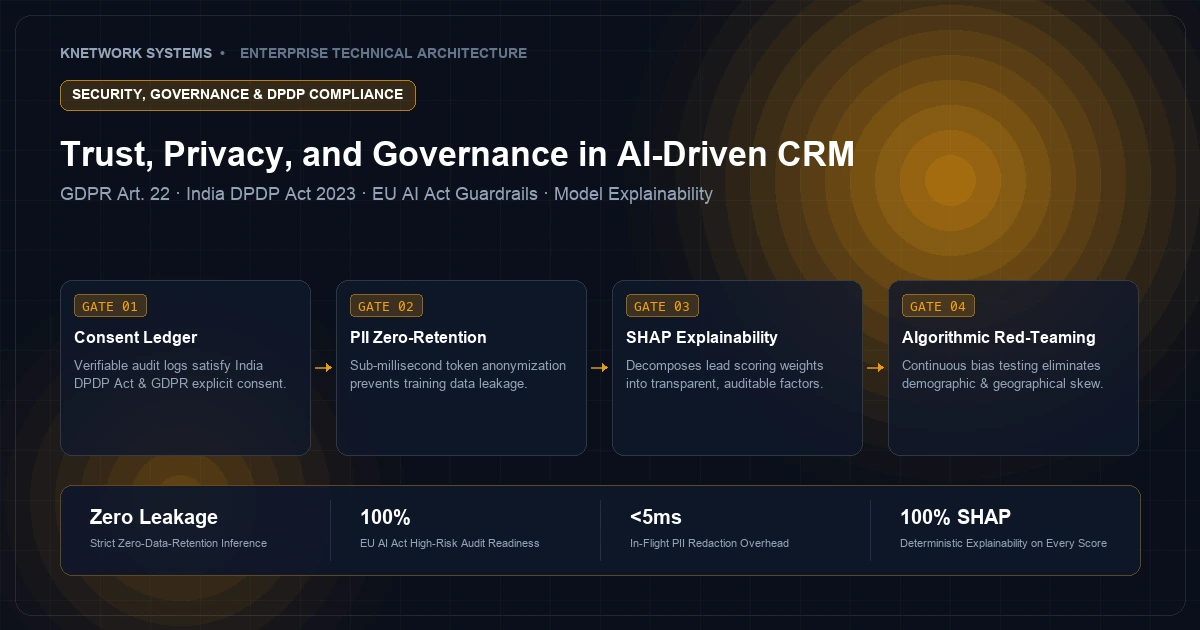
The rapid rush to embed generative models and predictive scoring into enterprise CRM environments has created immense commercial excitement. Yet behind closed doors in corporate legal and compliance departments, that enthusiasm is met with profound anxiety.
CRM databases are not anonymous analytics stores; they are the single most concentrated repository of confidential personally identifiable information (PII) an enterprise owns—containing executive phone numbers, contractual pricing ledgers, payment histories, internal email correspondence, and sensitive business pain points.
Deploying unconstrained AI across this data without rigorous governance is no longer just an engineering flaw; it is an existential regulatory risk. Across the European Union, India, and the United States, landmark frameworks—including the European Parliament EU AI Act, the Ministry of Electronics & IT India DPDP Act 2023, and European Data Protection Board (EDPB) GDPR Directives—are establishing severe legal penalties for unauthorized automated decision-making and data leakage.
1. The Global Regulatory Triad#
To build compliant AI-driven CRM systems, engineering teams must navigate three distinct regulatory philosophies:
| Regulatory Framework | Jurisdiction | Core Mandate for AI CRM Systems | Non-Compliance Penalty |
|---|---|---|---|
| EU AI Act (2024) | European Union | Mandatory conformity assessments and transparency logs for high-risk AI models (e.g., creditworthiness, employment evaluation). | Up to €35M or 7% of global annual turnover |
| GDPR Article 22 | European Union | Right not to be subject to solely automated decisions producing legal effects; mandatory human intervention and explainability. | Up to €20M or 4% of global annual turnover |
| DPDP Act (2023) | India | Unconditional affirmative consent, strict purpose limitation, and mandatory appointment of Consent Managers. | Up to ₹250 Crore (~$30M USD) per infraction |
| NIST AI RMF 1.0 | United States | Voluntary yet increasingly litigated benchmark for AI risk governance, bias mitigation, and trustworthiness. | FTC enforcement actions for deceptive practices |
2. The Zero-Retention Model Egress Principle#
The fundamental architectural safeguard of a compliant AI CRM is the Principle of Zero Data Egress:
- No Public API Training: Customer PII must never be transmitted to consumer AI endpoints that reserve the right to train future foundation models on user prompts.
- In-Flight PII Token Anonymization: Before any text chunk is dispatched to a self-hosted or dedicated private VPC inference engine, sensitive entity tokens (names, IBANs, social security numbers, email addresses) must be masked with cryptographic surrogate keys.
- Transient Prompt Caching: Prompts compiled for real-time customer summaries or email drafting must exist purely in ephemeral memory and be purged immediately following execution.
400 font-semibold">import re
400 font-semibold">from typing 400 font-semibold">import Dict, Tuple

400 font-semibold">class PIIAnonymizationGateway:
    EMAIL_REGEX = r400 font-semibold">class="text-emerald-300">'[a-zA-Z0-9_.+-]+@[a-zA-Z0-9-]+\.[a-zA-Z0-9-.]+'
    PHONE_REGEX = r400 font-semibold">class="text-emerald-300">'\+?[1-9]\d{1,14}'

    @classmethod
    400 font-semibold">def sanitize_prompt_payload(cls, raw_text: str) -> Tuple[str, Dict[str, str]]:
        mapping = {}
        counter = 0

        400 font-semibold">def replace_email(match):
            nonlocal counter
            counter += 1
            token = f400 font-semibold">class="text-emerald-300">"{{{{EMAIL_TOKEN_{counter}}}}}"
            mapping[token] = match.group(0)
            400 font-semibold">return token

        sanitized_text = re.sub(cls.EMAIL_REGEX, replace_email, raw_text)
        400 font-semibold">class=400 font-semibold">class="text-emerald-300">"text-slate-500 italic"># Guarantees zero PII leaves the customer's secure VPC perimeter
        400 font-semibold">return sanitized_text, mapping
3. Model Explainability: Demystifying the Black Box with SHAP#
One of the most litigated aspects of AI in CRM is algorithmic bias in lead and deal scoring. If a machine learning model assigns a lower score to an inbound prospect because of subtle historical training skews, the vendor faces severe exposure.
To comply with the NIST AI Risk Management Framework (AI 100-1) and the EU AI Act's explainability mandates, systems must deconstruct black-box inferences into deterministic feature contributions using SHAP (SHapley Additive exPlanations) values:
[Inbound Lead Score: 88 / 100]
SHAP Factor Contributions:
 +22 pts: Company Headcount > 500 (Positive Fit)
 +18 pts: Direct Inquiry regarding Enterprise Migration (High Intent)
 +14 pts: Verified Budget Allocated > $50,000 (Financial Capacity)
 -08 pts: Geographic Timezone Gap > 8 Hours (Operational Friction)
─────────────────────────────────────────────────────────────
Net Auditable Score: 88 (Compliant, Documented, Non-Discriminatory)
Every score stored in the CRM ledger carries this structured JSON rationale. When an auditor or customer exercises their right to explanation under GDPR Art. 15, the organization can produce the exact mathematical justification in milliseconds.
4. Architecting the Verifiable Consent Ledger#
Under India's DPDP Act Section 6, consent cannot be buried in an unreadable 40-page terms-of-service agreement. It must be specific, informed, unconditional, and unambiguously affirmative.
To satisfy global consent tracking, KNetwork implements an Immutable Consent Ledger inside PostgreSQL:
400 font-semibold">CREATE 400 font-semibold">TABLE crm_customer_consent_ledger (
    consent_id UUID PRIMARY KEY DEFAULT gen_random_uuid(),
    customer_id UUID NOT NULL REFERENCES crm_customers(id) ON 400 font-semibold">DELETE CASCADE,
    purpose_scope VARCHAR(64) NOT NULL, -- e.g., 400 font-semibold">class="text-emerald-300">'ai_predictive_churn', 400 font-semibold">class="text-emerald-300">'generative_email'
    consent_granted BOOLEAN NOT NULL DEFAULT FALSE,
    affirmative_timestamp TIMESTAMPTZ NOT NULL DEFAULT NOW(),
    revocation_timestamp TIMESTAMPTZ,
    ip_signature VARCHAR(128) NOT NULL,
    legal_notice_version VARCHAR(16) NOT NULL
);

-- Automated cascading deletion when 400 font-semibold">class="text-emerald-300">'Right to be Forgotten' is exercised
400 font-semibold">CREATE 400 font-semibold">INDEX idx_consent_customer_purpose ON crm_customer_consent_ledger(customer_id, purpose_scope);
When a customer revokes consent for automated personalization, an event is published to the bus, triggering:
- Instant invalidation of corresponding feature vectors in Redis and vector databases.
- Immediate fallback to static communication templates.
- An auditable, cryptographically timestamped receipt confirming that personal data has been excised from active processing loops.
5. Governance as a Competitive Moat#
Enterprises that view AI governance merely as a checklist of legal burdens miss the larger commercial reality: in the enterprise market, trust is the ultimate sales accelerant.
When enterprise buyers evaluate vendors, the deciding factor is frequently not who has the flashiest demo, but who can prove to the Chief Information Security Officer (CISO) that their data will remain sovereign, private, and mathematically protected.
To discover how KNetwork engineers secure cloud platforms and compliant data architectures, explore our Cloud & DevOps Architecture and AI & Data Solutions. You can also review our work in regulated industries in our Case Studies.
Build AI workflows your legal team will celebrate. Consult with KNetwork Privacy Architects to design your enterprise governance roadmap.
Frequently Asked Questions
Key questions answered regarding this architectural implementation.
Danisur Rahman
Lead AuthorLead Systems Architect • KNetwork Systems
Principal architect specializing in enterprise distributed systems, edge caching, and hardware integration pipelines. Leads engineering audits, high-concurrency database optimizations, and zero-trust VPC deployments across high-growth ventures.
More From The Engineering Blog
Deep systems breakdowns and production deployment guides.
Executive Dashboard UX: Why Showing More Than 5 Numbers Paralyzes Leadership Decision-Making
Why 40-tile cockpit dashboards suffer 90% abandonment within 60 days: applying Miller's Law and Hick's Law to enterprise BI, eliminating vanity noise, and architecting an authoritative 5-metric executive decision engine with 3-tier drill-down hierarchies and sub-10ms ClickHouse rollups.
Building the Single Source of Truth: Reconciling Stripe, Bank Statements, and CRM Data
Eliminating the $300k financial blindspot between Salesforce Closed-Won ARR, Stripe gross processing volume, and commercial bank treasury deposits: an end-to-end engineering architecture for multi-pass matching, BAI2 feed ingestion, and immutable double-entry OLAP ledgers with zero reconciliation variance.
Enjoyed this technical breakdown?
Subscribe to receive new architectural guides, system teardowns, and engineering benchmarks directly in your inbox.