Satellite NTN & 3GPP Release 18: Bridging Terrestrial Cellular and Orbital Direct-to-Device IoT
How 3GPP Release 17/18 standardized Direct-to-Device satellite connectivity, allowing standard NB-IoT modems with ordinary eSIMs to communicate with LEO constellations.
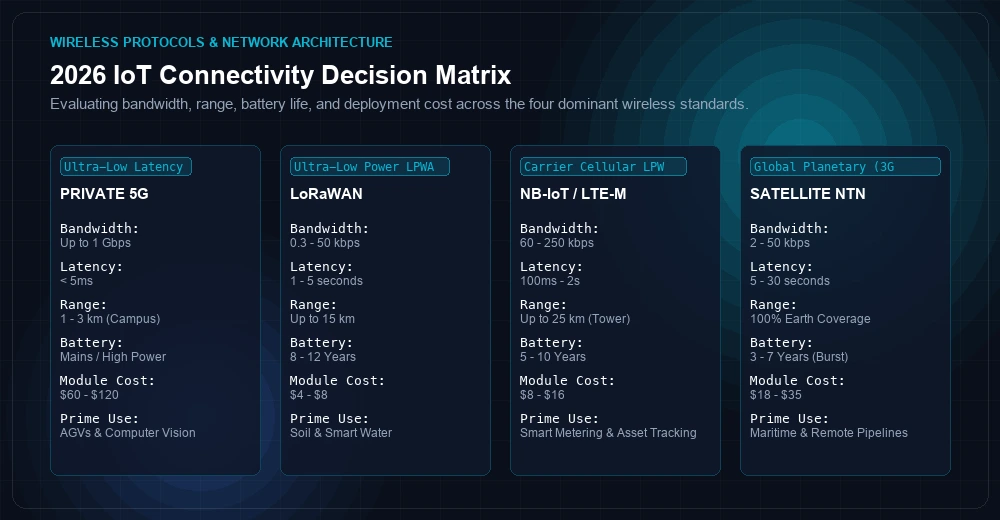
There is no universal IoT wireless connectivity protocol. Specifying high-speed 5G broadband for an agricultural soil sensor will bankrupt a project on battery replacements within weeks; choosing LoRaWAN for an autonomous guided vehicle (AGV) in a warehouse will cause collision shutdowns due to radio packet latency.
In 2026, wireless protocol selection has hardened into clear, physics-driven engineering tiers:
Figure 5: Technical and economic comparison across Private 5G, LoRaWAN, Cellular NB-IoT, and 3GPP Release 18 Satellite NTN.
1. The 2026 Enterprise Connectivity Decision Matrix#
| Wireless Protocol | Typical Bandwidth | Operational Range | Battery Life | Module Silicon Cost | Prime Enterprise Use Case |
|---|---|---|---|---|---|
| Private 5G (SA) | Up to 1 Gbps | 1 – 3 km (Campus) | Hours to Days | USD 65–130 | Autonomous mobile robots (AMRs), high-res optical inspection, real-time safety interlocks. |
| LoRaWAN | 0.3 – 50 kbps | Up to 15 km | 8 – 12 Years | USD 4–8 | Sub-surface water metering, soil moisture probes, HVAC damper sensors. |
| NB-IoT / LTE-M | 60 – 250 kbps | Up to 25 km (Tower) | 5 – 10 Years | USD 8–16 | Smart electricity meters, connected streetlighting, inter-city cold chain logistics. |
| Satellite NTN | 2 – 50 kbps | Global (100% Earth) | 3 – 7 Years | USD 18–35 | Maritime cargo containers, remote mining telemetry, trans-continental oil pipelines. |
2. The Breakthrough: 3GPP Release 18 Satellite NTN#
The decisive connectivity milestone of 2026 is the commercial availability of Direct-to-Device Satellite IoT, standardized under 3GPP Release 17 and Release 18 (5G-Advanced).
Historically, connecting an asset outside terrestrial cellular coverage required a bulky, proprietary satellite transceiver (Iridium, Inmarsat, or Globalstar) costing hundreds of dollars, paired with an expensive, non-standard airtime subscription.
Release 18 eliminated that barrier forever by enabling standard, low-cost NB-IoT silicon to communicate directly with Low Earth Orbit (LEO) satellite constellations.
Overcoming the Physical Challenges of Orbital Links:
- Doppler Frequency Shift Compensation: A satellite in Low Earth Orbit (500 km altitude) travels at approximately 7.5 kilometers per second. At sub-GHz carrier frequencies, this orbital velocity causes Doppler frequency shifts exceeding ±50 kHz.
Release 18 modems utilize onboard GNSS coordinates combined with orbital ephemeris tables (TLEs) to calculate and pre-compensate the uplink carrier frequency before transmitting.
- Propagated Path Delay: Uplink packets travel between 500 km and 1,800 km through the atmosphere. The 3GPP standard extends HARQ (Hybrid Automatic Repeat Request) retransmission timers to accommodate 20ms to 40ms round-trip propagation times without dropping connection state.
- Power-Optimized Burst Scheduling: Endpoints remain in deep sleep (PSM / eDRX mode) consuming under 3 micro-amperes, waking only when satellite constellation passes are scheduled overhead to transmit encrypted 100-byte telemetry bursts.
3. Real-World Case Study: Maritime Cold-Chain Logistics#
Spanish satellite pioneer Sateliot, in partnership with Deutsche Telekom, operates an orbital constellation of LEO nanosatellites functioning as roaming cellular towers in space.
A refrigerated maritime shipping container equipped with a standard cellular eSIM travels through inland Europe on terrestrial cellular. When the cargo vessel sails into the mid-Atlantic—hundreds of miles beyond any terrestrial cell tower—the container's standard cellular modem automatically roams onto the LEO satellite network using the exact same SIM card, enterprise APN, and protocol stack.
The asset transmits critical container core temperature, GPS coordinates, and door-opening shock alerts across the open ocean without requiring dedicated satellite dishes or costly terminal hardware.
4. What to Watch: 5G RedCap (Reduced Capability)#
The next major migration horizon is 5G RedCap (3GPP Rel-17/18). Positioned squarely between high-speed 5G broadband and low-speed NB-IoT, RedCap provides 150 Mbps downlink with low latency at half the silicon and battery cost of full 5G NR chips. It is rapidly emerging as the enterprise standard for industrial AR glasses, plant robotics, and high-frequency predictive telemetry gateways.
Designing global multi-bearer telematics or private wireless networks? Review our Taxi Jee Fleet Telemetry Case Study or Consult with KNetwork Systems Architects.
Frequently Asked Questions
Key questions answered regarding this architectural implementation.
Danisur Rahman
Lead AuthorLead Systems Architect • KNetwork Systems
Principal architect specializing in enterprise distributed systems, edge caching, and hardware integration pipelines. Leads engineering audits, high-concurrency database optimizations, and zero-trust VPC deployments across high-growth ventures.
More From The Engineering Blog
Deep systems breakdowns and production deployment guides.
Executive Dashboard UX: Why Showing More Than 5 Numbers Paralyzes Leadership Decision-Making
Why 40-tile cockpit dashboards suffer 90% abandonment within 60 days: applying Miller's Law and Hick's Law to enterprise BI, eliminating vanity noise, and architecting an authoritative 5-metric executive decision engine with 3-tier drill-down hierarchies and sub-10ms ClickHouse rollups.
Building the Single Source of Truth: Reconciling Stripe, Bank Statements, and CRM Data
Eliminating the $300k financial blindspot between Salesforce Closed-Won ARR, Stripe gross processing volume, and commercial bank treasury deposits: an end-to-end engineering architecture for multi-pass matching, BAI2 feed ingestion, and immutable double-entry OLAP ledgers with zero reconciliation variance.
Enjoyed this technical breakdown?
Subscribe to receive new architectural guides, system teardowns, and engineering benchmarks directly in your inbox.