Closed-Loop Digital Twins: Bridging OPC UA Industrial Protocols and IT Event Streams
Moving beyond passive 3D dashboards: how bidirectional OT/IT event bridges with OPC UA and Apache Kafka reduce unplanned industrial downtime by up to 28%.
For years, the phrase "digital twin" spent its lifecycle as an overused marketing buzzword. Early enterprise implementations were frequently little more than static 3D CAD models linked to a lagging temperature reading—visually impressive during corporate board presentations, but largely useless on the operational factory floor.
In 2026, digital twins have graduated into bidirectional, closed-loop operational engines.
Instead of merely mirroring past states on passive monitoring screens, modern industrial twins actively simulate future physical physics, forecast mechanical degradation, and autonomously adjust operational setpoints to prevent catastrophic failure.
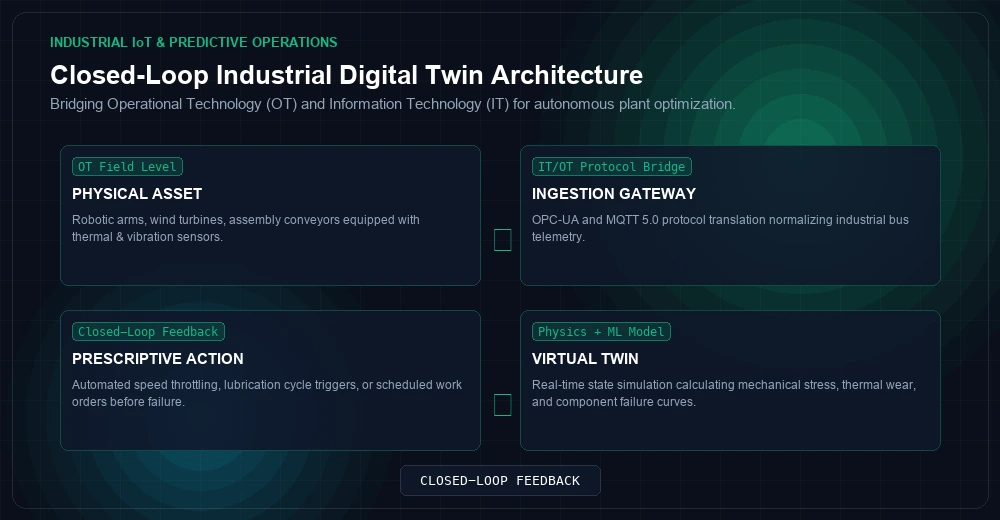
Figure 3: Bidirectional data flow linking physical operational assets with real-time physics simulations and autonomous prescriptive feedback loops.
1. The Core Architecture: Bridging the OT/IT Divide#
The fundamental engineering obstacle in industrial IoT is the cultural and protocol chasm between Operational Technology (OT) and Information Technology (IT):
- Operational Technology (OT): Prioritizes sub-millisecond determinism, safety-critical loops, and serial/industrial fieldbuses (Modbus, Profinet, EtherCAT, OPC UA). An unhandled network packet could cause a hydraulic press to injure a technician.
- Information Technology (IT): Prioritizes horizontal elasticity, event-driven streaming (Apache Kafka, Redis, PostgreSQL), and cloud data lakes. Latency variance of 200ms is standard and acceptable.
The Closed-Loop Pipeline:
- Field Ingestion: An industrial gateway connects to Siemens S7 or Rockwell PLCs via OPC UA (Open Platform Communications Unified Architecture).
- Standardization: High-frequency registers are encapsulated into structured MQTT 5.0 Sparkplug B payloads at the machine edge.
- Real-Time Simulation: Streaming event brokers feed telemetry into Physics-Informed Neural Networks (PINNs) running inside an on-premise compute cluster.
- Prescriptive Actuation: If the twin forecasts cavitation fatigue inside a centrifugal pump within 36 hours, it does not wait for a maintenance email. It issues a cryptographically signed writeback command to the PLC's register, throttling motor velocity by 12% to preserve the asset until the overnight maintenance shift.
2. High-Performance OPC UA Ingestion Service (Node.js / TypeScript)#
Below is an engineered microservice connecting to an industrial OPC UA server and bridging structured node values directly to a Kafka event log:
400 font-semibold">import {
  OPCUAClient,
  AttributeIds,
  ClientSubscription,
  TimestampsToReturn,
  MonitoringParametersOptions,
  ReadValueIdOptions,
} 400 font-semibold">from 400 font-semibold">class="text-emerald-300">"node-opcua";
400 font-semibold">import { Kafka } 400 font-semibold">from 400 font-semibold">class="text-emerald-300">"kafkajs";

400 font-semibold">const kafka = 400 font-semibold">new Kafka({ clientId: 400 font-semibold">class="text-emerald-300">"twin-telemetry-bridge", brokers: [400 font-semibold">class="text-emerald-300">"kafka.internal:9092"] });
400 font-semibold">const producer = kafka.producer();

400 font-semibold">async 400 font-semibold">function startTwinTelemetryBridge() {
  400 font-semibold">await producer.connect();
  400 font-semibold">const client = OPCUAClient.create({ endpointMustExist: 400">false });
  400 font-semibold">const endpointUrl = 400 font-semibold">class="text-emerald-300">"opc.tcp:400 font-semibold">class="text-slate-500 italic400 font-semibold">class="text-emerald-300">">//edge-plc-gateway.local:4840";

  400 font-semibold">await client.connect(endpointUrl);
  400 font-semibold">const session = 400 font-semibold">await client.createSession();

  400 font-semibold">const subscription = 400 font-semibold">await session.createSubscription2({
    requestedPublishingInterval: 100, 400 font-semibold">class=400 font-semibold">class="text-emerald-300">"text-slate-500 italic">// 100ms high-resolution loop
    requestedLifetimeCount: 1000,
    requestedMaxKeepAliveCount: 12,
    maxNotificationsPerPublish: 100,
    publishingEnabled: 400">true,
    priority: 10,
  });

  400 font-semibold">const nodeToMonitor: ReadValueIdOptions = {
    nodeId: 400 font-semibold">class="text-emerald-300">"ns=2;s=Turbine.Gearbox.VibrationRMS",
    attributeId: AttributeIds.Value,
  };

  400 font-semibold">const parameters: MonitoringParametersOptions = {
    samplingInterval: 50,
    discardOldest: 400">true,
    queueSize: 10,
  };

  400 font-semibold">const monitoredItem = 400 font-semibold">await subscription.monitor(nodeToMonitor, parameters, TimestampsToReturn.Both);

  monitoredItem.on(400 font-semibold">class="text-emerald-300">"changed", 400 font-semibold">async (dataValue) => {
    400 font-semibold">const vibrationRms = dataValue.value.value;
    400 font-semibold">const timestamp = dataValue.serverTimestamp;

    400 font-semibold">class=400 font-semibold">class="text-emerald-300">"text-slate-500 italic">// Stream telemetry directly to Kafka topic 400 font-semibold">for real-time physics twin
    400 font-semibold">await producer.send({
      topic: 400 font-semibold">class="text-emerald-300">"industrial-digital-twin-stream",
      messages: [
        {
          key: 400 font-semibold">class="text-emerald-300">"turbine-unit-04",
          value: JSON.stringify({
            sensor: 400 font-semibold">class="text-emerald-300">"Gearbox_Vibration_RMS",
            value: vibrationRms,
            timestamp,
            engineering_unit: 400 font-semibold">class="text-emerald-300">"mm/s",
          }),
        },
      ],
    });
  });

  console.log(400 font-semibold">class="text-emerald-300">"OPC UA bidirectional telemetry bridge active.");
}
3. Documented Enterprise Returns#
Major industrial manufacturing operations are validating double-digit ROI from closed-loop digital twin deployments:
- BMW Group: Integrated NVIDIA Omniverse and Siemens automation across its Regensburg and Debrecen facilities, simulating every robotic welding path before physical tooling. The implementation reduced factory changeover timelines by months and slashed unplanned downtime by 24% to 28%.
- Equinor: Deployed hydrodynamic digital twins across offshore floating wind turbines. The system models structural wave fatigue and cyclic blade load, predicting mechanical wear 60 days in advance and eliminating emergency offshore vessel deployments costing upwards of $120,000 per mission.
Modern physical infrastructure cannot afford disconnected data silos. Discover how KNetwork engineers mission-critical distributed systems in our Custom Software Development practice.
Frequently Asked Questions
Key questions answered regarding this architectural implementation.
Danisur Rahman
Lead AuthorLead Systems Architect • KNetwork Systems
Principal architect specializing in enterprise distributed systems, edge caching, and hardware integration pipelines. Leads engineering audits, high-concurrency database optimizations, and zero-trust VPC deployments across high-growth ventures.
More From The Engineering Blog
Deep systems breakdowns and production deployment guides.
Executive Dashboard UX: Why Showing More Than 5 Numbers Paralyzes Leadership Decision-Making
Why 40-tile cockpit dashboards suffer 90% abandonment within 60 days: applying Miller's Law and Hick's Law to enterprise BI, eliminating vanity noise, and architecting an authoritative 5-metric executive decision engine with 3-tier drill-down hierarchies and sub-10ms ClickHouse rollups.
Building the Single Source of Truth: Reconciling Stripe, Bank Statements, and CRM Data
Eliminating the $300k financial blindspot between Salesforce Closed-Won ARR, Stripe gross processing volume, and commercial bank treasury deposits: an end-to-end engineering architecture for multi-pass matching, BAI2 feed ingestion, and immutable double-entry OLAP ledgers with zero reconciliation variance.
Enjoyed this technical breakdown?
Subscribe to receive new architectural guides, system teardowns, and engineering benchmarks directly in your inbox.