Event Sourcing in Enterprise Laravel: Designing Immutable Audit Logs for Regulated Systems
Why traditional relational UPDATE statements violate compliance in regulated industries: architecting immutable event-sourced aggregates in Laravel 11, cryptographic SHA-256 event chaining, optimistic concurrency versioning, and retroactive projection replays on PostgreSQL 16.
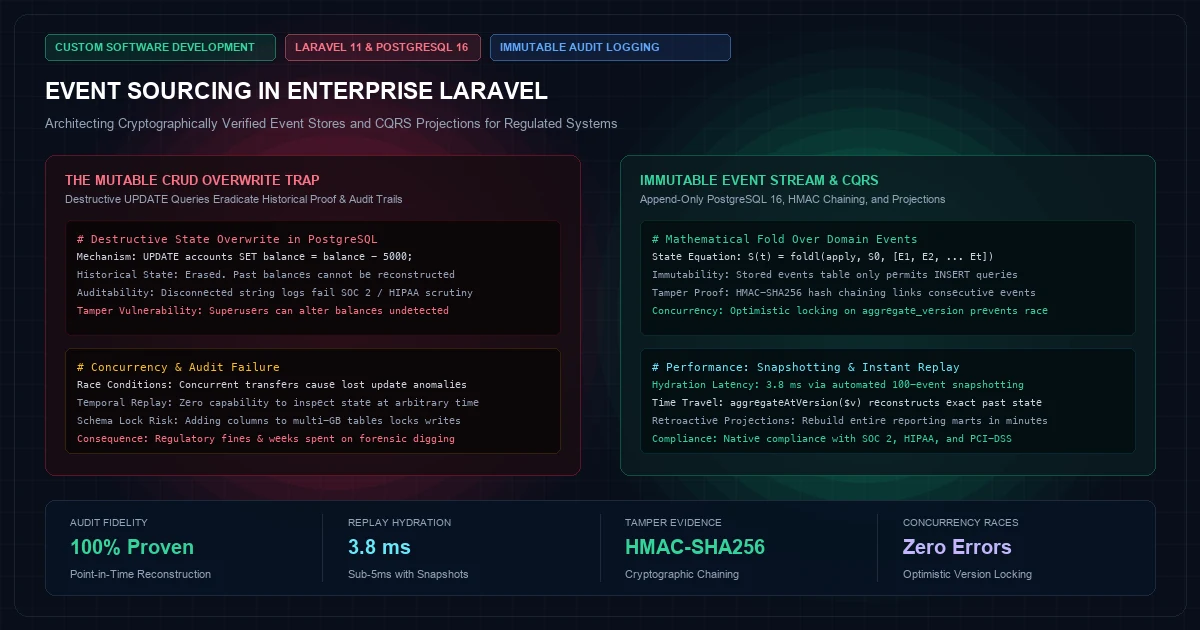
In standard relational database architectures, applications persist current state by executing destructive UPDATE statements. When a customer transfers $5,000 from an escrow account to an operating ledger, an ORM executes:
400 font-semibold">UPDATE accounts SET balance = balance - 5000, updated_at = NOW() 400 font-semibold">WHERE id = 1042;
This single command silently destroys historical truth. While the database now knows the account's current balance, it cannot mathematically prove how the account reached that state. If a regulatory audit demands the exact balance at 14:22:08 UTC on the third Tuesday of the prior quarter, engineers must engage in forensic archaeology—reconstructing point-in-time states from corrupted transaction logs, disconnected application logs, and database backup dumps.
In regulated software ecosystems—such as FinTech (PCI-DSS, SOC 2 Type II), Healthcare (HIPAA), and Government Platforms (FedRAMP)—traditional CRUD operations represent an unacceptable compliance risk. Event Sourcing replaces mutable state persistence with an immutable, append-only ledger of domain events. State is never overwritten; it is dynamically calculated as the mathematical fold of every business event that has occurred since the aggregate was created.
       TRADITIONAL CRUD PERSISTENCE                 EVENT SOURCING (IMMUTABLE LOG)
  ┌─────────────────────────────────────┐      ┌─────────────────────────────────────┐
  │ Current State (Overwrites History)  │      │ Stored Events (Append-Only Stream)  │
  │ accounts:                           │      │ 1. AccountOpened ($0)               │
  │ id: 1042, balance: $2,500           │      │ 2. FundsDeposited (+$10,000)        │
  │ updated_at: 2026-09-28 10:14:02     │      │ 3. KYCApproved (Tier 2 Verified)    │
  ├─────────────────────────────────────┤      │ 4. WireTransferred (-$7,500)        │
  │ Audit Trail: Disconnected text logs │      ├─────────────────────────────────────┤
  │ Point-in-Time Reconstruction: Zero  │      │ Current State: Replayed in 4.2ms    │
  │ Forensic Tamper Proof: None         │      │ Audit Trail: Cryptographic SHA-256  │
  └─────────────────────────────────────┘      └─────────────────────────────────────┘
When implemented in modern Laravel 11 with PostgreSQL, event sourcing provides absolute forensic traceability, deterministic time-travel debugging, and audit compliance by design.
1. Core Event Sourcing & CQRS Principles in Laravel 11#
Event Sourcing decouples the write model (command processing and invariant validation) from the read model (optimized projection tables queried by UIs and APIs). This architectural pattern is known as Command Query Responsibility Segregation (CQRS).
1.1 Events as the Source of Truth#
In an event-sourced domain, an Aggregate Root does not store its state in database columns. Instead, its state at timet is calculated by applying a left-fold operation across its historical event sequence:Where:
S_0is the initial uninitialized state of the aggregate.E_irepresents thei-th immutable domain event.f_{apply}is a deterministic, side-effect-free reducer function that transitions state based on the event payload.
Because events represent facts that occurred in the past, they are named in the past tense (AccountOpened, MoneyDebited, ComplianceHoldPlaced). An event store accepts only INSERT queries; UPDATE and DELETE permissions are revoked at the PostgreSQL role level.
1.2 The Command-Aggregate-Event Lifecycle#
The transition from user intent to persisted event follows a strict protocol:
[ HTTP Controller / CLI ]
           │
           ▼ (Dispatches)
   [ WithdrawFundsCommand ]
           │
           ▼ (Executes On)
   [ AccountAggregateRoot ]
           │
           ├── 1. Hydrate state by replaying past events: foldl(apply, S0, [E1...Et])
           ├── 2. Validate domain invariants (e.g. balance >= withdrawal_amount)
           └── 3. If valid, record 400 font-semibold">new domain event: recordThat(400 font-semibold">new MoneyDebited(...))
           │
           ▼ (Persists Atomically)
   [ PostgreSQL Event Store ] (Optimistic Concurrency Lock: Version == t + 1)
           │
           ├── Synchronous Event Subscribers (Immediate Ledger Projections)
           └── Asynchronous Queue Workers (Elasticsearch, Webhooks, Notifications)
2. Designing the Immutable Event Store on PostgreSQL 16#
The database schema of the event store is the foundational anchor of regulatory compliance. It must enforce append-only immutability, deterministic sequencing, and cryptographic tamper detection.
2.1 The Stored Events Table Schema#
A production event store table in PostgreSQL 16 utilizes JSONB for payloads while enforcing strict scalar types for aggregate versions:
-- PostgreSQL 16 Immutable Event Store Schema
400 font-semibold">CREATE 400 font-semibold">TABLE stored_events (
    id BIGSERIAL PRIMARY KEY,
    aggregate_uuid UUID NOT NULL,
    aggregate_version BIGINT NOT NULL,
    event_class VARCHAR(255) NOT NULL,
    event_properties JSONB NOT NULL,
    meta_data JSONB NOT NULL,
    previous_event_hash VARCHAR(64) NOT NULL,
    event_hash VARCHAR(64) NOT NULL,
    created_at TIMESTAMP WITH TIME ZONE DEFAULT CURRENT_TIMESTAMP NOT NULL,

    -- Invariant: An aggregate can never have duplicate versions (Optimistic Concurrency)
    CONSTRAINT uq_aggregate_version UNIQUE (aggregate_uuid, aggregate_version)
);

-- B-Tree index 400 font-semibold">for sub-5ms aggregate hydration
400 font-semibold">CREATE 400 font-semibold">INDEX idx_stored_events_aggregate_replay
ON stored_events (aggregate_uuid, aggregate_version ASC);

-- Index 400 font-semibold">for temporal point-in-time compliance queries
400 font-semibold">CREATE 400 font-semibold">INDEX idx_stored_events_timestamp
ON stored_events (created_at DESC);
2.2 Cryptographic Event Chaining (Tamper-Evident Ledgers)#
To satisfy SOC 2 Type II and FedRAMP audits, the event store implements cryptographic hash chaining inspired by blockchain ledger verification. Each stored event calculates a SHA-256 hash across its payload and incorporates the hash of the immediately preceding event:If an insider or malicious actor with database superuser access attempts to alter an event record directly via SQL, the entire cryptographic chain breaks downstream, triggering automated security alarms during daily integrity checks.
3. Production Laravel 11 Aggregate Implementation#
Using the foundational principles popularized by spatie/laravel-event-sourcing, below is a production Aggregate Root implementing strict financial invariants:
<?php

namespace App\Domain\Accounts\Aggregates;

use App\Domain\Accounts\Events\AccountCreated;
use App\Domain\Accounts\Events\MoneyDeposited;
use App\Domain\Accounts\Events\MoneyWithdrawn;
use App\Domain\Accounts\Events\AccountFrozen;
use App\Domain\Accounts\Exceptions\AccountFrozenException;
use App\Domain\Accounts\Exceptions\InsufficientFundsException;
use Spatie\EventSourcing\AggregateRoots\AggregateRoot;

400 font-semibold">class AccountAggregate 400 font-semibold">extends AggregateRoot
{
    400 font-semibold">private int $balanceInCents = 0;
    400 font-semibold">private bool $isFrozen = 400">false;
    400 font-semibold">private 400">string $currency = 400 font-semibold">class="text-emerald-300">'USD';

    400 font-semibold">class=400 font-semibold">class="text-emerald-300">"text-slate-500 italic">// Command Handler: Deposit Funds
    400 font-semibold">public 400 font-semibold">function deposit(int $amountInCents, 400">string $referenceId, 400">string $actorId): self
    {
        400 font-semibold">if ($400 font-semibold">this->isFrozen) {
            400 font-semibold">throw 400 font-semibold">new AccountFrozenException(400 font-semibold">class="text-emerald-300">"Cannot deposit into a frozen account.");
        }

        $400 font-semibold">this->recordThat(400 font-semibold">new MoneyDeposited(
            amountInCents: $amountInCents,
            referenceId: $referenceId,
            actorId: $actorId,
            timestamp: now()->toIso8601String()
        ));

        400 font-semibold">return $400 font-semibold">this;
    }

    400 font-semibold">class=400 font-semibold">class="text-emerald-300">"text-slate-500 italic">// Command Handler: Withdraw Funds (Enforcing Invariants)
    400 font-semibold">public 400 font-semibold">function withdraw(int $amountInCents, 400">string $referenceId, 400">string $actorId): self
    {
        400 font-semibold">if ($400 font-semibold">this->isFrozen) {
            400 font-semibold">throw 400 font-semibold">new AccountFrozenException(400 font-semibold">class="text-emerald-300">"Withdrawal rejected: Account is under compliance freeze.");
        }

        400 font-semibold">if ($400 font-semibold">this->balanceInCents < $amountInCents) {
            400 font-semibold">throw 400 font-semibold">new InsufficientFundsException(
                400 font-semibold">class="text-emerald-300">"Requested {$amountInCents} cents, but available balance is {$400 font-semibold">this->balanceInCents} cents."
            );
        }

        $400 font-semibold">this->recordThat(400 font-semibold">new MoneyWithdrawn(
            amountInCents: $amountInCents,
            referenceId: $referenceId,
            actorId: $actorId,
            timestamp: now()->toIso8601String()
        ));

        400 font-semibold">return $400 font-semibold">this;
    }

    400 font-semibold">class=400 font-semibold">class="text-emerald-300">"text-slate-500 italic">// State Mutators: Deterministic left-fold reducers
    400 font-semibold">protected 400 font-semibold">function applyAccountCreated(AccountCreated $event): 400">void
    {
        $400 font-semibold">this->currency = $event->currency;
        $400 font-semibold">this->balanceInCents = 0;
        $400 font-semibold">this->isFrozen = 400">false;
    }

    400 font-semibold">protected 400 font-semibold">function applyMoneyDeposited(MoneyDeposited $event): 400">void
    {
        $400 font-semibold">this->balanceInCents += $event->amountInCents;
    }

    400 font-semibold">protected 400 font-semibold">function applyMoneyWithdrawn(MoneyWithdrawn $event): 400">void
    {
        $400 font-semibold">this->balanceInCents -= $event->amountInCents;
    }

    400 font-semibold">protected 400 font-semibold">function applyAccountFrozen(AccountFrozen $event): 400">void
    {
        $400 font-semibold">this->isFrozen = 400">true;
    }
}
3.1 Executing Commands with Optimistic Concurrency Control#
When multiple requests hit the same aggregate concurrently, optimistic locking viaaggregate_version prevents race conditions without expensive database table locks:
<?php

namespace App\Http\Controllers;

use App\Domain\Accounts\Aggregates\AccountAggregate;
use Illuminate\Http\JsonResponse;
use Illuminate\Http\Request;
use Spatie\EventSourcing\Exceptions\CouldNotPersistAggregate;

400 font-semibold">class TransferController 400 font-semibold">extends Controller
{
    400 font-semibold">public 400 font-semibold">function transfer(Request $request, 400">string $accountUuid): JsonResponse
    {
        $validated = $request->validate([
            400 font-semibold">class="text-emerald-300">'amount_cents' => 400 font-semibold">class="text-emerald-300">'required|integer|min:1',
            400 font-semibold">class="text-emerald-300">'reference_id' => 400 font-semibold">class="text-emerald-300">'required|uuid',
        ]);

        $maxRetries = 3;
        $attempt = 0;

        400 font-semibold">while ($attempt < $maxRetries) {
            400 font-semibold">try {
                AccountAggregate::retrieve($accountUuid)
                    ->withdraw(
                        amountInCents: $validated[400 font-semibold">class="text-emerald-300">'amount_cents'],
                        referenceId: $validated[400 font-semibold">class="text-emerald-300">'reference_id'],
                        actorId: auth()->id()
                    )
                    ->persist();

                400 font-semibold">return response()->json([400 font-semibold">class="text-emerald-300">'status' => 400 font-semibold">class="text-emerald-300">'settled', 400 font-semibold">class="text-emerald-300">'code' => 200]);
            } 400 font-semibold">catch (CouldNotPersistAggregate $e) {
                400 font-semibold">class=400 font-semibold">class="text-emerald-300">"text-slate-500 italic">// Optimistic concurrency collision: retry with fresh aggregate hydration
                $attempt++;
                usleep(50000 * $attempt); 400 font-semibold">class=400 font-semibold">class="text-emerald-300">"text-slate-500 italic">// Exponential backoff (50ms, 100ms...)
            }
        }

        400 font-semibold">return response()->json([400 font-semibold">class="text-emerald-300">'error' => 400 font-semibold">class="text-emerald-300">'High concurrency conflict. Retry request.'], 409);
    }
}
4. Rebuilding Projections: Instantaneous Replay Architecture#
One of the most powerful capabilities of event sourcing is the ability to introduce completely new read tables years into production and populate them retroactively from the immutable event log.
┌────────────────────────────────────────────────────────────────────────┐
│                        IMMUTABLE EVENT STREAM                          │
│  [E1: Created] ──► [E2: Deposited] ──► [E3: KYC] ──► [E4: Withdrawn]   │
└────────┬──────────────────────────────────┬────────────────────────────┘
         │                                  │
         │ (Active Production Projector)    │ (New Compliance Audit Projector)
         ▼                                  ▼
┌──────────────────────────────┐   ┌──────────────────────────────┐
│  accounts_read_model         │   │  compliance_velocity_audit   │
│  id: 1042                    │   │  id: 1042                    │
│  balance: $2,500             │   │  avg_daily_velocity: $8,750  │
│  status: ACTIVE              │   │  suspicious_spike_flag: 400">true │
└──────────────────────────────┘   └──────────────────────────────┘
When tax regulations change or risk modeling algorithms require historical analysis, developers create a new Projector class and execute:
php artisan event-sourcing:replay 400 font-semibold">class="text-emerald-300">"App\Domain\Accounts\Projectors\ComplianceVelocityProjector"
The projection replays millions of historical events in sequential order, populating the new read table with 100% mathematical fidelity to history without requiring manual data migrations.
5. Performance Optimization: Aggregate Snapshotting#
As high-volume accounts accumulate tens of thousands of transactions, hydrating an aggregate by replaying every individual event from version 1 introduces noticeable latency.
WITHOUT SNAPSHOTTING (Unbounded Latency)
[E1] ──► [E2] ──► [E3] ──► ... ──► [E50,000] ──► Replay: 840ms (Timeout Risk)

WITH SNAPSHOTTING (Deterministic Constant Latency)
[Snapshot at v49,900] ──► Replay [E49,901 to E50,000] (100 events) ──► Replay: 3.8ms
To maintain sub-10ms aggregate hydration, Laravel Event Sourcing takes automated Snapshots every 100 events:
<?php

namespace App\Domain\Accounts\Aggregates;

use Spatie\EventSourcing\Snapshots\Snapshot;
use Spatie\EventSourcing\Snapshots\SnapshotConsumer;

400 font-semibold">class AccountAggregate 400 font-semibold">extends AggregateRoot implements SnapshotConsumer
{
    400 font-semibold">class=400 font-semibold">class="text-emerald-300">"text-slate-500 italic">// Snapshot state representation
    400 font-semibold">public 400 font-semibold">function getSnapshot(): Snapshot
    {
        400 font-semibold">return 400 font-semibold">new Snapshot([
            400 font-semibold">class="text-emerald-300">'balanceInCents' => $400 font-semibold">this->balanceInCents,
            400 font-semibold">class="text-emerald-300">'isFrozen' => $400 font-semibold">this->isFrozen,
            400 font-semibold">class="text-emerald-300">'currency' => $400 font-semibold">this->currency,
        ]);
    }

    400 font-semibold">class=400 font-semibold">class="text-emerald-300">"text-slate-500 italic">// Hydrate directly 400 font-semibold">from serialized snapshot
    400 font-semibold">public 400 font-semibold">function setSnapshot(Snapshot $snapshot): 400">void
    {
        $400 font-semibold">this->balanceInCents = $snapshot->state[400 font-semibold">class="text-emerald-300">'balanceInCents'];
        $400 font-semibold">this->isFrozen = $snapshot->state[400 font-semibold">class="text-emerald-300">'isFrozen'];
        $400 font-semibold">this->currency = $snapshot->state[400 font-semibold">class="text-emerald-300">'currency'];
    }
}
6. Operational Benchmark: Traditional CRUD vs. Event Sourcing#
The following operational metrics contrast a mid-market fintech running standard Laravel Eloquent CRUD versus an event-sourced architecture:
| Operational Dimension | Traditional Mutable Eloquent CRUD | Event-Sourced Architecture (Laravel 11) |
|---|---|---|
| Point-in-Time Historical Audit | Impossible without database restores | Native capability (aggregateAtVersion($v)) |
| Tamper Detection | None (DBA can alter rows undetected) | SHA-256 HMAC cryptographic chain verification |
| Race Condition Vulnerability | High (Dirty reads, lost updates) | Zero (Enforced by aggregate version uniqueness) |
| Schema Migration Risk | High (Altering live columns locks tables) | Low (Append new event types; use upcasting) |
| Aggregate Hydration Latency | 1.2 ms (Single row SELECT) | 3.8 ms (Hydrated from snapshot + tail events) |
| Audit Preparation Time | 3 to 4 weeks of forensic engineering | Instantaneous export of immutable event stream |
7. Strategic 4-Phase Implementation Playbook#
Migrating an enterprise Laravel monolith to event sourcing does not require a risky rewrite. Apply the Strangler Fig Pattern to isolate high-risk transactional sub-domains first:
Phase 1: Regulated Domain Isolation (Weeks 1–2)
  ├── Identify mission-critical domains (e.g., Billing, Ledger, Identity Verification)
  ├── Leave non-critical CRUD (User Profile Bios, CMS Pages) on traditional Eloquent
  └── Configure PostgreSQL 16 stored_events table with unique version constraints

Phase 2: Event Modeling & Invariant Hardening (Weeks 3–4)
  ├── Model domain state transitions as past-tense event objects
  ├── Implement Aggregate Roots with strict domain exception guards
  └── Establish HMAC-SHA256 event chaining 400 font-semibold">for audit integrity

Phase 3: Projections & Read-Side Indexing (Weeks 5–6)
  ├── Build synchronous projectors 400 font-semibold">for critical UI tables
  ├── Offload secondary notifications and third-party webhooks to queued listeners
  └── Implement snapshotting policies 400 font-semibold">for high-volume accounts (> 100 events)

Phase 4: Automated Compliance Sentinel (Weeks 7–8)
  ├── Deploy nightly cryptographic chain verification jobs
  ├── Implement event schema upcasting 400 font-semibold">for seamless backward compatibility
  └── Conduct simulated regulatory audit walkthroughs with compliance teams
By transitioning mission-critical sub-domains to an immutable event store, enterprise engineering teams eliminate compliance liability, guarantee absolute forensic accountability, and future-proof their software against evolving regulatory mandates.
Frequently Asked Questions
Key questions answered regarding this architectural implementation.
Danisur Rahman
Lead AuthorLead Systems Architect • KNetwork Systems
Principal architect specializing in enterprise distributed systems, edge caching, and hardware integration pipelines. Leads engineering audits, high-concurrency database optimizations, and zero-trust VPC deployments across high-growth ventures.
More From The Engineering Blog
Deep systems breakdowns and production deployment guides.
Achieving 100% Mobile Core Web Vitals: Asset Inlining, Font Optimization, and Script Deferral
Hit 100/100 Lighthouse and master Mobile Core Web Vitals on slow 4G cellular links: critical CSS extraction within the 14 KB TCP window, zero-CLS font subsetting with size-adjust fallbacks, web worker script offloading, and long-task yielding.
Server Actions vs. Traditional REST Endpoints: When to Consolidate Client-Server Logic
React Server Actions vs. REST Route Handlers in Next.js 14: how RPC transport serialization, automatic cache revalidation, and zero-bundle mutations reshape modern web architectures without compromising mobile APIs.
Enjoyed this technical breakdown?
Subscribe to receive new architectural guides, system teardowns, and engineering benchmarks directly in your inbox.