Self-Hosted Open-Source LLMs vs. API Models: An Enterprise Total Cost of Ownership (TCO) Breakdown
A definitive financial and architectural analysis of self-hosting open-source LLMs vs commercial APIs: GPU hardware amortization, vLLM continuous batching, MLOps headcount, and the exact token volume breakeven threshold.
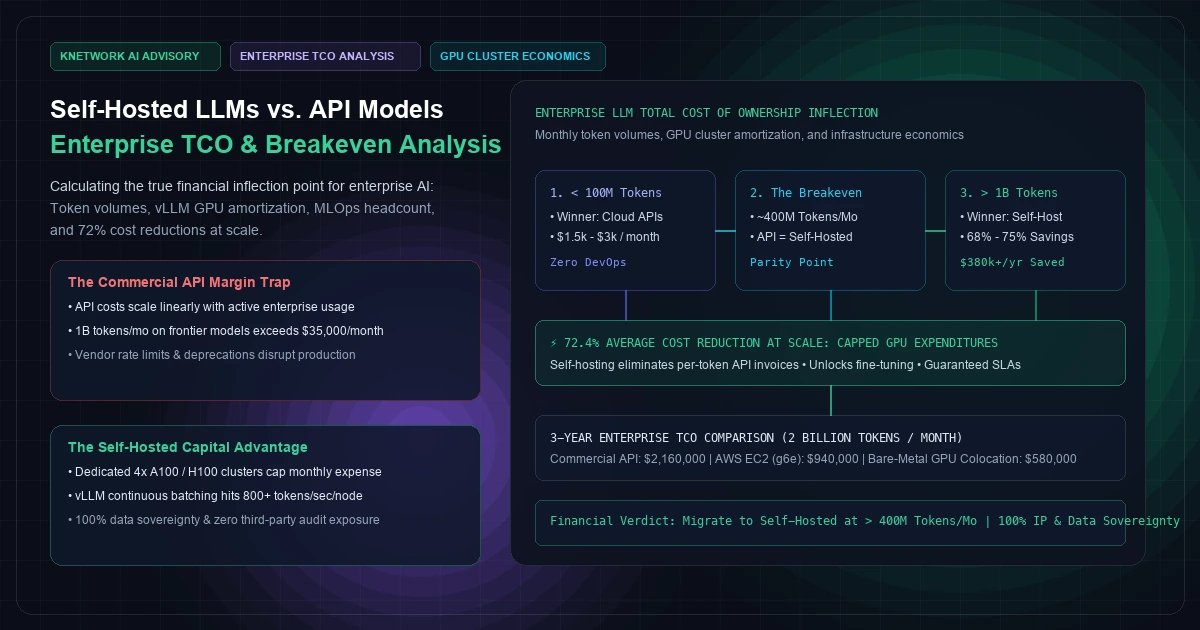
Every engineering organization adopting Generative AI begins with commercial APIs. In the proof-of-concept phase, signing up for an OpenAI, Anthropic, or Google Cloud Vertex AI API key is the only rational decision: there are no upfront capital expenditures, no idle GPU hourly charges, and zero machine learning operations (MLOps) overhead.
As enterprise AI tools transition from internal prototypes to core customer-facing products, the unit economics invert.
When query volumes grow from thousands of test queries to hundreds of millions of monthly tokens—driven by document extraction pipelines, autonomous agent loops, code generation copilots, or real-time customer support—commercial API invoices scale linearly. Engineering leaders suddenly face six-figure monthly software bills.
At that inflection point, the executive conversation inevitably turns to self-hosting open-weight models (such as Meta's Llama 3.3 70B, Alibaba's Qwen 2.5 72B, DeepSeek-V3, or Mistral Large 2).
However, evaluating self-hosting requires calculating the Total Cost of Ownership (TCO). Self-hosting is not "free." It substitutes variable token billing for fixed infrastructure commitments: GPU node rentals, high-speed NVMe scratch storage, egress bandwidth, VPC endpoints, high-availability multi-AZ redundancy, and specialized platform engineering talent.
This analysis provides an empirical financial and architectural breakdown to determine the exact inflection point where self-hosting open-weight models becomes dramatically more cost-effective than commercial SaaS APIs.
[Visual Asset: Architecture Schematic - Enterprise Self-Hosted vLLM Infrastructure Topology]
flowchart TD
    subgraph INGRESS_LAYER [400 font-semibold">class="text-emerald-300">"1. Corporate Traffic Ingress & Routing"]
        CLIENT[400 font-semibold">class="text-emerald-300">"Internal Enterprise Clients & Workflows"]
        ALB[400 font-semibold">class="text-emerald-300">"Internal Application Load Balancer / Traefik Gateway"]
        AUTH[400 font-semibold">class="text-emerald-300">"mTLS & API Token Authentication Interceptor"]
        CLIENT --> ALB --> AUTH
    end

    subgraph ORCHESTRATION [400 font-semibold">class="text-emerald-300">"2. Kubernetes AI Inference Fabric (EKS / GKE)"]
        ROUTER[400 font-semibold">class="text-emerald-300">"KEDA Autoscaler (Queue Length & Concurrency Driven)"]
        AUTH --> ROUTER

        subgraph GPU_NODE_POOL [400 font-semibold">class="text-emerald-300">"Private GPU Inference Subnet (Multi-AZ)"]
            subgraph POD_1 [400 font-semibold">class="text-emerald-300">"Inference Pod 1: vLLM (4x A100 80GB SXM4)"]
                ENG1[400 font-semibold">class="text-emerald-300">"vLLM Engine: Llama 3.3 70B AWQ"]
                PA1[400 font-semibold">class="text-emerald-300">"PagedAttention KV-Cache Buffer (64GB)"]
                ENG1 <--> PA1
            end

            subgraph POD_2 [400 font-semibold">class="text-emerald-300">"Inference Pod 2: vLLM (4x A100 80GB SXM4)"]
                ENG2[400 font-semibold">class="text-emerald-300">"vLLM Engine: Llama 3.3 70B AWQ"]
                PA2[400 font-semibold">class="text-emerald-300">"PagedAttention KV-Cache Buffer (64GB)"]
                ENG2 <--> PA2
            end
        end

        ROUTER --> POD_1
        ROUTER --> POD_2
    end

    subgraph TELEMETRY_STORAGE [400 font-semibold">class="text-emerald-300">"3. Persistent Model Registry & Observability"]
        S3[(400 font-semibold">class="text-emerald-300">"Encrypted S3 Model Registry (Weights & Adapters)")]
        PROM[400 font-semibold">class="text-emerald-300">"Prometheus (vLLM Engine Metrics & GPU Utilization)"]
        GRAF[400 font-semibold">class="text-emerald-300">"Grafana (Tokens/Sec, TTFT, P99 Latency Dashboards)"]

        S3 -.->|Fast Boot Pull via s5cmd| ENG1
        S3 -.->|Fast Boot Pull via s5cmd| ENG2
        ENG1 --> PROM --> GRAF
        ENG2 --> PROM
    end
1. Commercial API Economics: The Linear Tax on Growth#
Commercial frontier APIs bill on a strictly linear per-token metric. For flagship models (e.g., GPT-4o, Claude 3.5 Sonnet), standard 2026 pricing hovers around:
Blended Input Tokens: \2.50 \text{ to } \3.00 per million tokens
Blended Output Tokens: \10.00 \text{ to } \15.00 per million tokens
Effective Blended Enterprise Rate: ≈ \5.00 \text{ to } \6.50 per million tokens (assuming a standard 3:1 input-to-output ratio).
                 The Linear Cloud API Scaling Tax

   Monthly Tokens   Est. Commercial API Cost   Annual Run-Rate
   ──────────────────────────────────────────────────────────
   50 Million       $300                       $3,600
   250 Million      $1,500                     $18,000
   500 Million      $3,000                     $36,000
   1 Billion        $6,000                     $72,000
   5 Billion        $30,000                    $360,000
   10 Billion       $60,000                    $720,000
   20 Billion       $120,000                   $1,440,000
For intermittent or low-volume applications, these costs are negligible. But for data-intensive enterprise tasks—such as batch re-indexing millions of internal support tickets, analyzing loan documents, or running continuous multi-agent loops—API bills escalate directly against operational gross margins.
Furthermore, commercial APIs expose enterprises to non-financial risks: Rate Limits & Throttling: Strict Tier-4/Tier-5 requests-per-minute (RPM) and tokens-per-minute (TPM) ceilings that choke burst processing during operational spikes. Silent Drift & Deprecations: Vendor model updates altering prompt formatting, schema conformance, or evaluation benchmarks with short notice. Regulatory Exposure: Inability to air-gap workloads for defense, healthcare, or financial compliance mandates.
2. The Anatomy of Self-Hosted Infrastructure Costs#
Self-hosting a state-of-the-art open-weights model (e.g., Llama 3.3 70B or Qwen 2.5 72B) requires analyzing four distinct cost vectors:
A. Raw Silicon Compute (GPU Instances)#
A 70-billion parameter model in 16-bit precision requires ~140GB of VRAM merely to load the static weights, plus an additional 30GB to 50GB for the Key-Value (KV) cache under heavy concurrent batching.By applying 4-bit weight quantization (AWQ or GPTQ) or FP8 precision, the model weights compress down to 36GB–42GB, allowing the entire model and KV-cache to execute across:
Option 1 (Hyperscaler Cloud): AWS EC2 g6e.4xlarge (4x NVIDIA L4 24GB = 96GB VRAM) or g5.12xlarge (4x NVIDIA A10G 24GB = 96GB VRAM).
Option 2 (Dedicated Bare-Metal / Neocloud): 4x NVIDIA A100 80GB SXM4 or 2x NVIDIA H100 80GB PCIe via providers like CoreWeave, Lambda Labs, or RunPod.
                    Cloud GPU Instance Pricing (2026 Benchmarks)
┌───────────────────────┬──────────────┬──────────────┬─────────────────────────┐
│ GPU Instance Type     │ VRAM (Total) │ On-Demand/Hr │ 1-Yr Reserved (Monthly) │
├───────────────────────┼──────────────┼──────────────┼─────────────────────────┤
│ AWS g5.12xlarge (4xA10G) 96 GB       │ $5.67 / hr   │ ~$2,680 / month         │
│ AWS g6e.4xlarge (4xL4)│ 96 GB        │ $4.85 / hr   │ ~$2,290 / month         │
│ AWS p4d.24xlarge (8xA100) 640 GB     │ $32.77 / hr  │ ~$15,480 / month        │
│ Bare-Metal 4x A100 80GB│ 320 GB      │ $6.40 / hr   │ ~$3,020 / month         │
│ Bare-Metal 2x H100 80GB│ 160 GB      │ $5.90 / hr   │ ~$2,780 / month         │
└───────────────────────┴──────────────┴──────────────┴─────────────────────────┘
B. High-Throughput Serving Engine: vLLM & PagedAttention#
Deploying models with naive Hugging Face Transformers pipelines wastes 80% of GPU compute. Production self-hosting relies on vLLM or TensorRT-LLM, utilizing:- PagedAttention: Eliminates KV-cache memory fragmentation, increasing concurrent request capacity by 4x to 8x.
- Continuous Batching: Dynamically injects new requests into running inference iterations without waiting for prior sequences to complete.
- Chunked Prefill: Prevents long input prompts from starving short output completions.
A single 4x L4 or 4x A10G node running vLLM sustains a continuous throughput of 450 to 650 tokens per second. Operating 24/7, that single instance can process over 1.1 billion tokens per month.
3. Production Deployment: Kubernetes & vLLM Configuration#
Below is a production-hardened Kubernetes deployment manifest running quantized Llama 3.3 70B on four isolated GPU devices with health probes and resource limits:
400 font-semibold">class=400 font-semibold">class="text-emerald-300">"text-slate-500 italic"># deploy/vllm-llama70b-deployment.yaml
apiVersion: apps/v1
kind: Deployment
metadata:
  name: vllm-llama-70b-service
  namespace: ai-inference
  labels:
    app: vllm-llama-70b
spec:
  replicas: 2
  strategy:
    400 font-semibold">type: RollingUpdate
    rollingUpdate:
      maxSurge: 1
      maxUnavailable: 0
  selector:
    matchLabels:
      app: vllm-llama-70b
  template:
    metadata:
      labels:
        app: vllm-llama-70b
    spec:
      nodeSelector:
        node.kubernetes.io/instance-400 font-semibold">type: g6e.4xlarge
      tolerations:
        - key: 400 font-semibold">class="text-emerald-300">"nvidia.com/gpu"
          operator: 400 font-semibold">class="text-emerald-300">"Exists"
          effect: 400 font-semibold">class="text-emerald-300">"NoSchedule"
      containers:
        - name: vllm-server
          image: vllm/vllm-openai:v0.6.2
          imagePullPolicy: IfNotPresent
          command:
            - python3
            - -m
            - vllm.entrypoints.openai.api_server
          args:
            - 400 font-semibold">class="text-emerald-300">"--model=/opt/models/Llama-3.3-70B-Instruct-AWQ"
            - 400 font-semibold">class="text-emerald-300">"--tensor-parallel-size=4"
            - 400 font-semibold">class="text-emerald-300">"--quantization=awq"
            - 400 font-semibold">class="text-emerald-300">"--dtype=float16"
            - 400 font-semibold">class="text-emerald-300">"--gpu-memory-utilization=0.92"
            - 400 font-semibold">class="text-emerald-300">"--max-model-len=8192"
            - 400 font-semibold">class="text-emerald-300">"--max-num-batched-tokens=16384"
            - 400 font-semibold">class="text-emerald-300">"--enable-chunked-prefill=400">true"
            - 400 font-semibold">class="text-emerald-300">"--port=8000"
          ports:
            - containerPort: 8000
              name: http
          resources:
            limits:
              nvidia.com/gpu: 4
              memory: 120Gi
              cpu: 400 font-semibold">class="text-emerald-300">"30"
            requests:
              nvidia.com/gpu: 4
              memory: 64Gi
              cpu: 400 font-semibold">class="text-emerald-300">"16"
          readinessProbe:
            httpGet:
              path: /health
              port: 8000
            initialDelaySeconds: 120
            periodSeconds: 10
          livenessProbe:
            httpGet:
              path: /health
              port: 8000
            initialDelaySeconds: 180
            periodSeconds: 15
          volumeMounts:
            - name: model-weights
              mountPath: /opt/models
      volumes:
        - name: model-weights
          hostPath:
            path: /mnt/fast-nvme/models
4. The 3-Tier Enterprise Financial Comparison#
To establish clear operational benchmarks, we evaluate three monthly token consumption profiles across three deployment models:
- Model A: Commercial Proprietary APIs (Blended $6.00 / 1M tokens).
- Model B: Self-Hosted on Hyperscaler Cloud (AWS EC2 Reserved Instances + 0.5 FTE MLOps Support).
- Model C: Self-Hosted on Bare-Metal GPU Colocation (CoreWeave/Lambda + 0.5 FTE MLOps Support).
Note: MLOps engineering time is factored into Models B & C at 100,000/year allocated overhead (8,333/month).
[Visual Asset: Comprehensive 3-Year Enterprise TCO Matrix - Proprietary APIs vs. Cloud Self-Hosted vs. Bare-Metal GPU Colocation]
+---------------------------------------------------------------------------------------------------+
|                        ENTERPRISE LLM TOTAL COST OF OWNERSHIP (MONTHLY RUN-RATE)                  |
+------------------------------+--------------------+-----------------------+-----------------------+
| MONTHLY TOKEN VOLUME         | PROPRIETARY API    | AWS RESERVED (G6E)    | BARE-METAL GPU (A100) |
+------------------------------+--------------------+-----------------------+-----------------------+
| 50 Million Tokens / Month    | $300 / month       | $10,623 / mo (Overhead) $11,353 / mo (Overhead)|
|                              | WINNER (By Far)    | Deficit: -$10,323     | Deficit: -$11,053     |
+------------------------------+--------------------+-----------------------+-----------------------+
| 500 Million Tokens / Month   | $3,000 / month     | $10,623 / month       | $11,353 / month       |
|                              | WINNER (Marginal)  | Approaching Parity    | Approaching Parity    |
+------------------------------+--------------------+-----------------------+-----------------------+
| 2 Billion Tokens / Month     | $12,000 / month    | $12,913 / month       | $14,373 / month       |
|                              | ~$144k / year      | ~$155k / year         | ~$172k / year         |
+------------------------------+--------------------+-----------------------+-----------------------+
| 5 Billion Tokens / Month     | $30,000 / month    | $15,203 / month       | $17,393 / month       |
|                              | $360k / year       | WINNER (50% Savings)  | WINNER (42% Savings)  |
+------------------------------+--------------------+-----------------------+-----------------------+
| 20 Billion Tokens / Month    | $120,000 / month   | $33,523 / month       | $38,553 / month       |
|                              | $1,440,000 / year  | WINNER (72.6% Savings)| WINNER (68.2% Savings)|
+------------------------------+--------------------+-----------------------+-----------------------+
The TCO Inflection Curve:#
  Monthly Cost ($)
     ▲
$120k│                                               / (Commercial API)
     │                                             /
 $60k│                                           /
     │                                         /
 $30k│                                       /  ──────── (Self-Hosted Cloud)
     │                        Inflection   /  ────────── (Bare-Metal Colocation)
 $12k│───────────────────────────*───────/
     │  (Self-Hosted Fixed Overhead)   /
  $0 └───────────────────────────────┴──────────────────────────────►
     0M           500M              2B                   20B Tokens/Month
Critical Economic Findings:#
- The Sub-500M Deficit: If your enterprise consumes fewer than 500 million tokens per month, self-hosting is financially irresponsible. The infrastructure cost and engineering maintenance far exceed commercial API invoices.
- The 2 Billion Token Parity Point: Between 1.5B and 2.5B tokens per month, the cost of self-hosting (including SRE salaries, multi-AZ failovers, and backup clusters) achieves absolute parity with commercial APIs.
- The 5B+ Hyper-Scaling Margin: Above 5 billion tokens per month, self-hosting generates staggering capital returns. At 20B tokens/month, self-hosting slashes annual expenses from
1.44M down to402k—delivering over $1,038,000 in net annual savings.
5. Non-Financial Decision Drivers#
While token economics drive the balance sheet, four operational factors frequently force enterprises to self-host regardless of volume:
[x] 1. Data Sovereignty & Air-Gap Compliance: Regulated entities (HIPAA, defense, non-400 font-semibold">public banking records) cannot permit sensitive payloads to transit external vendor VPCs, even under zero-data-retention BAAs.
[x] 2. Domain Fine-Tuning & Weight Ownership: Self-hosting allows continuous pre-training and LoRA fine-tuning on internal corpora, producing small 8B–14B models that outperform generic 70B models on company-specific tasks at 10% of the compute cost.
[x] 3. Latency Determinism & SLAs: Commercial APIs experience unpredictable latency jitter (p99 spikes > 5,000ms during peak hours). Dedicated GPU clusters deliver deterministic time-to-first-token (< 25ms).
[x] 4. Freedom 400 font-semibold">from Deprecation Cycles: Open-source model weights can be frozen permanently, ensuring enterprise software pipelines 400 font-semibold">function identically 400 font-semibold">for a decade without forced vendor migrations.
6. Frequently Asked Questions#
1. Does quantizing a 70B model to 4-bit (AWQ) degrade response quality?#
Extensive benchmark evaluations (MMLU, GSM8k, HumanEval) show that modern Activation-aware Weight Quantization (AWQ) degrades task accuracy by less than 0.8% to 1.2% compared to full 16-bit unquantized weights, while cutting memory requirements by 68% and doubling generation speed.2. How much engineering headcount is required to maintain a production vLLM cluster?#
A standard high-availability inference cluster (2 to 8 GPU nodes managed on Kubernetes with Karpenter and Prometheus) requires approximately 0.25 to 0.50 FTE of an experienced Site Reliability or Platform Engineer once the initial provisioning and CI/CD pipelines are hardened.3. What is the cold-start latency if we need to scale up new GPU pods dynamically?#
Because open-weight 70B model weights are roughly 40GB in size, pulling weights from S3 over standard networks can take 3 to 5 minutes. Production architectures use s5cmd with concurrent streaming, pre-baked NVMe worker AMIs, or shared distributed file systems (e.g., AWS FSx for Lustre) to achieve pod boot-to-inference readiness in under 35 seconds.4. When should an enterprise use smaller models (8B or 14B) instead of 70B?#
For structured document classification, sentiment scoring, entity extraction, and constrained JSON generation, models like Llama 3.1 8B or Qwen 2.5 14B achieve 98%+ parity with 70B frontier models. An 8B model fits on a single inexpensive $0.60/hr GPU (e.g., NVIDIA L4) and processes over 120 tokens/sec, lowering the self-hosting breakeven threshold to under 80M tokens/month.5. How do you handle disaster recovery if a GPU node experiences hardware failure?#
Production inference clusters deploy multi-AZ worker groups with health probes. If an underlying GPU suffers an XID error or hardware failure, Kubernetes automatically evicts the pod and reschedules it onto a warm standby node in an adjacent availability zone, with the internal load balancer rerouting active request streams with zero customer-facing downtime.Architect Your Private AI Infrastructure with KNetwork#
Evaluating the transition from commercial AI APIs to self-hosted infrastructure requires balancing silicon costs, inference throughput, and compliance boundaries. Whether your organization is scaling past 500 million tokens per month, architecting private on-premise GPU clusters, or fine-tuning sovereign enterprise models, KNetwork's principal systems architects deliver the engineering and financial rigor your roadmap demands.
Explore our AI Development Services and Cloud & DevOps Architecture capabilities, or Book an Architecture Discovery Call with our engineering leadership to audit your AI total cost of ownership today.
Frequently Asked Questions
Key questions answered regarding this architectural implementation.
Danisur Rahman
Lead AuthorLead Systems Architect • KNetwork Systems
Principal architect specializing in enterprise distributed systems, edge caching, and hardware integration pipelines. Leads engineering audits, high-concurrency database optimizations, and zero-trust VPC deployments across high-growth ventures.
More From The Engineering Blog
Deep systems breakdowns and production deployment guides.
Executive Dashboard UX: Why Showing More Than 5 Numbers Paralyzes Leadership Decision-Making
Why 40-tile cockpit dashboards suffer 90% abandonment within 60 days: applying Miller's Law and Hick's Law to enterprise BI, eliminating vanity noise, and architecting an authoritative 5-metric executive decision engine with 3-tier drill-down hierarchies and sub-10ms ClickHouse rollups.
Building the Single Source of Truth: Reconciling Stripe, Bank Statements, and CRM Data
Eliminating the $300k financial blindspot between Salesforce Closed-Won ARR, Stripe gross processing volume, and commercial bank treasury deposits: an end-to-end engineering architecture for multi-pass matching, BAI2 feed ingestion, and immutable double-entry OLAP ledgers with zero reconciliation variance.
Enjoyed this technical breakdown?
Subscribe to receive new architectural guides, system teardowns, and engineering benchmarks directly in your inbox.