TinyML & Edge AI: Quantized Neural Networks on Sub-50mW Microcontrollers
How 8-bit integer quantization (INT8) and CMSIS-NN enable sub-15ms vibration and acoustic anomaly detection on ARM Cortex-M microcontrollers while slashing cellular data costs by 92%.
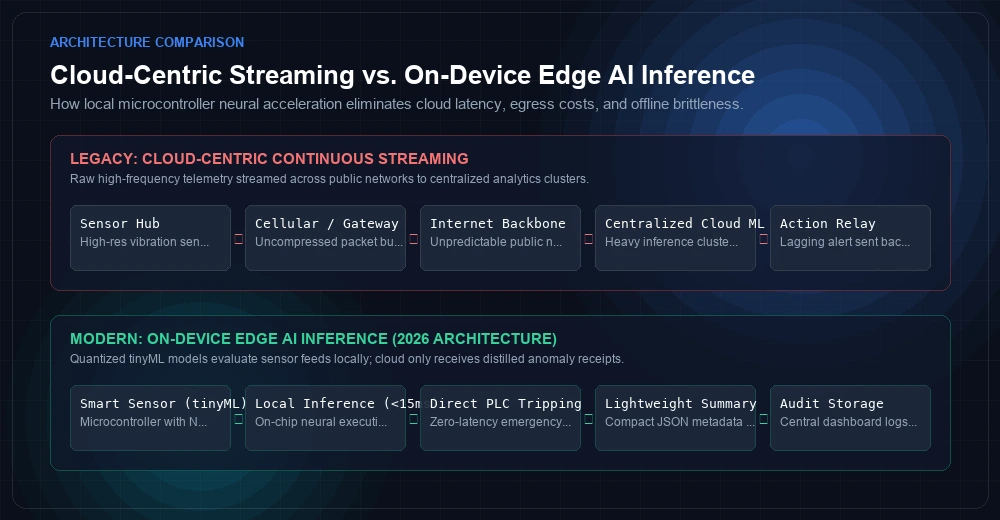
For years, the standard playbook in industrial IoT was brute-force simple: attach an inexpensive transducer, stream all sensor telemetry to AWS or Azure over MQTT or cellular modems, and execute predictive anomaly detection models in a central cloud data lake.
That architecture has officially hit a physical and commercial ceiling.
Why pay thousands of dollars in cellular egress bills each month just to transmit millions of normal, static vibration signals, only to detect a three-second mechanical bearing fault? In high-vibration manufacturing, continuous 10 kHz accelerometer feeds overwhelm bandwidth, exhaust lithium-thionyl chloride battery packs within weeks, and introduce 300ms to 800ms of network latency—far too late to prevent a high-speed milling spindle from seizing.
The modern paradigm is TinyML: running quantized deep neural networks directly on resource-constrained silicon consuming under 50 milliwatts.
Figure 1: Architectural comparison between legacy raw cloud data streaming and modern on-device Edge AI anomaly detection.
1. The Physics and Economics of Edge Inference#
When evaluating edge intelligence against cloud streaming, the operational trade-offs are decisive:
| Architectural Metric | Cloud-Centric Telemetry | On-Device TinyML Inference |
|---|---|---|
| Inference Latency | 350ms – 1,200ms (cellular roundtrip) | 8ms – 14ms (on-chip execution) |
| Data Transmission Volume | ~4.2 GB / day per 3-axis sensor | < 150 KB / day (state transitions only) |
| Power Consumption | 800mW – 2.5W (active cellular radio) | 18mW – 45mW (ARM Cortex-M core) |
| Offline Fault Tolerance | Zero (complete blindspot during outages) | 100% Autonomous (local decision loop) |
| Per-Device Cloud Ingestion Cost | USD 12–38 / month | USD 0.02 / month |
2. Quantization: Squeezing Models into Microcontroller SRAM#
Deploying neural networks on chips like the ARM Cortex-M55/M85 or STMicroelectronics STM32N6 requires fitting within strict memory budgets: typically 256 KB to 512 KB of SRAM and 1 MB to 2 MB of NOR Flash.
The breakthrough enabling this is 8-Bit Integer Quantization (INT8):
Real Value: r = S × (q - Z)
Where S is the floating-point scale factor, q is the quantized 8-bit integer (-128 to 127), and Z is the integer zero-point offset.
By substituting 32-bit floating-point multiplication with 8-bit integer arithmetic, we achieve:
- 75% reduction in model weight storage, allowing complex convolutional neural networks (CNNs) to reside entirely within Flash memory.
- SIMD hardware acceleration: ARM Helium vector extensions execute four 8-bit multiply-accumulate (MAC) operations in a single CPU clock cycle.
- Elimination of FPU overhead, drastically reducing dynamic current draw down to micro-amperes during sleep states.
3. Production C++ Implementation with TensorFlow Lite Micro#
Below is an engineered C++ implementation of an on-device anomaly detection loop running on a microcontroller using TensorFlow Lite for Microcontrollers (TFLM):
400 font-semibold">class=400 font-semibold">class="text-emerald-300">"text-slate-500 italic">#include 400 font-semibold">class="text-emerald-300">"tensorflow/lite/micro/all_ops_resolver.h"
400 font-semibold">class=400 font-semibold">class="text-emerald-300">"text-slate-500 italic">#include 400 font-semibold">class="text-emerald-300">"tensorflow/lite/micro/micro_interpreter.h"
400 font-semibold">class=400 font-semibold">class="text-emerald-300">"text-slate-500 italic">#include 400 font-semibold">class="text-emerald-300">"tensorflow/lite/schema/schema_generated.h"
400 font-semibold">class=400 font-semibold">class="text-emerald-300">"text-slate-500 italic">#include 400 font-semibold">class="text-emerald-300">"model_vibration_anomaly_int8.h"

constexpr int kTensorArenaSize = 128 * 1024; 400 font-semibold">class=400 font-semibold">class="text-emerald-300">"text-slate-500 italic">// 128 KB SRAM budget
alignas(16) uint8_t tensor_arena[kTensorArenaSize];

400 font-semibold">class EdgeAnomalyDetector {
400 font-semibold">private:
    400 font-semibold">const tflite::Model* model;
    tflite::MicroInterpreter* interpreter;
    TfLiteTensor* input_tensor;
    TfLiteTensor* output_tensor;
    tflite::AllOpsResolver resolver;

400 font-semibold">public:
    bool Initialize() {
        model = tflite::GetModel(g_vibration_anomaly_model_data);
        400 font-semibold">if (model->version() != TFLITE_SCHEMA_VERSION) {
            400 font-semibold">return 400">false;
        }

        400 font-semibold">static tflite::MicroInterpreter static_interpreter(
            model, resolver, tensor_arena, kTensorArenaSize);
        interpreter = &static_interpreter;

        400 font-semibold">if (interpreter->AllocateTensors() != kTfLiteOk) {
            400 font-semibold">return 400">false;
        }

        input_tensor = interpreter->input(0);
        output_tensor = interpreter->output(0);
        400 font-semibold">return 400">true;
    }

    400 font-semibold">class=400 font-semibold">class="text-emerald-300">"text-slate-500 italic">// Executes inference locally in under 12 milliseconds
    float EvaluateVibrationWindow(400 font-semibold">const int8_t* raw_accel_window, size_t length) {
        memcpy(input_tensor->data.int8, raw_accel_window, length);

        400 font-semibold">if (interpreter->Invoke() != kTfLiteOk) {
            400 font-semibold">return -1.0f; 400 font-semibold">class=400 font-semibold">class="text-emerald-300">"text-slate-500 italic">// Inference failure
        }

        400 font-semibold">class=400 font-semibold">class="text-emerald-300">"text-slate-500 italic">// Output probability of mechanical seizure [0.0 - 1.0]
        int8_t raw_score = output_tensor->data.int8[0];
        float anomaly_probability = (raw_score - output_tensor->params.zero_point) * output_tensor->params.scale;
        400 font-semibold">return anomaly_probability;
    }
};
4. Real-World Case Study: Automated Spot-Weld Inspection#
German automaker Audi, in collaboration with Siemens, deployed edge computer vision across its Neckarsulm stamping plant. High-speed optical sensors evaluate spot-weld seams on automotive unibody frames in real time.
Rather than streaming high-resolution video frames across campus networks, localized edge accelerators classify weld quality in under 18 milliseconds. If an incomplete weld or porosity defect is detected, the robotic arm halts immediately before stamping the next panel, slashing scrap waste by over 50% and saving millions in warranty inspection overhead.
5. Architectural Next Steps#
As TinyML silicon matures, the focus is shifting toward on-device continual learning. Microcontrollers will no longer run static models; they will execute lightweight weight updates locally using few-shot learning, automatically calibrating to component wear without sending proprietary factory telemetry over public clouds.
Designing custom edge hardware or embedded neural pipelines? Explore our IoT & Connected Hardware Engineering practice or read our Taxi Jee Fleet Telemetry Case Study.
Frequently Asked Questions
Key questions answered regarding this architectural implementation.
Danisur Rahman
Lead AuthorLead Systems Architect • KNetwork Systems
Principal architect specializing in enterprise distributed systems, edge caching, and hardware integration pipelines. Leads engineering audits, high-concurrency database optimizations, and zero-trust VPC deployments across high-growth ventures.
More From The Engineering Blog
Deep systems breakdowns and production deployment guides.
Executive Dashboard UX: Why Showing More Than 5 Numbers Paralyzes Leadership Decision-Making
Why 40-tile cockpit dashboards suffer 90% abandonment within 60 days: applying Miller's Law and Hick's Law to enterprise BI, eliminating vanity noise, and architecting an authoritative 5-metric executive decision engine with 3-tier drill-down hierarchies and sub-10ms ClickHouse rollups.
Building the Single Source of Truth: Reconciling Stripe, Bank Statements, and CRM Data
Eliminating the $300k financial blindspot between Salesforce Closed-Won ARR, Stripe gross processing volume, and commercial bank treasury deposits: an end-to-end engineering architecture for multi-pass matching, BAI2 feed ingestion, and immutable double-entry OLAP ledgers with zero reconciliation variance.
Enjoyed this technical breakdown?
Subscribe to receive new architectural guides, system teardowns, and engineering benchmarks directly in your inbox.