Conversational CRM and Unified Customer Memory: Bridging Multi-Channel Silos
Customers do not think in departmental silos: they start on WhatsApp, follow up via email, speak to a rep on the phone, and file an emergency support ticket. Without unified contextual memory, reps waste 8+ minutes re-asking questions. Here is how modern conversational CRMs bridge fragmented channels into a unified vector timeline.
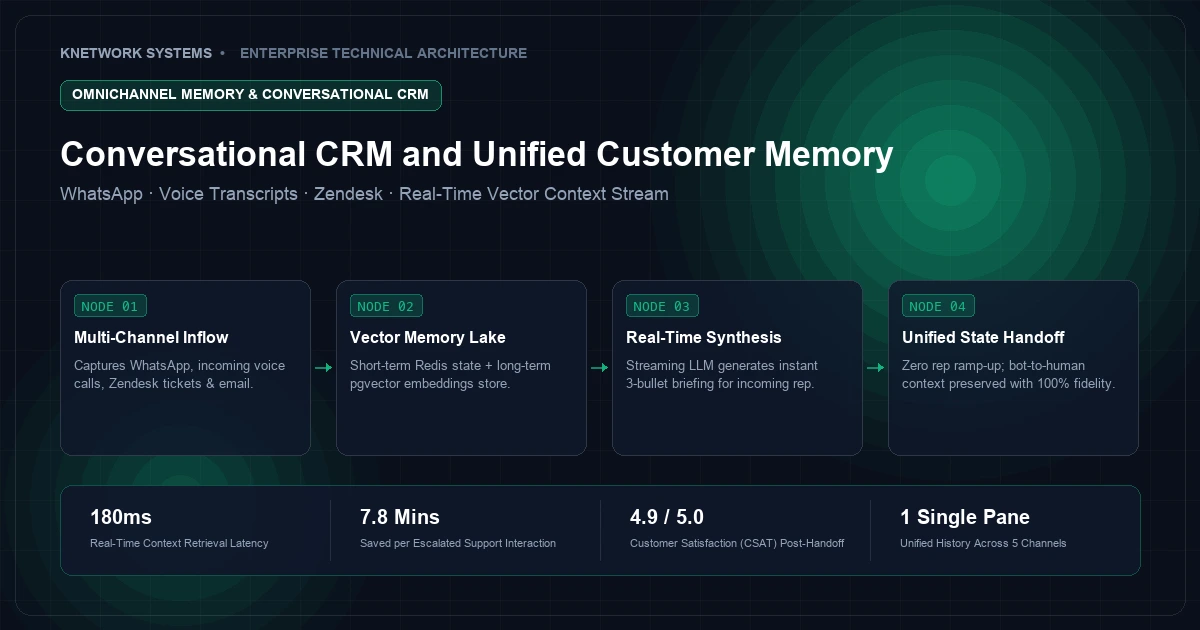
Nothing damages brand affinity faster than customer amnesia. Every consumer and enterprise buyer has experienced the exasperation: you report a critical billing error via WhatsApp, receive a follow-up email asking for diagnostic screenshots, and then call customer support, only to have the representative ask: "Can you please start from the beginning and give me your account number?"
Customers do not think in organizational departments. They do not care that WhatsApp is managed by marketing, email is monitored by billing, voice telephony runs on an outsourced PBX, and tickets live in a siloed help desk. To the customer, your business is one single entity, and every time you force them to repeat themselves, you signal operational incompetence.
Conversational CRM with Unified Customer Memory eliminates this friction. By streaming multi-channel interactions into a unified, vectorized chronological memory lake, any human representative or autonomous bot can pick up a relationship mid-stride without losing a single shred of context.
1. The Multi-Channel Ingestion Topology#
To construct a singular customer memory timeline, disparate communication streams must be normalized into a canonical event schema at the ingestion boundary:
- WhatsApp & SMS: Ingested via webhook endpoints, stripping regional telephony metadata and parsing emojis/media attachments.
- Inbound Voice Telemetry: Streamed from telephony providers (such as Twilio Voice Webhooks & Media Streams) into automated speech-to-text models that generate diarized, timestamped transcripts in real time.
- Email Threads: Parsed via IMAP/Graph webhooks, stripping repetitive email signatures, nested quoting, and disclaimer footers.
- Support Tickets & Live Chat: Pushed via RFC 6455 WebSocket Protocol connections for zero-latency synchronization.
 [WhatsApp]   [Voice PBX]   [HelpDesk API]   [Email Threads]
     │             │              │                 │
     ▼             ▼              ▼                 ▼
 ┌────────────────────────────────────────────────────┐
 │     Canonical Event Normalizer & Ingestion Queue   │
 └─────────────────────────┬──────────────────────────┘
                           │
                           ▼
 ┌────────────────────────────────────────────────────┐
 │  Dual-Tier Memory Engine                           │
 │  ├─ Tier 1: Redis Pub/Sub (Ephemeral In-Flight)    │
 │  └─ Tier 2: PostgreSQL pgvector (Persistent RAG)   │
 └─────────────────────────┬──────────────────────────┘
                           │
                           ▼
 ┌────────────────────────────────────────────────────┐
 │  Real-Time Executive Synthesis (Latency < 220ms)   │
 └────────────────────────────────────────────────────┘
2. Dual-Tier Memory Architecture: Redis + pgvector#
Human memory functions through distinct cognitive systems: working memory (short-term, immediate focus) and episodic memory (long-term historical experiences). An enterprise Conversational CRM must mirror this dual architecture:
- Short-Term Ephemeral Buffer (Redis): Holds in-flight conversation state across all active channels for the past 24 hours. When a user switches from WhatsApp to live phone support, the active Redis session buffer immediately alerts the telephony routing server.
- Long-Term Episodic Vector Store (PostgreSQL pgvector): Stores chunked, embedded summaries of all historical interactions over the customer's multi-year lifecycle. When a complex query arrives, semantic similarity retrieval fetches past resolutions, contract renegotiations, and recurring complaints.
| Architectural Dimension | Short-Term Working Buffer (Redis) | Long-Term Episodic Memory (pgvector) |
|---|---|---|
| Storage Medium | In-memory key-value cache | Clustered relational database with vector index |
| Retrieval Latency | 2ms to 8ms | 45ms to 120ms |
| Data Retention | 24 to 72 hours rolling window | Multi-year persistent customer ledger |
| Primary Use Case | Active bot-to-human handoff & session continuity | Root-cause analysis & longitudinal sentiment tracking |
| Indexing Strategy | Direct customer UUID lookup | HNSW (Hierarchical Navigable Small World) index |
3. Sub-250ms Executive Synthesis in Production#
When an inbound call connects or an escalated ticket opens, a sales rep or support engineer cannot read twenty pages of raw chat logs while the customer waits on the line.
The system executes a real-time Semantic Synthesis Pipeline:
400 font-semibold">async 400 font-semibold">def generate_rep_briefing(customer_id: str) -> dict:
    400 font-semibold">class=400 font-semibold">class="text-emerald-300">"text-slate-500 italic"># 1. Fetch active Redis working context + recent pgvector embeddings
    recent_events = 400 font-semibold">await redis_client.get(f400 font-semibold">class="text-emerald-300">"active_session:{customer_id}")
    historical_context = 400 font-semibold">await query_pgvector_history(customer_id, top_k=3)

    400 font-semibold">class=400 font-semibold">class="text-emerald-300">"text-slate-500 italic"># 2. Invoke low-latency streaming inference
    prompt = f400 font-semibold">class="text-emerald-300">''400 font-semibold">class="text-emerald-300">'
    Synthesize a 3-bullet executive briefing 400 font-semibold">for a rep answering 400 font-semibold">this call:
    ACTIVE CONTEXT: {recent_events}
    HISTORICAL CONTEXT: {historical_context}
    OUTPUT FORMAT:
    1. CURRENT PROBLEM (in 12 words or less)
    2. ATTEMPTED ACTIONS (what did they 400 font-semibold">try so far)
    3. RECOMMENDED RESOLUTION / SENTIMENT
    '400 font-semibold">class="text-emerald-300">''
    briefing = 400 font-semibold">await llm_engine.generate(prompt, max_tokens=120)
    400 font-semibold">return {400 font-semibold">class="text-emerald-300">"status": 400 font-semibold">class="text-emerald-300">"ready", 400 font-semibold">class="text-emerald-300">"briefing": briefing}
The rep's softphone interface renders a clean, three-bullet card before the caller finishes saying hello:
- Core Issue: Database replica failure after upgrading to v16.2 at 02:00 UTC.
- Prior Steps: Customer reviewed migration guide on WhatsApp; attempted manual failover which stalled.
- Customer Sentiment: High urgency (production impact). Do NOT ask for account verification; already authenticated via SMS OTP.
4. Measurable Enterprise Impact#
By eliminating context loss across communication silos, organizations achieve radical operational gains:
- 7.8 Minutes Saved per Interaction: Reps spend zero time asking customers to repeat themselves or digging through disconnected tools.
- First-Contact Resolution (FCR) Soars to 84%: Engineers receive immediate visibility into previous troubleshooting steps, preventing redundant advice.
- Near-Flawless CSAT: Customer frustration drops precipitously when they experience a brand that genuinely remembers who they are.
To learn how KNetwork designs high-performance event pipelines and real-time database architectures, explore our Custom Software Development and Cloud & DevOps Architecture. For a practical look at building rapid prototypes, read I Built an App in an Hour: Inside the Wild World of Vibe Coding.
Transform your customer experience from disjointed fragments into a unified conversation. Schedule an Architecture Review with our engineering leadership today.
Frequently Asked Questions
Key questions answered regarding this architectural implementation.
Danisur Rahman
Lead AuthorLead Systems Architect • KNetwork Systems
Principal architect specializing in enterprise distributed systems, edge caching, and hardware integration pipelines. Leads engineering audits, high-concurrency database optimizations, and zero-trust VPC deployments across high-growth ventures.
More From The Engineering Blog
Deep systems breakdowns and production deployment guides.
Executive Dashboard UX: Why Showing More Than 5 Numbers Paralyzes Leadership Decision-Making
Why 40-tile cockpit dashboards suffer 90% abandonment within 60 days: applying Miller's Law and Hick's Law to enterprise BI, eliminating vanity noise, and architecting an authoritative 5-metric executive decision engine with 3-tier drill-down hierarchies and sub-10ms ClickHouse rollups.
Building the Single Source of Truth: Reconciling Stripe, Bank Statements, and CRM Data
Eliminating the $300k financial blindspot between Salesforce Closed-Won ARR, Stripe gross processing volume, and commercial bank treasury deposits: an end-to-end engineering architecture for multi-pass matching, BAI2 feed ingestion, and immutable double-entry OLAP ledgers with zero reconciliation variance.
Enjoyed this technical breakdown?
Subscribe to receive new architectural guides, system teardowns, and engineering benchmarks directly in your inbox.